Assignments for Math S-305
Math for Teaching Advanced Algebra and Trigonometry Summer 2014
Tenth Assignment (due Wednesday, July 16th) (the last assignment for the summer!)
1) Following up on the first Puzzle of the Day involving the formulas for cosine and sine of angle sums, now come up with a formula for the tangent of an angle sum, i.e. what does Tan(A+B) equal in terms of Tan(A) and Tan(B)? To do this we know that Tan(X) is just Sin(X)/Cos(X), and given that we have formulas for Sin(A+B) and Cos(A+B), then you can get started with Tan(A+B) by using these existing formulas.
To rewrite your answer so that it's just in terms of Tan(A) and Tan(B) try dividing the numerator and denominator by Cos(A)Cos(B)...
Next, time to finish off the Puzzle of the Day that's been lingering from several classes ago(!) - that the product of the length of the diagonals of a regular N-gon (measured from one vertex) equals N. This is a multi-step process, so hang in there! Note that there really isn't much to do (i.e. to write down) - this is mostly an exploration of the ideas that lead up to the result.
2) Start by considering Z1 = e^(2Pi i / 5). What is Z1^5? Let Z2 = Z1^2. What is Z2^5? What about other "fifth roots of 1"? Write down all five "fifth roots of unity" (i.e. fifth roots of 1) just in terms of powers of Z1 (including 1 itself as a power of Z1) and note that if you plotted these five complex numbers on an Argand diagram then these would just be the five vertices of a regular pentagon inscribed in the unit circle, which you can see in the diagram below (in the picture note that "Z0" just equals 1, and that it is the same thing as Z5 = Z1^5)

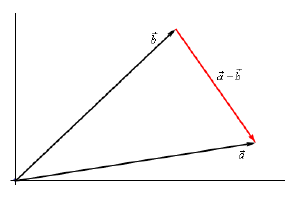
3) Now revisit addition and subtraction of complex numbers where we consider complex numbers as vectors on an Argand diagram (i.e. on the complex number line). If you start with the concept that adding complex numbers/vectors looks like this graphically:

Then convince yourself that the following picture shows off the difference of two complex numbers/vectors. Think about what b + (a - b) must equal (nothing to write down for this problem):
4) Going back to the fifth roots of unity example:
Now the Puzzle of the Day said to consider the product of the four diagonal lengths, which in the picture are equivalent to the distances from Z1 to Z0, from Z2 to Z0, from Z3 to Z0, and from Z4 to Z0, respectively.
Using the idea of vector subtraction that we saw in class and in the last problem, we know that Z1 - Z0 (which is really just Z1 - 1) is the complex number whose modulus is the same as the distance from Z1 to Z0. Similarly, the other three distances we want to consider are the moduli of Z2 - 1, and Z3 - 1, and Z4 - 1 respectively. So now we just need to multiply these four complex numbers together, and find the modulus of the resulting product to get the answer in this particular case.
Backing up, try using this approach to find the answer for the (simpler!) case of a square inscribed in the unit circle - in this case the fourth roots of unity are at i, -1, -i, and 1.
So, this just means you need to find the product of i - 1 times (-1) - 1 times (-i) - 1, and see what you get!
5) Back to the fifth roots of unity, Z1, Z2, Z3, Z4, and Z5. Since we know that (Zi)^5 = 1 for all the fifth roots of unity then this means they are the five roots of the polynomial X5 - 1. Given that 1 is a root of X5 - 1. then we can factor out the factor (X - 1), and yes, X5 - 1 factors neatly as (X - 1)(X4 + X3 + X2 + X + 1) (easy to check!).
Thus the four roots of (X4 + X3 + X2 + X + 1) must be Z1, Z2, Z3, and Z4, (since Z5 = 1 is the root of the factor (X-1), so the roots of the other factor, (X4 + X3 + X2 + X + 1) must be the other four roots).
Now we're actually interested in the complex numbers Z1 - 1, Z2 - 1, Z3 - 1, and Z4 - 1, not Z1, Z2, Z3, and Z4. So here's the trick for the whole Puzzle of the Day. Find a polynomial whose roots are Z1 - 1, Z2 - 1, Z3 - 1, and Z4 - 1 (instead of Z1, Z2, Z3, and Z4). To do this remember that we know that Z1, Z2, Z3, and Z4 are the four roots of (X4 + X3 + X2 + X + 1). So try writing in "X+1" for "X" in this same fourth degree polynomial and write down the result (no need to expand it out at this point)... will this work and give us a polynomial whose roots are precisely Z1 - 1, Z2 - 1, Z3 - 1, and Z4 - 1?
6) Now if you actually expanded out the polynomial you just found in the last question, what would its constant term be equal to? (no need to find all the terms, just figure out what the constant term would equal) - this is quite simple if you think about all the constants that would be generated if you expanded it out - they all come from the "+1" parts of the (X+1) terms.
7) And time for the "Aha!" - if you have an Nth degree polynomial that starts XN + ... and it has roots R1, R2, R3, ... , RN, then by the work we'd done with polynomials earlier in the semester, the polynomial must factor as (X - R1)(X - R2) ... (X - RN). If you expand this polynomial, multiplying out all the terms, what would its constant term equal? (important note - given that we just want the modulus (absolute value in this case) of the root's product, then it doesn't matter whether the result is positive or negative)
8) And so finally, for the general case, one could go through everything from above, but instead of doing it with the fifth roots of unity, one could work with the Nth roots of unity, where Z1 would equal e^(2Pi i / N), and Z2 would equal Z1^2, Z3 = Z1^3, etc. all the way up to ZN = Z1^N = 1.
In this case, you'd just need to figure out the constant term of (X+1)N-1 + ... + (X+1)2 + (X+1) + 1 (what is this?) and see that that would equal the product of (Z1 - 1)(Z2 - 1)...(ZN-1 - 1), whose modulus (just absolute value in this case) is the same as the product of the lengths of the diagonals... done!
Bonus question: To see one more result with all the machinery you just worked through, calculate the sum of the N Nth roots of unity, i.e. the sum of Z1 = e^(2Pi i / N), plus Z2 (which equals Z1^2), plus Z3 (which equals Z1^3), etc. all the way up to ZN = Z1^N = 1. Here's the trick. Think about this sum S = Z1 + Z2 + Z3 + ... + ZN . Given what we know about each of the numbers, then S can also be written as Z1 + Z1^2 + Z1^3 + ... + Z1^N. Now multiply this whole sum by Z1, and think about what you get as a result (remembering that ZN = Z1^N just equals 1) i.e. what is Z1 times S? Now if Z1 times S just equals S (as you should have just figured out!), then what does this imply that S equals (knowing that Z1 doesn't equal 1)?
You can picture this geometrically on an Argand diagram - it's easy to see what the answer must be in the case where N is even. Draw out the case of N = 6 for yourself, drawing a vector from the origin to each 6th root of unity and think about how each vector sums with the vector directly opposite (it's a bit more mysterious geometrically what happens when N is odd!).
That's it - the last of your problem sets! Congrats! Hope you enjoyed the exploration!
Ninth Assignment (due Tuesday, July 15th)
1) Let's start off by revisiting the connection between generating functions (aka "infinite polynomials") and interesting functions (such as sine, cosine, e^x, etc.) First, try to find an infinite polynomial that represents LN(X) (the "natural" logarithm function). The way to find this will be to note/remember that the derivative of LN(X) is 1/X. Now we just need to find a generating function for 1/X and find an infinite polynomial that has this generating function as its derivative. Oops, this doesn't quite work, as we've found generating functions for things like 1/(1-X), but we're not (easily) going to find one for 1/X.
So... let's find an infinite polynomial for LN(1+X) instead. The derivative of LN(1+X) equals 1/(1+X). Okay, now (a) write down a generating function equal to 1/(1+X) (relatively easy since we've found something like this a number of times in the past).
Next, (b) find an infinite polynomial (generating function) whose derivative is the infinite polynomial you just found in part (a) - and so this should be equal to LN(1+X).
Note that unlike the infinite polynomials that we found in class for e^x, Sin(X), and Cos(X) the infinite polynomial for LN(1+X) will only produce results for -1 < X < 1 as you can check. For instance LN(0) is "negative infinity." Try plugging X = -1 into the infinite polynomial you just found for LN(1+X) and check to see that you get a familiar non-converging series as a result! (write down which series you get)
2) Now try plugging X = 1 into the infinite polynomial we found in class for e^x and find (write down) a series whose sum equals the number e (= 2.718281828...) Add up the first 8 terms of the series and see for yourself if this is "believable"!
3) Next, time for a bit of a "flipped classroom" feel - right at the end of class we talked about multiplying complex numbers together. One way to approach this is to think about complex numbers using the distance z is from the origin (its "absolute value" which is sometimes called the "modulus" of a complex number), and the angle that the vector pointing at z makes with the x-axis. Well, watch this Khan Academy video and learn about the "absolute value"/"modulus" and "argument" approach to writing down complex numbers. Note - in the latter part of the video he goes over the famous e to the i phi formula again(!) - this video should just serve to give you a feel for where we're heading - you don't need to follow every detail.
Final note - I'm somewhat "agnostic" about Khan Academy - the presentations lose much of the joy of math that I value - they're much more about the nuts and bolts/details - and tend to miss a fair amount of the motivation for why things work the way they do. On the other hand, they can serve as a useful tool in a teacher's toolkit for specific purposes. In our next class it would be great to have a conversation about people's impressions about these types of videos, and how they can be used for teaching purposes.
Note that there's nothing to turn in for this problem.
4) Now it's time to "play" with complex multiplication some more... to do this, first please play around with the applet you saw in class - Complex Multiplication and Division Graphically.nb which runs in Mathematica - just click anywhere in the set of command lines and "execute" it by hitting shift+enter (or if you haven't got Mathematica running, you can use a similar applet available on the Cut the Knot website at http://www.cut-the-knot.org/Curriculum/Algebra/ComplexNumbers.shtml and click on "common product").
Next, please look through the following two pictures Complex Multiplication using a similar triangles perspective (from Mathematical Connections, pages 113/114) - and see if you can come up with more ideas concerning the product of two complex numbers w and z, comparing the absolute value(modulus) of wz to the absolute values(moduli) of w and z, and, likewise, comparing the argument of wz to the arguments of w and z. As soon as you do the rest of the reading in Mathematical Connections it will "let the cat out of the bag" about this approach, so please try figuring this out on your own first! For this problem just write down your conjecture - you don't need to write down a proof of this - you'll read about this later in the Mathematical Connections text and we'll discuss this together in class tomorrow.
Bonus - if you've worked out a conjecture about the product of wz as compared to w and z, what about division? How does w/z compare to w and z? (hint, in this case note that z is the product of the complex numbers w and w/z, and you should already know about what happens with complex products).
5) In class using complex numbers, we found the two classic trig addition formulas: Cos(A+B) = Cos(A) Cos(B) - Sin(A) Sin(B) and Sin(A+B)= Cos(A) Sin(B) + Sin(A) Cos(B).
These then easily show that Cos(2A) = Cos(A)^2 - Sin(A)^2 , and then by subbing in 1 - Cos(A)^2 for Sin(A)^2 (using the Cos(A)^2 + Sin(A)^2 = 1 identity), you can also easily get to
Cos(2A) = 2 (Cos(A))^2 - 1 as well (these are known as the "Double Angle" formulas). Note that the second form gives Cos(2A) just in terms of Cos(A).
Is there a Triple Angle formula? Yes! So try to find a formula for Cos(3A) that's just in terms of Cos(A) (i.e. doesn't include anything involving Sines)
hint - use the Cos(A+B) formula but do it with Cos(A + 2A) instead, and then rewrite things in terms of Cos(A) by replacing Sin(A)^2 with 1 - Cos(A)^2 whenever you can. You'll also need to rewrite Sin(2A) at some point using the Sin(A+B) formula).
Bonus: is there a Quartic Angle formula for Cos(4A) that's just in terms of Cos(A) (now it's really getting ugly - not for the faint of heart - and definitely feel free to use Mathematica as much as you'd like!)
Finally - Reading! Much of what we've been discussing with complex numbers is covered in Chapter 3 of Mathematical Connections - please do try to answer questions 4 and 5 before reading all of the sections (question 5 is discussed on page 123 in section 3.4, for instance, and question 4 is discussed in section 3.3) I've scanned in the first four sections of the chapter for those who weren't able to get the book in time! Note that you don't need to read all of this tonight - you can keep going with it for the next two days as an accompaniment to our classes.
Eighth Assignment (due Monday, July 14th)
1) Transformation time! During class on Wednesday, when we were working towards Cardano's formula for cubic equations, I said that the first trick to finding a cubic equation formula was to rewrite the cubic X^3 + A X^2 + B X + C in such a way that one of the four terms "disappears" - and then we'd be able to use the quadratic formula eventually with what was left (with some more finagling though!) The way we did this was to substitute X = Z - A/3 in what is termed a "transformation" - something I'd like you to explore a bit more in these next few problems.
First, remember that in class we used a transformation to solve X^2 - 4X - 5 = 0. We substituted X = Z + 2 into the equation, then solved the resulting equation Z^2 - 9 = 0 (trivial to do!) and then used the X = Z + 2 relationship to get back the solutions to the original X^2 - 4X - 5 = 0 equation.
Now this yourself - start with X^2 - 14 X + 40 = 0. This time use the transformation X = Z + 7, substituting this in to the equation. Solve the resulting equation in Z and then find the solutions to the original X^2 - 14 X + 40 = 0 equation by using the X = Z + 7 relationship.
To see what's going on visually, graph both the X^2 - 14 X + 40 quadratic, and then the quadratic in Z that you found on, the same graph. Aha - you should see (or already know) that the X = Z + 7 transformation just "shifts" the X^2 - 14 X + 40 curve to the left by 7, moving its line of symmetry neatly.
2) Okay, following along, in the case of X^2 - 4X - 5 = 0 we used the transformation X = Z + 2. In the case of X^2 - 14 X + 40 = 0 we used the transformation X = Z + 7. So now what transformation would you have to use to solve X^2 + B X + C = 0 in a similar fashion? Try using this transformation, solving the resulting quadratic, and then "undo" the transformation the same way you did in the previous problems to find the solutions to the original X^2 + B X + C = 0 equation and compare your solution to the one you'd get using the usual quadratic formula.
Bonus - try to find an appropriate transformation to solve the full A X^2 + B X + C = 0 situation (i.e. when A might not equal 1). If you work this out all the way through, you should end up with the full quadratic formula! This is not the easiest way to find the quadratic formula, but it shows off another, entirely different approach, from the completing the squares approach we used in class.
3) Next please head back to Cardano's formula and use what we all discovered in class together to find one real root for the following cubic: x3 - 18x - 35 = 0. You can check the Mathematica file we used in class that day if you'd like - Cubic Equations (or the PDF file: cubic equations) - and note that the newsletter given in the next problem gives Cardano's formula if you'd like to read about it there before finishing this problem!
4) Time for some mathematical history sleuthing about Cardano - please read the first several pages of Jim Tanton's Newsletter on Cardono's Formula - nothing to turn in for this problem - just enjoy finding out about a mathematical feud!
5) Next, here's a short foray based on our work today with the Law of Sines and the Law of Cosines. You might not know it but Heron's formula giving the area of a triangle, can be proved using the Law of Cosines, and this problem will guide you through this proof (and if you're not familiar with Heron's formula, you'll find out about this too!) Quick background - Heron's formula gives the area of any triangle just in terms of its side lengths (i.e. no mention of angles at all).
First off, suppose you have a triangle (not necessarily right) with sides a, b, and c, and angles A, B, and C (with the usual arrangement of angle A opposite side a, etc.)
(i) Using the Law of Cosines, first write down what a2 equals in terms of b, c, and Cos A.
(ii) Next, using the previous result, solve for Cos A in terms of a, b, and c.
(iii) Next, recall the basic trig result that comes right from the Pythagorean Theorem, that (Cos A)2 + (Sin A)2 = 1, and now using the previous result, find Sin A in terms of a, b and c (note - this result is going to look pretty "ugly"! ... lots of terms... square roots... everything!)
(iv) Next, write down the area of the original triangle in terms of b, c, and Sin A.
(v) Aha! Given that you found out what Sin A equals using just a, b, and c (in part (iii)) now write down what the area of the triangle equals just in terms of its side lengths, a, b, and c.
Yea! This is Heron's formula, just in a completely unrecognizable form given that everything is/should be completely messy at the moment.
You're done with the problem (in terms of what you need to turn in for it, that is), except you're probably interested/eager/slightly curious to see whether what you've gotten really is equivalent to Heron's formula. So... Heron's formula says the area of a triangle with side lengths a, b, and c, equals the square root of s(s-a)(s-b)(s-c) where s is the so-called "semi-perimeter" which is half of the true perimeter (a+b+c).
Bonus - If you'd like to test out your Mathematica simplification skills (or any CAS... or, heaven forbid, by hand!) - see if what you got in part (v) really is equivalent to Heron's formula. It would probably be easiest to square both expressions first (e.g. Heron's formula squared is s(s-a)(s-b)(s-c)), and then take one minus the other, then simplify this resulting behemoth expression to see if it is indeed equal to 0 (i.e. that they're the same - their difference is 0).
6) You might get a kick out of seeing another proof of the Law of Cosines on the Cut the Knot website (an excellent resource for those of you who haven't played around with this website before). Please go to http://www.cut-the-knot.org/Curriculum/Geometry/GeoGebra/CosineLawAB.shtml and check out the proof by picture. The trick is to realize that one can put together three copies of any given triangle in such a way as to create a trapezoid (as shown in the applet). Thus the trapezoid is made up of three copies of the original triangle, one scaled up by a scaling factor equal to a, one by a scaling factor b, and the third by a scaling factor c (thus the side lengths in the trapezoid are all things like "ab" or "bc" meaning "a times b" and "b times c" respectively).
Nothing to turn in for this problem - just enjoy (and make sense of the picture proof for yourself!)
7) Next, time to find out a bit more about this Argand fellow, and why his contribution to math/complex numbers has been so powerful. First read about the basics of this at http://mathworld.wolfram.com/ArgandDiagram.html
Next, find out more about Argand at http://en.wikipedia.org/wiki/Jean-Robert_Argand - there's quite a bit more about Argand, but this is a quick sampler of what he accomplished (and again, there's nothing to turn in for this problem)
Seventh Assignment (due Wednesday, July 9th)
First, please do some reading about Singapore Math using the Model (or Bar) method - please read the following articles:
The Singapore Model Method and A Modeling Approach to Problem Solving (Ban-Har Yeap, the fellow I mentioned in class, is one of the authors of this article)
1) Next, please write a brief response giving your perspective on the pros and cons of using the Singapore Model method in math education, specifically thinking about teaching algebra (just a few paragraphs should be sufficient - nothing over a page, please!)
2) And following up, please create two problems in algebra and solve them by using the Singapore Model Method (i.e. drawing a visual representation for each one using a Bar Model). If you are stuck finding problems to use, please feel free to modify a problem from the following Set of Model Method Algebra Examples (an appendix from The Singapore Model Method text from above).
And...if you’re really intrigued, have a look at this description of “A day in the life of an elementary classroom” .
Sixth Assignment (due Tuesday, July 8th)
1) First, please explore a bit more about the Pascal Triangle/Binomial Theorem approach that you worked on in class with the beehive problem last Thursday. Please read from Jim Tanton's Thinking Math series and do questions 1, 2, and 3 starting on page 13 of the reading. You might enjoy reading through questions 4 and 5 as well, but you don't need to do them.
Bonus problem - try doing question 6 - this one is relatively challenging, but important to work through carefully, so take your time with it - if you get stuck thinking about a formula for part d) then you might first want to use Mathematica/Wolfram Alpha to calculate a number of numeric examples by using the command "Expand[(x + y + z)^n]" for various values of n. After that, you can go ahead and read through the following page comparing binomial coefficients and so-called "trinomial coefficients"(!)
2) Next please follow up on the reading you did in Mathematical Connections (sections 1.2 and 1.3) continuing on with Difference Table computations, but now approaching the problem using the second approach we saw in class on Thursday and today of "breaking down" an output value and seeing Pascal's Binomial Coefficients showing up, along with so-called "Combinatorial Polynomials." At this point use this new-found approach to do problems 11 (just parts a and c) and problem 13 (starting on page 15). Remember the useful "Binomial[x,k]" function in Mathematica/Wolfram Alpha - feel free to use the Mathematica/Wolfram Alpha software to make these problems as easy as possible for yourself (i.e. please don't spend any time actually expanding things out by hand!!)
Reading (and one last problem!) - please read through the first two sections of Chapter 2 in Mathematical Connections (scanned here for your convenience). I'd mentioned asking you to prove the last two results that we looked at right at the end of class - I'll let you off the hook for these given that you can just read about them (they're pretty short!) at the bottom of page 65, but go ahead and...
3) prove another corollary - please do problem 37 on page 67.
Fifth Assignment (due Monday, July 7th)
1) First, revisit the whole issue of finding formulas for sequences defined recursively. Here's a reminder of the basic ideas we used for the Fibonacci sequence - Finding formulas for recursively defined sequences. Now it's your turn to go through all of the steps yourself (including solving a relatively simple system of linear equations in two unknowns).
So, suppose there's a sequence starting a0 = 1, a1 = 4, and that for the rest of the sequence an is found by taking the average of the last two terms (e.g. a2 = (a0 + a1)/2 = (1 + 4)/2 = 2.5, etc.). Now use the approach we used to find a formula for the nth term of the Fibonacci sequence to find a formula for the nth term of this new sequence.
Note that this is a pretty involved process(!), so that even though this is just one question, it will require several steps to solve. At the end of your work, please check your formula by writing down the first five terms of the sequence as they're given by the recursive formula a0 = 1, a1 = 4, and an = (an-1 + an-2)/2) and then by the formula you've just found (good luck!)
2) Now read a bit more about the formula we found in class for the Fibonacci sequence at A Formula for Fib(n) and learn about the history of who "discovered" this formula first (we weren't the first to do this, evidently!) You don't need to read through this whole website - just down through the section marked "Historical Note - Binet's, de Moivre's or Euler's Formula?" - and note that there's nothing to turn in for this question.
3) Next, do a bit more work on fitting polynomials to points the way we worked on in our last class - suppose you are given the two points (0,0) and (2,2). Working with the polynomial A X^2 + B X + C, plot a quick graph of the two points and then try sketching at least three parabolas (quadratic functions in X) that go through the two points (try sketching them before you do any actual calculations of what the polynomials formulas would have to be - they don't have to be super accurate - just try to imagine what the quadratics might look like!). Next, find an equation that gives all the possible quadratics that go through the two points (your resulting equation will be a quadratic expression in X, but should have an "extra variable" in it that can take on different values - the so-called "parameter" that we talked about in class).
As I mentioned in class, Judah Schwartz, who'll be teaching a class this fall in the Math for Teaching program, has produced a series of very intriguing "inquiries" that use the program Geogebra. The one I was thinking of is related to this same curve fitting problem and I think you'd enjoy playing around with - so please try your hand at Build___fit_Quadratic_function.html - enjoy! Note that you should be able to use this program in your internet browser without having to have Geogebra downloaded
4) Next find two cubic polynomials (A X^3 + B X^2 + C X + D) that go through the same two points (note - no need to sketch them for this problem). Can you then find a cubic polynomial that starts with the first term 10 X^3... that goes through these two points? Can you find a cubic starting with 1000 X^3 instead?
5) Find a 100th degree polynomial that goes through these same two points (i.e. starts A X^100 + B X^99 +... where A is not equal to 0) - this is actually quite easy to do if you think about keeping the polynomial "as simple" as possible.
6) Now add another point, (1, -1) to the mix so that you've got three points to deal with. How many quadratic functions go through these three points - find them (or it!) And one other quick, curious side note - we "know" that it takes three points to define a quadratic - what if the points had been (0,0), (1,1) and (2,2) instead of (1,-1) - is there a quadratic function that goes through these three points?
7) Here's a bit of a twist on the Alexa polynomial puzzle (remember that we found the 10th degree polynomial that Alexa had created by just knowing two points it went through - asking what the value of P(1) was followed by P(100) (or in fact P(any power of 10 larger than P(1))). Okay... this just plays off of our base 10 system, but is it necessary to use a power of 10 to do this? What if I told you that P(X) is a fourth degree polynomial (i.e A X^4 + B X^3 + C X^2 + D X + E), where A, B, C, D, and E are each positive integers. If you know P(1) = 9, then telling you what P(10) equals will give away the coefficients just as we saw in class (since knowing P(1) = 9 tells you that all five coefficients are single digit numbers). What if instead of telling you what P(10) equals, I tell you that P(16) = 74,529. Can you figure out what the polynomial is from just this information? (hint - think binary! and you'll probably find the following base conversion website http://korn19.ch/coding/base_converter.php useful!)
bonus - what other input values could be used to figure out the polynomial? ...what strategy would you use to do this?
Reading - and, finally, as mentioned on the main page, please read the next several sections in Mathematical Connections - please read sections 1.2 and 1.3 which discuss the example we looked at in class, and talk about the new way of thinking about "combinatorial polynomials" which generalize binomial coefficients. Then please read section 1.4 which pushes up our conversations about delta - the "difference operator" which is essentially a function of functions! Here is a scanned in copy of Sections 1.2 1.3 and 1.4 in case you don't have a copy of the textbook yet.
Fourth Assignment (due Thursday, July 3rd)
Here are some "classic" sequence questions - please feel free to read through the following Sequences and Series article to help out - but please note that this includes quite a bit more information than we've covered (i.e. don't feel you need to learn everything that's in this article!!)
1) A classic summing problem (this shows up in some form in practically every text on the subject!) You hold a tennis ball 4 feet above the floor and drop it. After each bounce, it bounces back up to a height that's 3/4ths of the height of the previous bounce (i.e. after the first bounce it bounces back up to 3 feet, and after the second bounce it bounces back up to 2 1/4 feet ( = 9/4 feet). How far has the ball "traveled" by the time it hits the floor for the Nth time?
2) In class we came up with formulas for sums of finite arithmetic sequences, along with formulas for sums of geometric series (both finite and infinite). Now try your hand at using these formulas to find the sums (if they exist!) of the following series (each series is either arithmetic or geometric). To begin with please review these by writing down the formulas for 1) the sum of the first N terms of an arithmetic sequence, 2) the sum of the first N terms of a geometric sequence, and 2a) the sum of an infinite geometric sequence (assuming that there is a finite sum - i.e. that R, the ratio of terms is less than 1, if all the terms are positive, otherwise that the absolute value of R is less than 1).
(a) 70 + 84 + 98 + 112 + ... + 280 + 294
(b) 90 + 60 + 40 + ...
(c) 1 + 1.1 + 1.21 + 1.331 + ... + 2.357947691
3) Let
{an} be the sequence given explicitly by an = (n2 - n) / 2.(a) First find terms a1 , a2 , a5 , and a10
(b) Next show that an+1 = (n2 + n) / 2 and then find a formula for an+1 - an
(c) Finally, use this to come up with recursive description for the same sequence (i.e. a starting point a1 along with a formula for finding an+1 in terms of an)
4) We saw that the Harmonic Series doesn't converge (i.e. the series 1 + 1/2 + 1/3 + 1/4 + ... doesn't have a finite sum). I also mentioned that if you created a new series by getting rid of all the terms with 9's in them, then in fact what was left did converge (the sum has a finite value). Is this also the case if you start with the Harmonic Series and this time only keep the terms whose denominators end in 0? Thus you're left with the series 1/10 + 1/20 + 1/30 + ... + 1/100 + 1/110 + 1/120 + ... showing off the fact that "most" of the terms of the original Harmonic series are gone, so does this now converge - did we throw out enough terms?
5) Explain why it's the case that if you start with the Harmonic Series and get rid of a finite number of terms in the series, that what's left will still not have a finite sum.
6) Next, do some internet sleuthing to find out why the Harmonic series is called "The Harmonic Series" - your explanation doesn't need to be very long, just long enough to give a sense of why it's named the way it is (i.e. no essays, please!).
7) And finally, thinking about defining sequences recursively instead of with closed formulas, figure out what sequence is described by the following "recipe"
a1 = 1, a2 = 4, a3 = 9, and from then on an = 3an-1 - 3an-2 + an-3
Now try to show why this is the case (i.e. why the sequence will continue the way it looks like it is!) Hint - if three consecutive terms an-3 , an-2 and an-1 are squares (and equal to (n-3)2, (n-2)2, and (n-1)2, respectively) then what does that make an equal to? (feel free to use Mathematica/Wolfram Alpha to do the "dirty work" for you!!) This is essentially a proof by induction if you throw in the fact that the sequence starts with a1 = 12, a2 = 22, and a3 = 32)
In any case, this once more shows that it's possible to describe the same sequence in a variety of ways - both "direct" (i.e. with closed formulas) and "indirect" (i.e. with a recursive formula)
Third Assignment (due Wednesday, July 2nd)
1) Time to do some reading in Mathematical Connections (and if you haven't gotten a chance to get it yet, here is part of the first chapter for you to use for now). Please just read pages 1 through 9 and then do the following problems on pages 8 and 9: 3(just part c), 4, 6, 7 and 8.
2) Sequences! Following up on the introduction of notation today, please skim through the following Introduction on Sequences Next, here are a few sequence puzzles I pulled together - find the next (as you see it!) term in the following (describing a possible pattern as best you can): (feel free to fall back to the Online Encyclopedia of Sequences if you get frustrated!)
(a) 4, 9, 25, 49, 121 ... (hint - I like prime numbers!)
(b) 1, 2, 6, 30, 210, 2310 ... (see previous hint!)
(c) 2, 3, 3, 5, 10, 13, 39, 43, 172, 177 ... (a puzzle featured in the New York Times a while ago - hint, the rule alternates - think addition and multiplication... )
(d) 1, 2, 3, 2, 1, 2, 3, 4, 2, 1, 2, 3, 4, 3, 2, 3, 4, 5, 3, 2.. (hint: this one is closer to the 3 3 5 4 4 3 5 5 4... type of sequence - think Roman)
Bonus questions - if you've got a bit more time to think about sequences, then try to come up with next terms in the sequences your classmates posed as puzzles in our last class! (if you figure them out, then just describe the sequence to make it clear that you "get it"!) There are some really challenging ones here - good luck!
2 4 6 30 32 34 36 40 ... (hint - write out numbers and see what's missing(?!))
1 2 4 8 16 31 62 ... (there are only three more terms)
1 3 5 7 9 15 17 21 27 31 45 ... (think about binary expansions)
1 2 4 8 16 31 60 116 224 ...
1 2 4 8 16 24 40 80 ... (hint - look at differences...)
1 3 6 9 18 18 27 45 36 ...
Second Assignment (due Tuesday, July 1st)
1) Using the fact we found in class that 1/(1 - a X) = 1 + a X + a2 X2 + a3 X3 + ... (formally, that is!), come up with a fraction that equals 1 + 0.2 + 0.04 + 0.008 + 0.0016 + 0.00032... If you think about this closely, it's a little bit weird to think that everything sums up by overlapping so beautifully/seamlessly as to end up with a number that actually ends after just two decimal places - how is that possible? (must be magic!!) For example, somewhere in this sum is the term (this is the 20th power of 2, starting 20 places to the right of the decimal point):
+ 0.00000000000001048576 +...
so how do those seven digits (1048576) turn out to exactly match all the digits around it so that they essentially disappear in the final result?!
2) The Fibonacci Sequence is just one type of recursively generated sequence (we'll look at these a bit more in the next class), meaning a sequence in which each new term is derived by creating a combination of the previous several terms. Suppose you start off a sequence that begins 1 2 6 16 44 120... where each new term is the twice the sum of the two previous terms (as opposed to the "regular" Fibonacci sequence which just sums the two previous terms) - and note that the sequence starts "1 2" instead of "1 1"
(a) First off, write out three more terms in this sequence.
(b) Next come up with a polynomial (in the form 1/P(X)) which is equivalent to the generating function for this new "modified" Fibonacci sequence
i.e. you need to find the polynomial P(X) such that 1/P(X) = 1 + 2 X + 6 X2 + 16 X3 + 44 X4 + 120 X5 + ...
The nice thing is that you can check out your answer using either Mathematica (if you managed to download it!) or Wolfram Alpha (the free internet "version" at http://www.wolframalpha.com/ To do this try using the command "Series[ 1 / P(x) , {x, 0, 10}]" where you type in whatever you found for P(x).
3) Now using your result in the last question find a fraction that equals the sum 1 + .2 + .06 + .016 + .0044 + .00120 + ... where each term comes from the sequence in the last problem, but shifted one decimal place to the right each time - similar to the type of result we saw for the Fibonacci sequence. (Do all sequences that are defined recursively share this same type of summing up property? you don't need to answer this - just food for thought!)
4) And a last (puzzle!) setting us up for some work in class at some point - try to find the polynomial that is equivalent to the generating function for the squares:
1 + 4 X + 9 X2 + 16 X3 + 25 X4 + 36 X5 + ...
Hint - you might want to play around with the fact that 1/(1-X)3 = 1 + 3 X + 6 X2 + 10 X3 + 15 X4 + 21 X5 + ... and think about combining it with itself, but shifted (...?!)
Second hint - your answer won't be of the form 1/P(X), with numerator equal to 1, instead the numerator will be slightly more complicated (like "1 + X" or something else instead of just 1) (and remember that you can always check your answer with Mathematica/Wolfram Alpha).
5) Pushing along with the "Triple Fibonacci Sequence" we tinkered around with in class: 1, 1, 1, 3, 5, 9, 17, 31, ... where each term was the sum of the last three terms. We almost found a generating function for this sequence using 1/(1 - X - X^2 - X^3), but unfortunately that produced 1, 1, 2, 4, 7, 13, 24, 44, ... instead - starting with 1, 1, 2, instead of just 1, 1, 1. Now try your hand at "fixing" this - here's the idea - any sequence with the same "sum three terms to get the next term" rule will have a generating function of the form P(X) / (1 - X - X^2 - X^3), where P(X) is a polynomial (why? because the "1 - X - X^2 - X^3" is necessary for the "sum three terms to get the next term" rule to show up in the sequence).
Now if you stick with the numerator P(X) equaling just 1, then you only get the one sequence 1, 1, 2, 4, 7, 13, 24, ... So try changing P(X) a little. Big hint - look at the sequence 1, 1, 2, 4, 7, 13, 24, 44, ... "minus" 0, 0, 1, 1, 2, 4, 7, 13 ... Okay, now find a generating function representing 0, 0, 1, 1, 2, 4, 7, 13 ... and subtract it from the one for 1, 1, 2, 4, 7, 13, 24, 44, ...
Finally - you can always check out your answer using either Mathematica or Wolfram Alpha - you'll just need to use the command "Series[ P(x) / (1-x-x^2-x^3), {x, 0, 10}]" where you type in whatever you found for P(x).
6) (a) Sequences! Try finding two different sequences that all start 1, 2, 4, 8, 16, ... by using the Online Encyclopedia of Sequences that I briefly introduced at the end class (not just the obvious 2^n powers of 2 sequence!). Write down at least the first 7 or 8 terms of each sample sequence, describing the pattern giving the sequence.
(b) and then just explore some random sequences using the Online Encyclopedia and pick your favorite sequence - write down the first 7 or 8 terms explaining the sequence, and be prepared to share it with your colleagues in class tomorrow!
First Assignment (due Monday, June 30th) - good luck!
Please write up the results for the following questions legibly enough for Alexa to read(!) - and please provide explanations where necessary. Occasionally some problems don't have anything that needs to be turned in in class - the first question, for instance, just asks for some email information.
1) Please don't forget to email me some contact information as I'd asked your help for in the email sent to the class on Thursday - thanks! ...In order to create an email contact list for everyone in the class, please email me some basic contact information that can then be shared with the rest of the class. In your email please let me know some basic contact information that can be shared with the rest of the class, such as a preferred email address - a phone number would also be helpful but please don't feel obliged to include that if you'd rather not. This contact information should only be used for this class. I will print out copies of the contact list to pass out (or email back to everyone) - I won't make any of this information available online.
2) Time for a bit of history sleuthing... I gave just a brief snapshot of a few people involved with the historical development of algebra, but at this point please read the full (nine page) article from the 1911 Encyclopedia Brittanica. Please don't feel it necessary to memorize all the names, but for this problem, please write down at least three people mentioned in the article who caught your attention for one reason or another, and what they did or are famous for.
3) Following up on the "cheap calculations" that you worked on in class on Friday (thanks to Josh and the others who wrote up their results on the board to share with the class!), now, using a calculator, multiply 11202361 by 54700343 by multiplying the polynomials 1120 t + 2361 and 5470 t + 343 and evaluating the product at an appropriate value for t (if you download Mathematica - later in this assignment - you can check the final result, given that most pocket calculators typically don't show enough digits of accuracy). Approaches like this - cutting down long calculations into series of substeps, are used regularly for high-precision computer calculations.
4) Next, it's time to dive into some more generating functions(!) First, remember that a generating function is a "formal" expression -
equivalent to an "infinite polynomial" A + B X+ C X2 + D X3 + E X4 + ... (all the generating functions we saw today started with A = 1)
meaning that it might or might not make sense when viewed as a polynomial function(!)
(a) As a first quick reminder of what we worked on in class, what is 1 / (1 - x) equal to as an "infinite" polynomial? (using the idea that if A times B = 1, then we can say that 1 / A is "formally" equivalent to B)
(b) Thinking about this result, then what (formally) is the infinite polynomial that "equals" 1 / (1 + x) ? The reason I keep writing "formally" is that we don't know if these infinite polynomials "make sense" in the way we're used to regular finite polynomial functions - it's not as if we can just substitute any value for x and expect to get a finite result - we're just working with these infinite polynomials using the same rules we have for regular/finite polynomials - but we're not treating them as if they're the same as polynomial functions.
5) (a) Now, formally applying rules of addition of polynomials, term by term, what is the infinite polynomial that is "equal" to 1 / (1 - x) + 1 / (1 + x) ?
(b) Thinking about this in another way, the infinite polynomial 1 + x^2 + x^4 + x^6 + ... equals 1 / P(x) for what polynomial P(x)?
(c) And generalizing this result, the infinite polynomial 1 + x^3 + x^6 + x^9 + ... equals 1 / R(x) for what polynomial R(x)?
(d) and, some last "food for thought" - in our next class we'll look at the infinite polynomial F(x) = 1 + x + 2 x^2 + 3 x^3 + 5 x^4 + 8 x^5 + 13 x^6 + ...
...why did I label this infinite polynomial "F(x)"?!
6) And now, here's a somewhat challenging problem involving more coin counting, using the generating functions that you just investigated, as an extension of what we did in class on Friday... good luck!
How many ways are there to make 40 cents out of pennies, nickels, dimes, and quarters? You can almost just work this out by hand, but here's a much more sophisticated way to go about this type of problem... following up on a comment that Marie had made at one point about substituting values for p, n, d, q, and h...
First, there is only one way to represent any particular value as the sum of pennies (i.e. using pennies there is only one way to make 6 cents - just use 6 pennies!). Now we can use a generating function to encode this information as follows:
P(x) = 1 + x + x2 + x3 + ... which formally equals 1/(1 - x)
Here the coefficients of P(x) are all equal to 1, which just means that there is exactly 1 way that each amount can be represented (e.g. the coefficient of x^6 is 1, which means that there is just one way that 6 cents can be represented using pennies).
Next, here's a generating function for the number of ways C cents can be made using just nickels (this should look pretty familiar/plausible thinking about your results to problem 5):
N(x) = 1 + x5 + x10 + x15 + x20 + ... which formally equals 1 / (1 - x5)
Why is this? ...there's only 1 way to make any multiple of 5 cents, and there are 0 ways of making any other amount, so the coefficients are all either equal to 1 (for the powers of x equal to multiples of 5), or 0 (for all the other powers of x).
So, here's the cool thing - look at P(x) times N(x). If we actually multiply this out we'll get the generating function (infinite polynomial)
1 + x + x2 + x3 + x4 + 2x5 + 2x6 + 2x7 + 2x8 + 2x9 + 3x10 + 3x11 + ...
which formally equals 1/(1-x) times 1/(1-x5), or just 1 / [(1-x) (1-x5)]
Now, take a look - given that the coefficient of x10 is 3, then this means that there are 3 ways of representing 10 cents with just pennies and nickels - and yes, this is the case - you can choose either (i) 10 pennies, or (ii) 1 nickel and 5 pennies, or (iii) just 2 nickels.
So now write down a way to use this approach to figure out the number of ways M cents can be represented using pennies, nickels, dimes, and quarters - It's possible to use Mathematica to actually calculate the result for any value of M cents (if you've got Mathematica on your laptop - great! - see the next question!), but for now don't worry about calculating any actual numerical answers.
7) Finally, I'd like you to give a shot at installing Mathematica on your computer (please note - using Mathematica is just to help us do large scale simulations - there won't be any problems testing you on its use on the midterm or final - we'll usually just use it in class, as we've already seen, but I wanted to give you all a chance to try it out on your own too if you're curious!). Mathematica is a very cool mathematical software package that's been around for the better part of a couple of decades. It can calculate things amazingly quickly as we saw a few times in class (it can also make excellent plots of functions, and much much more). Here's the nice part - as Harvard Extension School students you are all eligible to get a free copy of the Mathematica package - it won't last forever on your machine as Mathematica requires new passwords each year.
Note that there's nothing to turn in for this part of the assignment.
First, please go to http://www.wolfram.com/broadcast/#Tutorials-GS to run through a demonstration of Mathematica in action (click on the "Hands-on Start to Mathematica" Parts 1 and 2) This is a short guide to give you just a bit of a feel for this software. After you've done that you might want to browse through some of the Mathematica demonstrations available at http://demonstrations.wolfram.com/
Next, let's get set for the installation itself. Bear with me, as this will get pretty involved!! First, if you already have a working version of Mathematica on your computer, then don't bother going through with all of the following. On the other hand if you do have a copy of Mathematica already and you want to upgrade your Mathematica program, then you might need to uninstall the older copy first.
To download the software and get a password you'll need to have a Harvard ID number (you should have gotten this when you registered for the course), as well as a Harvard PIN and a Harvard email address. Even though you've all gotten a Harvard ID number, you probably have never signed up for a Harvard email address or PIN. You'll need the Harvard email address as this is what the Mathematica company (Wolfram) uses to send the activation codes to (because it's Harvard that has a site license, so Wolfram only sends the codes to official Harvard email addresses!) So...
(0) (Step Zero!) You first need to get a Harvard PIN and activate your Harvard email address and to do this, please go to http://huit.harvard.edu/ and go to "Set up my email" down on the left hand side - this will take you to http://huit.harvard.edu/pages/all-about-email
Once you've got a Harvard email and Harvard PIN you're ready for the actual software installation!
(1) Now go to http://huit.harvard.edu/services/campus-licensed-software and click the link at the top to "Downloadable Software."
(2) You'll then be asked to enter your Harvard ID number and PIN to proceed.
(3) Scroll down to Mathematica and click on the name to start downloading the software..
(4) You'll probably be prompted as to whether to run or save the software. Save the software Mathematica.exe in a location on your computer so that you can find it in as soon as it's finished downloading.
(5) Now find the Mathematica.exe file and run it to start the actual software installation on your computer. Again note that if for some reason you already have Mathematica on your computer you're supposed to uninstall the older version first.
(6) Start up the Mathematica program - it will stop immediately and ask you for an Activation Key (XXXX-XXXX-XXXXXX). To get this go back to the Software Downloads page by going through http://www.fas-it.fas.harvard.edu again (you might have to re-enter your ID and PIN given that it times out after a certain amount of time has elapsed) - and click on "Students may request an Activation key here"
(7) Click on "Continue without signing in" when the Wolfram website comes up taking you to a "Wolfram Activation Key Request Form - Harvard University" webpage
(8) Type in your information on the form - important - using your new Harvard email address (that's the only one that the Activation Key can be sent to) on the form.- Department can just be "DCE" for Division of Continuing Education, Machine name can just be "home computer" or something like that.. Under 2. Select a product just leave it as "Mathematica for Sites 9.0.1 (Single Machine)"
(9) Now, a bit of waiting (but maybe not too long) - an email from Wolfram should be sent to your new Harvard email address (sigh - trying to find it - i.e. using your new email account might take a bit of effort, good luck!) - with the Activation Key enclosed. With any luck you just need to cut and paste that new Key into the Activation Key request window that you should still have open with your copy of Mathematica and then... presto! it should now complete the start up of your copy of Mathematica - hopefully!
Whew!!!!
To see if you've actually got it running, try running the following commands - type these into Mathematica then after each line hit Shift+Enter (on a PC) to make Mathematica execute the command:
First, to check out the unlimited precision capabilities of Mathematica try finding the first 1000 digits of Pi by typing
N[Pi, 1000]
(try testing out some limits in terms of computation speed - up the ante to 10,000 digits by typing N[Pi, 10000] what about 100,000 digits!)
Now see what Mathematica can do with polynomials - try
Expand[(x + 1)^10]
and finally, check your answer to question 3 - to multiply two numbers put a space between them and hit Shift+Enter (i.e. type "11254361 57762343")
Now, have fun poking around with your new software! (and again, there's nothing to turn in for this particular part of the assignment)
That's it for the first assignment - have fun!