Math E-320 Spring 2022
Teaching Math with a Historical Perspective

Math E-320 Blog
Previous blogs: 2021, 2017, 2016, 2015 (fall), 2015 (spring), 2014, 2013, 2012, 2011, 2010.Lecture 13: Computer science
The poll has shown that cryptology has been the most favorite topic this semester. Maybe because a fun homework had just been done in this subject ...?Something about AI: On May 29, 2022: Hammond sent the following link to an article which fits well into the AI part mentioned during our class.
We did one of the break out rooms without the jam board to experiment with some Bedford statistics and also to see how to get organized with work without a shared screen. Splitting up the task, sharing information on paper displaying it to the camera or using the chat were some creative solutions. Also interesting was to hear from everybody, where computers have been exciting. A few things which have come up is to use tablets in the classroom, being able to look up information easily on the web, or to have an entire library on your finger tip, or to see the transition to powerful visual user interfaces or to see hand made design transition to computerized CAD. When trying to predict what happens in the future of computing, we have looked at old 1900 predictions like this for the classroom

There is no evidence at all that the Pythagorean theorem was known at the time of the Babylonians.
Giving a few examples of integers a2 + b2 = c2 is even not the same than conjecturing that a Pythagorean theorem might hold. The Pythagorean theorem is a statement about right angle triangles. If you have a right angle triangle, then the relation holds. This is far, far away from a statement that for some select example cases of triangles, the relation holds. There are many, many examples of relations which hold in a few cases but do not hold in general. Formulating a Pythagorean theorem at the time of the Babylonians would have technically been possible, even without using any algebra notation. They managed to explain a computation of the length of a hypothenuse of a 45-45-90 triangle in YBC 7289. A picture like the one given by Chinese mathematicians 300 BC (however using a rather general triangle, not only 3-4-5 triangle) would have been enough. Note that also that picture from 300 BC only shows 32+42=52 and not the general case, even so, we can project from our modern point of view that the author of that text suspected that the general relation to hold as we see that the ``proof deforms". We do not know whether the author of that text had realized that. It is speculation from our side. On the other hand, we have seen crystal clear proofs written down by Euclid and reports (especially by third party texts like Platos) that it might have come from Pythagoras. The rumor that Pythagoras sacrificed 100 cattle to the gods after finding his theorem has already been disputed by the Romans.
Fermat famously claimed that Fn = 22n + 1 is prime. While true for 3, 5, 17, 257 and 65537, it turned out to be false in general. Already the 5th one 4294967297 is no more prime. Today, we see numerically that Fn has no square prime factor for all known n. At the moment, (in 2022) we do not know whether this is true or not. Assume if this were true and would become a theorem in the year 2300. In 1000 years in the 31'st century, it would be foolish for a mathematics historian to claim that already in the 20th century, one has known the theorem that Fn has no square prime factors. Actually it seems that many number theorists (maybe even all) made the observation by looking at the table of known Fermat numbers that they are all square free. It looks also, as if experts (like Richard K. Guy) suspect that there are some large Fn which are not square free. For preparation of our number theory class, I wrote down this.
Back to the exaggerations: even in the Wikipedia article about Pythgagoras the formulation, while not wrong, is misleading: Here is the statement: (May 8th 2022):
Furthermore, the manner in which the Babylonians employed Pythagorean numbers implies that they knew that the principle was generally applicable, and knew some kind of proof, which has not yet been found in the (still largely unpublished) cuneiform sources.
The part after ``implies" is speculation. Again, there is no historical evidence that they knew the theorem, there is no evidence that they conjectured the theorem, there is no evidence that they knew a proof. Anything in that direction (while possible) is speculation at best. The Wikipedia article gives as a reference There are about 100,000 unpublished cuneiform sources in the British Museum alone. Babylonian knowledge of proof of the Pythagorean Theorem is discussed by J. Hoyrup, 'The Pythagorean "Rule" and "Theorem" - Mirror of the Relation between Babylonian and Greek Mathematics,' in: J. Renger (red.): Babylon. Focus mesopotamischer Geschichte, Wiege früher Gelehrsamkeit, Mythos in der Moderne (1999). An other example is This article is speculation. There is no evidence that the Pythagorean theorem was known to the Sumerians. The statement refers to YBC 7289 which deals with the isosceles 90-45-45 degree triangle and which features a numerical approximation of the square root of 2.
The so-called Pythagorean theorem ("the sum of the hypotenuse of a right triangle is equal to the sum of the squares of the other two sides") was known to the Sumerians as early as 2000 B.C. A cuneiform tablet from Tell Hamal, dated to 1800 B.C., shows an algebraic-geometrical table with triangles described by perpendicular lines drawn from the right angle to the hypotenuse. Another shows an algebraic-geometrical problem involving a rectangle whose diagonal area is given and the length and width need to be determined. The are also tablets with quadratic equations. Also in the Britannic article we can read
They also show that the Babylonians were aware of the relation between the hypotenuse and the two legs of a right triangle (now commonly known as the Pythagorean theorem) more than a thousand years before the Greeks used it.
As evidence is again given YBC 7289.
Lecture 12: Cryptology
Cryptology involves combinatorics (complexity of ciphers), probability (estimate the chance of random attacks), number theory (public key or key exchange), dynamics (scrambling using maps like in DES) or geometry (physical locks or puzzles or elliptic curves) play together.The subject appears in many movies. Here is a collection of examples, compiled last year:
strong encryption is necessary to assure that such crucial information can not be tempered with. Without it, it would be possible today to burn books easily by just deleting any electronic record in any library of the world. It would be possible to break into bank accounts of the super rich and get their billions. It would be possible to smear an unwanted politician by planting smut pictures on their laptops. It would be possible for companies to employ only very healthy individuals who have no genetic risk for cancer for example. It does not need imagination to see that a world without strong cryptological protection would look like: the world would fall into chaos. Countries would attack each other electronically and bring down each others infra structure. Electronic wars would then lead to actual physical wars with terrible consequences. It is therefore important that we all understand how it works. The fact that cryptology is important not only manifests in academic interest. In this respect, the topic of cryptology beats any other mathematical field. We have looked at subjects like arithmetic, geometry, algebra, logic, analysis, probability, dynamics, topology in this course and there is not other field which is as strongly represented in the movie literature than cryptology.
It is nice to see that number theory has now a strong foothold in cryptology. The key exchange systems of Diffie and Hellman and the public key systems of Rivest, Shamir and Adleman have brought number theory, once a purely academic field without any applications to the top of the list of applications. If one would rank basic mathematical fields (like the ones we have covered in this course) according to ``applicability level", there is almost no question that 100 years ago, number theory would have been at the bottom and there is almost no question that today, number theory would be at the top. It could maybe even top analysis which contains important topics like partial differential equations, a mathematical branch which has allowed us to fly in airplanes or to predict the weather of tomorrow. It is a tough call however because analysis and algebra are both important for making our electronic devices operate. We could not do modern cryptology without strong computers. It is quite amazing that it is possible to operate a computer, watch movies, write texts, do computations while the information on the harddrive is stored in an encrypted way. With harddrive encryption (FileVault on OS X or DeviceEncryption on Windows, FullDisk encryption in Linux) it is no problem to lose a laptop. A third party (without enormous effort) could not read the content.
The NSA, as the largest employer of mathematicians could still crack it. But there are encryption techniques known today which even the NSA can not crack. They are the ones which are based on mathematical difficult problems. In order to attack them, one would have to solve basic mathematical problems. Every military agency in the world has a unit in which such problems are pondered. I myself have been in a cryptology unit in the Swiss army for some years. [Of course this is rather amateurish in comparison to professional groups like the NSA, as Swiss soldiers have (military is mandatory) to go for 3 weeks each year to military service only and in this time also repeat all kind of military drill like shooting or throwing grenades and go to coffee shops each morning and to drink beer every evening!). Still, it was quite impressive. This amateur group (consisting of mathematicians, statistitians and computer scientists, actually most of them professionals in their fields like several ETH professors, PhD students or PhDs working in various industries) was able within a few weeks to implement fast integer arithmetic from scratch, learn and implement all known encryption systems including cutting edge elliptic curve or digital signature techniques and also ponder questions about how to crack them. I myself have been programming in Pascal with Beat Scherer from scratch integer factorization Pollard-Brent Rho, continued fraction factorization by Morrison Brillard and the quadratic sieve (all above the from the computer science group implemented house built integer arithmetic) and also read quite a bit of algebraic geometry (Hartshorne) and pondered the discrete log problem using new ideas like with group theoretical attacks (applying any encryption several times produces eventually some loops. Does this make the discrete log problem vulnerable?) and of course reading lots of literature and doing lots of programming].
Lecture 11: Dynamics
A dynamical system is a defined by a differential equation or map. An example of a flow defined by a differential equation is the double pendulum dynamics in a four dimensional space given by two angles and two velocities. An example of a map is a billiard map in a convex table. Chaos means that the system shows sensitive dependence on initial conditions on a significant set of initial conditions. In the case of the double pendulum, it means that on the three dimensional energy surface, there is a set of positive volume on which the motion has positive Lyapunov exponents. In the case of a billiard, we want a set of position angle initial conditions of positive area for which the dynamics has positive Lyapunov exponents. We measured the entropy of lp billiards in 1994. It is important however to see that these are just measurements. Nobody has a method which would allow to prove there is positive entropy for some smooth billiard or then to prove that any smooth billiard has zero entropy (something which hardly anybody would believe but who knows what happens really).In principle, chaos can be is easy. The map T(x)=4x(1-x) on the unit interval [0,1] is completely understood, completely random. It is a random number generator. Also integrability, the pendulum we use in clocks is an example. It swings regularly, allowing to count time. The problem is that most systems are neither integrable, nor random. They show a mixed, complex behavior. The double pendulum is a good example. There is some regularity for small energy. In that case, we essentially have two uncoupled oscillators. Still, even in that regime of regularity, we expect some small parts of the phase space to be random. Also our solar system is turning around in astounding regularity, given that all the bodies interact with each other this is remarkable. One an measure some chaos in the solar system but it is very week. One big question is whether the solar system with the current given parameters is stable. Computer simulations indicate that it is for a very long time. But it could be in principle that in the long future (provided we leave the sun's mass constant which it is not of course as it radiates away energy all the time), something drastic happens like that Mars gets expelled. The theory which explains the stability of the solar system or the double pendulum with small energy is called KAM theory.
Lecture 10: Analysis
Update: Hammond found this Mandelbrot zoom. which had been the 2014 record. When discussing logs and exponential notation the question came up, when negative exponents like 10-3 have appeared first in literature. Sarah found a reference indicating that this was Nicolas Churquet in 1484 (Le Triparty en la Science des Nombres). I could not yet get hold of that document.We have also seen that instead of the "Spock formula" dim=-log(n)/log(r), it is maybe better to see the relation as n = 1/rdim which is more intuitive to indicate that 1/rdim boxes that are needed to cover a space of dimension dim.
The field of analysis is so big that it was split into subfields like complex analysis, calculus of variations, harmonic analysis, differential equations or functional analysis. We traditionally have looked at this topic always in a more tabloid style by looking at some famous objects. Mathematically, we learn how to compute the dimension of any self-similar fractals. We also learn how the Mandelbrot or Mandelbulb sets are generated.
Despite the fact that the topic of ``fractals" is often thrown in to the corner of ``arm chair mathematics", there are serious challenges ahead. Here are some open problems:
- Is the Mandelbulb connected? It is now exactly 40 years that Douady and Hubbard have proven that the Mandelbrot set is connected. The proof of Douady and Hubberd is on this Handout from 2005 on two pages. It shows heavy reliance on complex analysis which is no more available in three dimensions. Having been trying to render the Mandelbulb nicely for more than a decade with programs like Mathematica (Here is a talk paper from 2013 where I used my own Mathematica code to plot it for 3D printing reasons, it is still amazing to me how easily software like Mandelbulb3D can render this. For this lecture, I have the first time made myself a zoom movie about the Mandelbulb. It is included in the 4 minute 4 minute youtube presentation. In total, I spent about 3 days for that movie (rendering graphics alone) heavily relying on that I gave this fractal lecture already 12 years ago and have done pictures of fractals since college. I myself learned the proof of Douady Hubbard (from 1982) in a Moser Math Pro seminar which took place in the back of the Herman Weyl room at ETHZ. I myself have presented there as a junior an actually cool theorem of Rabinowitz in multi-dimensional complex dynamics but I remember being quite jelous that Jochen Denzler could then present the Mandlbrot connectivity theorem (which at that time (1985, three years after publication of Douady-Hubbard) was considered extremely cool. Students would still run around with copies of Mandelbrots ``The fractal geometry of Nature" and computer labs had been rendering already in 1982 Mandelbrot set pictures on Apple II's. (I myself spent much of my freshmen time in the computer labs). I remember (arrogant as I was at that time) that I complained loudly to Moser that I thought the topic he gave me was rather old fashioned! (The linearization theorem of Rabinowitz was maybe one or two decades old then and is at the heart of multi-dimensional complex analysis, formal power series, compact topological groups. The theorem was that if a multi-dimensional analytic differential equation z'=f(z) is stable (in the sense that there is a small neighborhood U such that if we start there, we stay in an other bounded neighborhood V for all times), then the system can be linearized to z'=Az where all eigenvalues of A are on the imaginary axes. I still find the connectivity proof of Douady-Hubbard cool as it uses potential theory in the complex, but the Rabinowitz theorem is very nice too dealing with various parts of mathematics at the same time (group theory, analysis, differential equations).
-
A big open question about the mandelbrot set is still, whether it is simply connected.
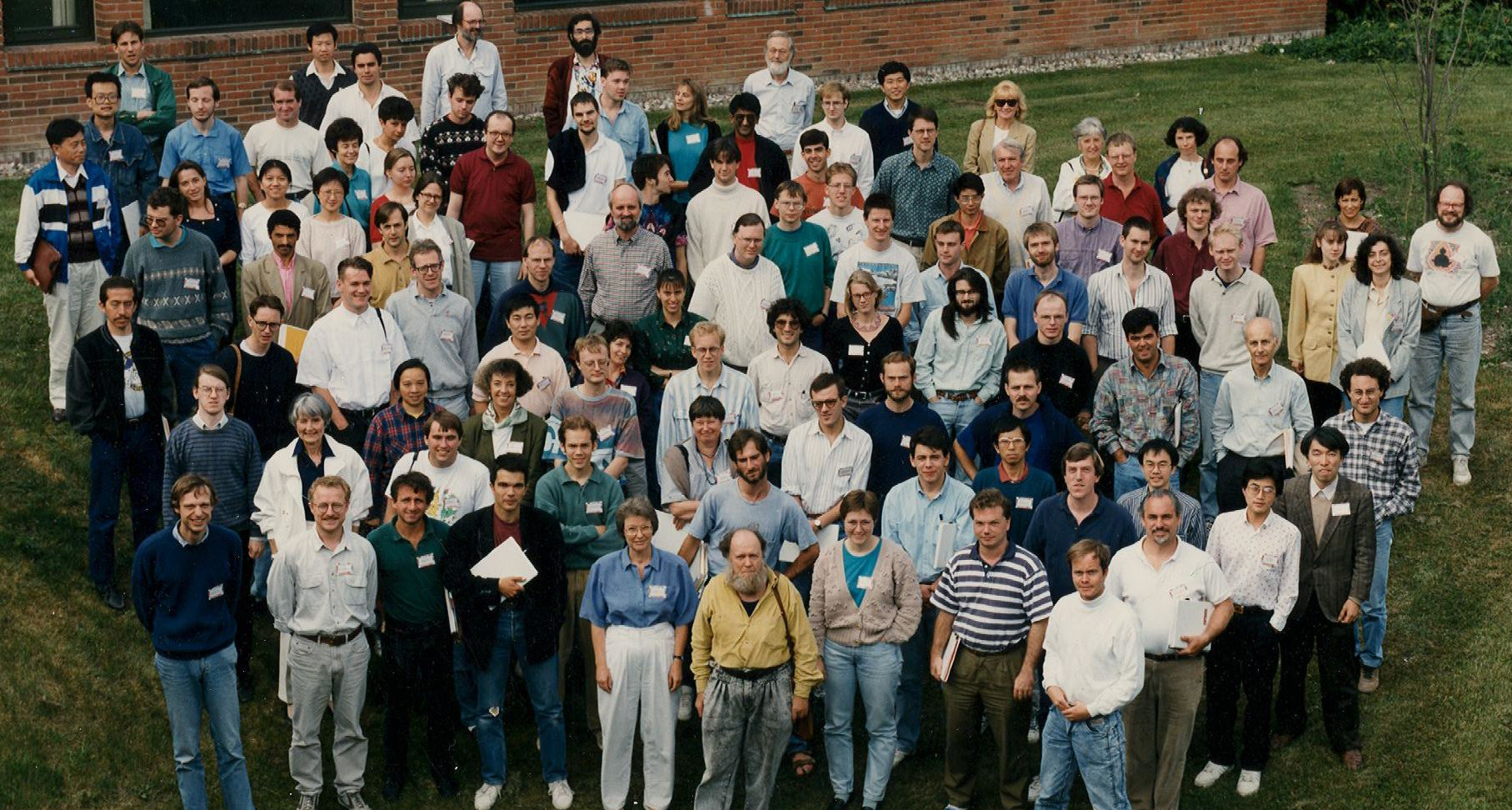
On the Hillerod conference picture from 1993
you see a rare collection of specialists on the Mandelbrot sets. I have seen there several of the Mandelbrot researchers
there discussing the problem and also the Mandelbar where one has seen non-local connectivity features. The problem has not
yet been solved. Present on the Hillerod conference were also John Hubbard and Adrian Douady. Click on the following picture
to see all the names:
Lecture 9: Topology
In the 9th lecture, we will look at topology which is a geometry in which symmetries are much more general. It is also called rubber geometry. A doughnut for example has a completely different topology than a sphere. A cube however is topologically the same than a sphere. here is a twitter entry trying to figure out, how Harvard would look like in a toral geometry similarly as Elysium is on a torus.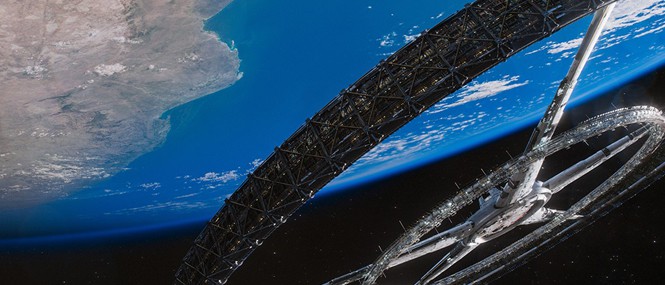
Lecture 8: Probability Theory
A drawing of Calder: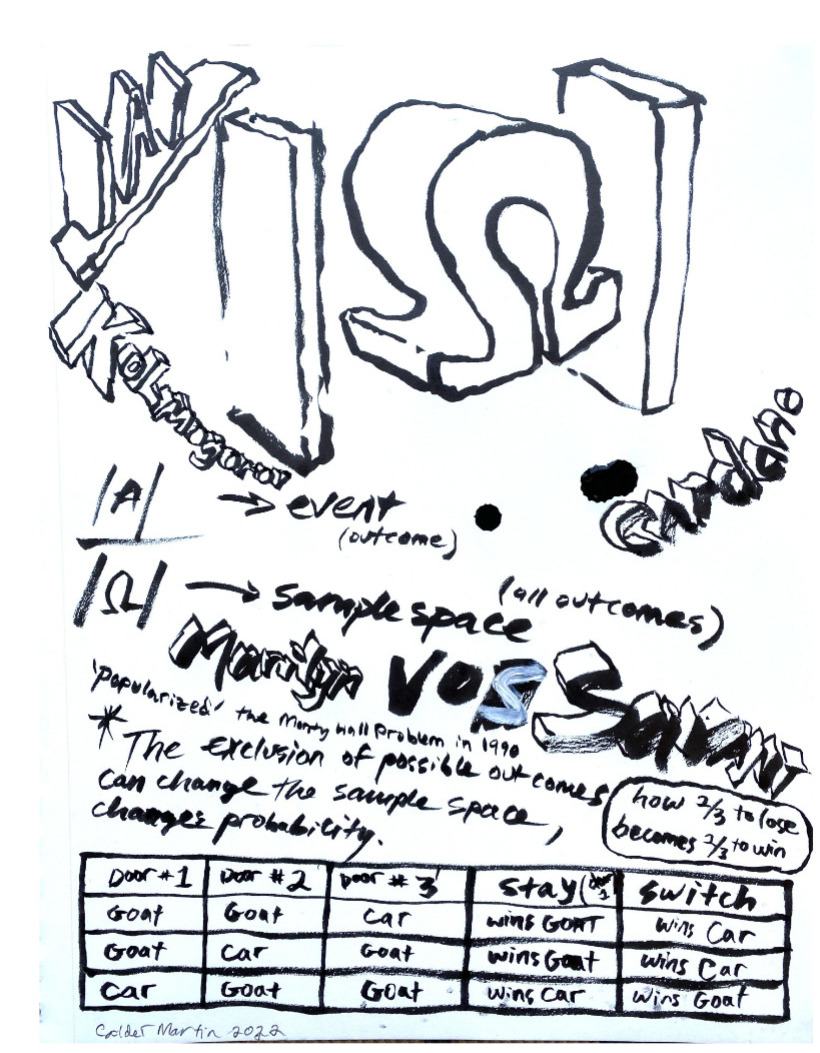
In the 8th lecture, we looked at probability theory. We started with a poll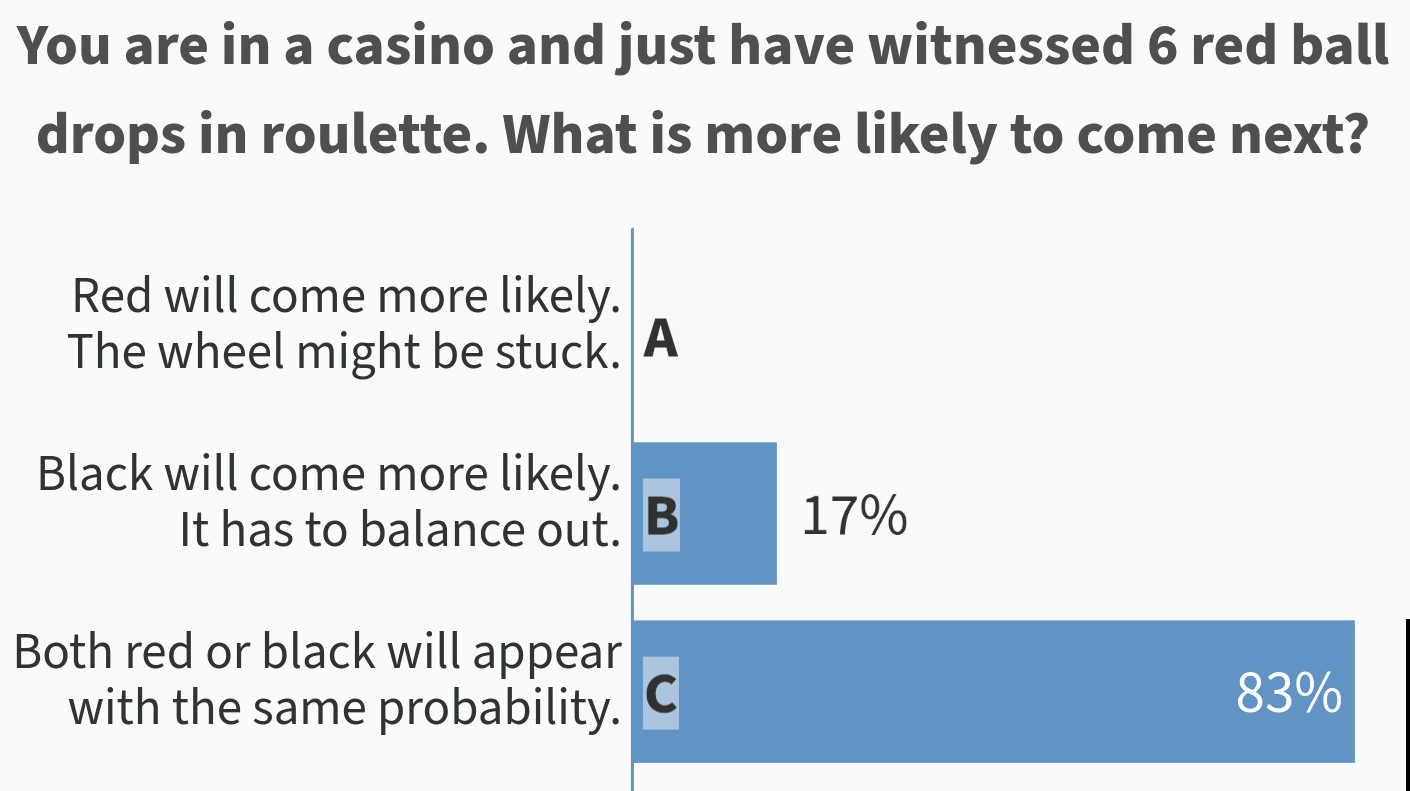
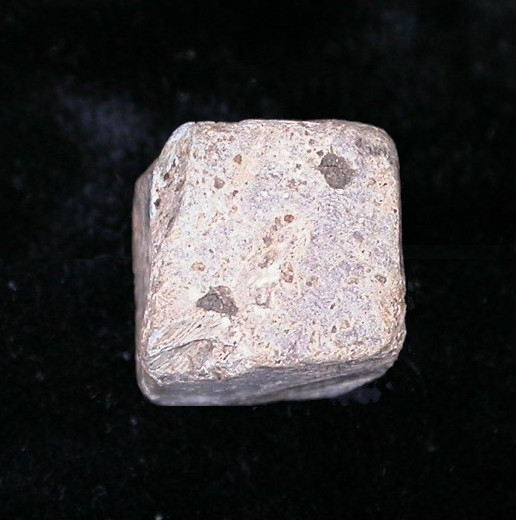
In this page the story of Chevalier de Mere appears (100 years after Caradano!) In 1654, another gambler named Chevalier de Méré created a dice proposition which he believed would make money. He would bet even money that he could roll at least one 12 in 24 rolls of two dice. However, when the Chevalier began losing money, he asked his mathematician friend Blaise Pascal (1623-1662) to analyze the proposition. Pascal determined that this proposition will lose about 51% of the time. Inspired by this proposition, Pascal began studying more of these types of problems. He discussed them with another famous mathematician, Pierre de Fermat (1601-1665) and together they laid the foundation of probability theory. After class Sarah mentioned a problem which has been haunting the internet recently. Is the probability larger to encounter a wheel or a door? Are there more wheels on earth or more doors? Big dabates. It seems that most say there are "there are more wheels than doors in the world". Also the majority of people think so. Finally a quote from one of the students:
"I teach basic probability and I enjoyed going just a bit deeper, was thinking all week about the way our knowledge changes the sample space for different varieties of conditional probabilities. It seems odd and mystical at first but then really becomes mechanical! Probability is science and tool more than art."
This is exactly how the subject has evolved. It was first a bit of a woodoo and art and now it is a very clear cut science.
Lecture 7: Set theory
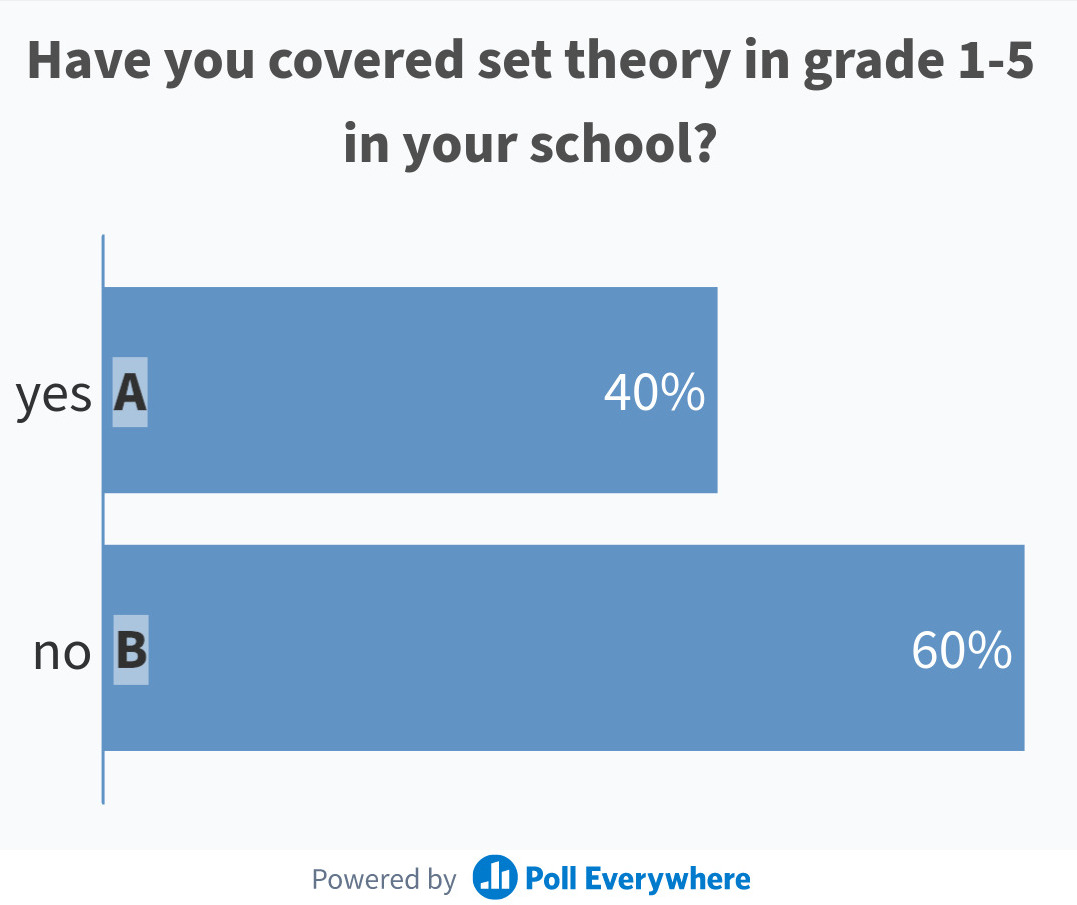
In the seventh lecture we learn how to compute with sets, that there are different infinities and that there are are some surprises in the grand picture of mathematics.
As we have seen in the Colbert comedy skit, set theoretical notions are quite natural because it is related to logic. Take the set of books which are math books and the set of books which are paperback books. Then the intersection is the set of books which are paperback math books. The intersection is related to ``and". The symmetric difference we have practiced with is the ``exclusive or". The reason why we took the symmetric difference and not the union is that with the symmetric difference + and the intersection *, we have an algebra with which we can compute like with numbers. Just remember the identity A*A=A2 = A and the identity A+A = 2A = 0. We have now seen expressions like A+B+AB which is the union. Boolean algebra is actually just replacing the field of real numbers with the field of numbers modulo 2. This field has two elements {0,1} and we have the law 1*1=1 (which corresponds to A*A=A and 1+1=0 which corresponds to A+A=0.
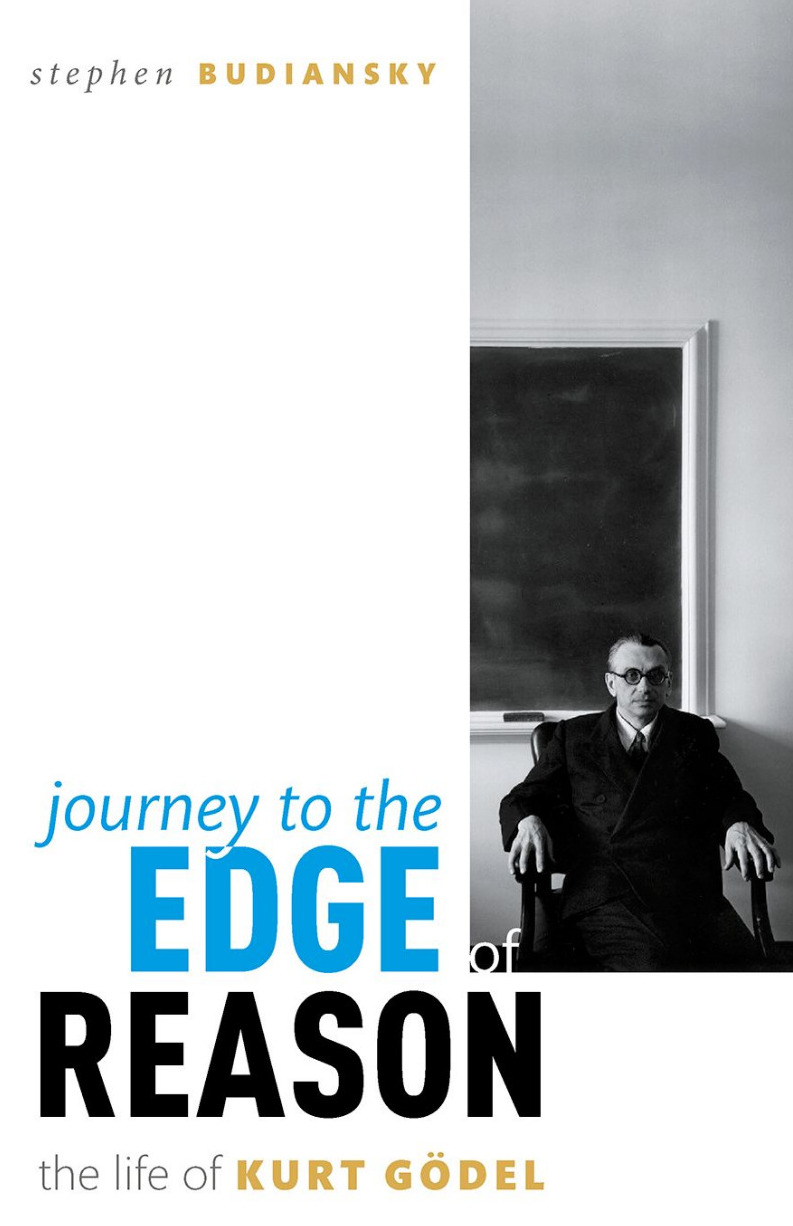
We have seen that both pioneers, Cantor as well as Goedel have had mental problems. Indeed, this has prompted some to suspect that ``thinking about infinity" can make you mad. I was indeed told in primary school that thinking about infinity is dangerous as it can drive you crazy.
There is a newer book from 2021 by Stephen Budiansky about Goedel "Journey to the edge of reason" which tries to summarize in an appendix the proof of Goedel in a few sentences and also, in the last chapter of the book, gives more account on the private life of Goedel. Here is a passage from that book (I also mention this because Gerald Sacks (who was at Harvard and with whom I have taught myself calculus once) is cited:"Einstein's death in April 1955 brought intimations of mortality which Gödel characteristically responded to with evasion and denial. It was another night-and-day difference between the two friends. Years earlier Einstein had told his wife,"I have firmly decided to bite the dust with the minimum of medical assistance when my times comes, and up to then to sin to my wicked heart's desire." He vowed to eat whatever and sleep whenever he felt like, smoke on his pipe "like a chimney," and "go for a walk only in really pleasant company, and thus only rarely." Gödel was one of the rare few on whom that privilege was bestowed. Suffering a ruptured aortic aneurysm at age seventy-six, Einstein refused surgery, explaining, 'I want to go when I want. It is tasteless to prolong life artificially.' Gödel wrote his mother,'Of course I have lost much by his death, purely personally speaking, all the more since in particular lately he had become even nicer to me than he already was before, and I had the feeling that he wanted to come out of himself even more than before. After his death, I was asked twice to say something about him, but of course I declined.' Einstein's death was the sudden end he had wanted, but von Neumann's death two years later from cancer was a prolonged ordeal which Gödel had a harder time facing. As the logician Gerald Sacks remarked with only slight exaggeration, "I noticed over the years that Gödel's way of cheering up a dying person was to send him a logical or mathematical puzzle." But it was also a manifestation of his own denial and fears of serious illness. In his last letter to von Neumann he expressed blithe confidence in his friend's imminent and complete recovery, before going on to pose what would be one of the most fundamental questions of computer science. Gödel's letter to his dying colleague was apparently the very first formulation of the so-called "P vs. NP" problem, which offered a striking analogy of his Incompleteness Theorem to the field of computing. 'P' is the set of problems easy to solve, for example multiplication and addition. 'NP' is the set of problems for which an efficient algorithm exists for checking a given solution, but finding the solution may or may not be easy, such as factoring a large number, solving a sudoku puzzle, or discovering a proof for a formula."
"Cohen, like most modern-day mathematicians, believed that his result meant it did not even make sense to speak of the Continuum Hypothesis or the Axiom of Choice (whose independence he was able to demonstrate using his same method) as being true or false; because they are neither contradicted nor implied by the other axioms of set theory, one can take them or leave them. Set theorists ever since have obtained interesting results from set theories with or without the Continuum Hypothesis. But that agnostic view never satisfied Gödel. He suspected that the Continuum Hypothesis would eventually be shown to be false, and he considered the Axiom of Choice to be obviously true. (The only time, Gerald Sacks said, he ever saw Gödel 'sneer' was when the notion of rejecting the Axiom of Choice - as constructivist mathematicians did - came up. 'I suppose it's interesting,' Gödel drily replied, 'to see what a man can do with one hand tied behind his back.' " The Gödels' neighbor Adeline Federici tried to help in Adele's absence, offering to go grocery shopping for him, but all Gödel ever wanted was Wonder bread, California navel oranges, and canned soup; when the price of soup went up two cents he refused to buy it anymore. To other visitors, including nursing help arranged for him, he refused even to open the door. The Institute administrators did what they could to reassure him that his wife's medical bills would be covered by his insurance and managed to arrange twenty-four-hour nursing care for Adele when, on December 19, she peremptorily discharged herself from the Princeton Nursing Home and had herself driven home by the Federicis. Until then, no one at the Institute had quite realized how terrible her husband's condition had become. He had spent the months of Adele's absence almost entirely alone and was slowly starving to death. Hao Wang, who had been away from his position at Rockefeller University in New York City for most of the fall and had been unable to come to Princeton to visit Gödel, saw him for the last time two days before Adele's return. Wang was struck by the nimbleness of Gödel's mind, and thought he did not seem very ill. But Gödel told his friend sadly, 'I have lost the faculty for making positive decisions. I can only make negative decisions.' On December 29, Adele managed to persuade him to enter Princeton Hospital. He died there on January 14, 1978, curled in a fetal position. He had refused to eat at all during his final weeks. His death certificate listed the cause as 'malnutrition and inanition secondary to personality disturbance.' "Gödel's public renown continued to grow after his death, notably boosted by the improbable 1979 bestseller `Gödel, Escher, Bach` by Douglas Hofstadter, which sought to weave Gödel's proof into an exploration of self-referential form in art, music, and ideas, but which contained not a word about the man himself. The general idea that there are truths that cannot be proved had an irresistible appeal that far outran Gödel's actual proof, helping to secure him a place, as the American mathematician and writer Jordan Ellenberg put it, as `the romantic's favorite mathematician.` Like Heisenberg's Uncertainty Principle and Einstein's Theory of Relativity, Gödel's Incompleteness Theorem has provided what Alan Sokal and Jean Bricmont, in their take-down of postmodernism, called `an inexhaustible source of intellectual abuse,` invoked by theologians, literary theorists, architects, photographers, academic deconstructionists, pop philosophers, and mystics of all kinds to prove everything from the existence of God to the nature of free will, the structure of poetry, and the phenomenon of human misery. A not atypical example reads, `Basically, Gödel's theorems prove the Doctrine of Original Sin, the need for the sacrament of penance, and that there is a future eternity.` " "The fact that there might exist truths forever beyond human reach is likewise not necessarily the cause for philosophical alarm and despair it was taken to be by some. As the philosopher Robert Fogelin observed, skeptics about the extent of human knowledge come in two types, facetiously categorized as East Coast skeptics and West Coast skeptics according to their relative degree of laid-backness. "East Coast skeptics recognize that their knowledge is limited," Fogelin said, "and this troubles them deeply. West Coast skeptics recognize the same thing but find it liberating." Gödel himself firmly believed that his proof was profoundly encouraging for human creativity. Humans will always be able to recognize some truths through intuition, he consistently maintained, that can never be established even by the most advanced computing machine. A machine that can literally duplicate the reasoning, learning, planning, and problem-solving ability of the human mind will be forever impossible if Gödel was right about what he believed to be the more far-reaching implications of his theorem. In place of limits on human knowledge and certainty, he saw only the irreplaceable uniqueness of the human spirit. As Gerald Sacks keenly observed, "He made mathematics more interesting. 'Though a"throwback as a philosopher,' he never wavered on this: That any problem the human mind can pose, it can solve.` "
Lecture 6: Calculus
In the sixth lecture, we looked at some calculus topics. In class, we will focus more also on the history as well as the difficulty of grasping the subject. It is a rather intimidating field for many high school or college students and history very much gives us also a guide why this is so. The concept of limit or notions like ``indivisibles" or ``infinitesimals" has confused over many centuries and historians are still often arguing at which time things have cleared up sufficiently. Did mathematicians like Leibniz have a rigorous enough notion of calculus already or not? Do we really need infinitesimal objects? Mathematicians have cleared the topic up very well these days but the difficulties of the past linger today still in pedagogical approaches to calculus. How much rigor is needed on which level for example to explain notions like continuity or limits?- I could no more identify the following figure in the list of animated people.
It is Thales of Miletus 624 BC - 547 BC.
Actually, a guess how Thales could have looked like.
See the Mac Tutor biography
- During class, I mentioned Jean Piaget. Here is one of the last photos of Piaget around 1979. We will this summer again go to the alp Salmenfee, close where Piaget lived: Here are some fhotos from August 2014. Piaget was interested on how children learn mathematics. The first encounters with mathematics are sensor-motor connections. We intuitively learn to grasp notions of number, length, area or volume. This can be happen through blocks, or with pieces of pizza or amounts of liquid in a cup. Still in an early stage, children learn how to operate, like to add different parts or divide up things (they are especially good in taking things apart ....!). Notions of arithmetic and fractional calculus come up. Then, after learning what numbers are, there is a symbolic operational stage, where one can count, or add numbers like 12+5. Much later come developments of limit intuition. Is 0.999999999... the same thing than 1.00000000? We discussed this a bit in class. Also college students often answer the question whether 0.999999999 ... is smaller than 1.0000000 with "yes" and only when probing with "but then give me a number larger than 0.99999999 and smaller than 1.00000000, most get convinced that there is nothing between. However, one must say that mathematicians have not stopped developing new numbers like infinitesimal numbers. Also non-Archimedean number systems have been developed. Actually in in a 13-adic world for example the number 0.99999999... is different than the number 1.000000000.... One can also build non-standard models with infinitesimals. See also this blog where it refers to hyuperreal numbers. In the Wikipedia article about 0.999 it is said: Students of mathematics often reject the equality of 0.999... and 1, for reasons ranging from their disparate appearance to deep misgivings over the limit concept and disagreements over the nature of infinitesimals. or the joke Q: How many mathematicians does it take to screw in a lightbulb? A: 0.999999.... .
- A link to Alizabeth Spelke mentioned by Aggie in the context of children learning.
Lecture 5: Algebra
Some board from an office hour:
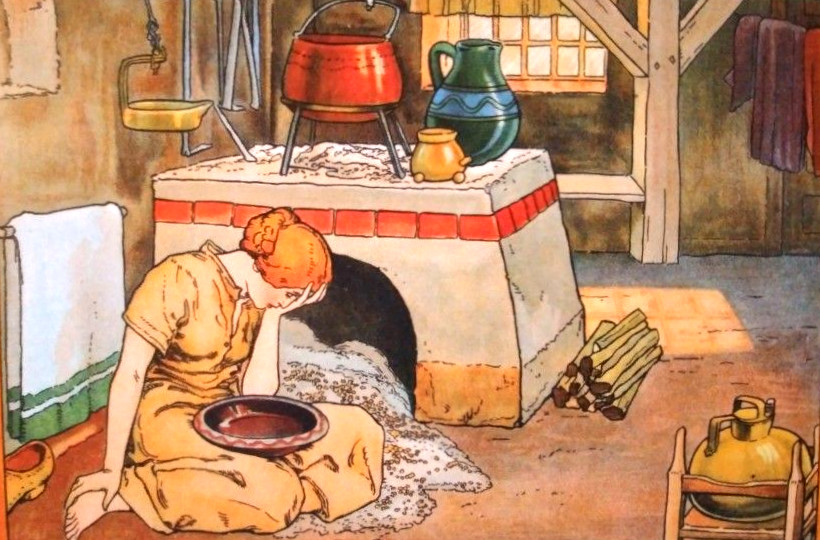
But Algebra blooms, once recognized. There are extremely interesting stories related to the problem of finding roots of polynomials. This leads also to geometric connections like symmetries. It turns out that the set of all symmetries form a group. This is a core algebraic subjects. Actually, one can go back to the integers or real numbers and see that they also form a group. One can also go to geometry and see that symmetry groups are pivotal to understand geometry, even planar geometry pioneered by Euclid. Group theory has also invaded and conquered number theory. One can do number theory on many groups, rings and fields. Cinderella has become a queen.
While discussing the quadratic equation, the following article was mentioned. It covers the quadratic method. Actually, this is the method which for many decades has been used for solving SAT type problems fast. It is the method of Viete. The statement, that it is a method known by Babylonians is not based on any evidence. The Babylonians did not know to solve quadratic equations. They have solved numerically x2 = 2 as we have seen on a Clay tablet. I think all historians agree that Al Khwarizmi was the first who solved the quadratic in general. Solving one quadratic equation does not mean to have a method. Finding examples of the Pythagorean theorem (as the Babylonians did) does not mean to have found the Pythagorean theorem.
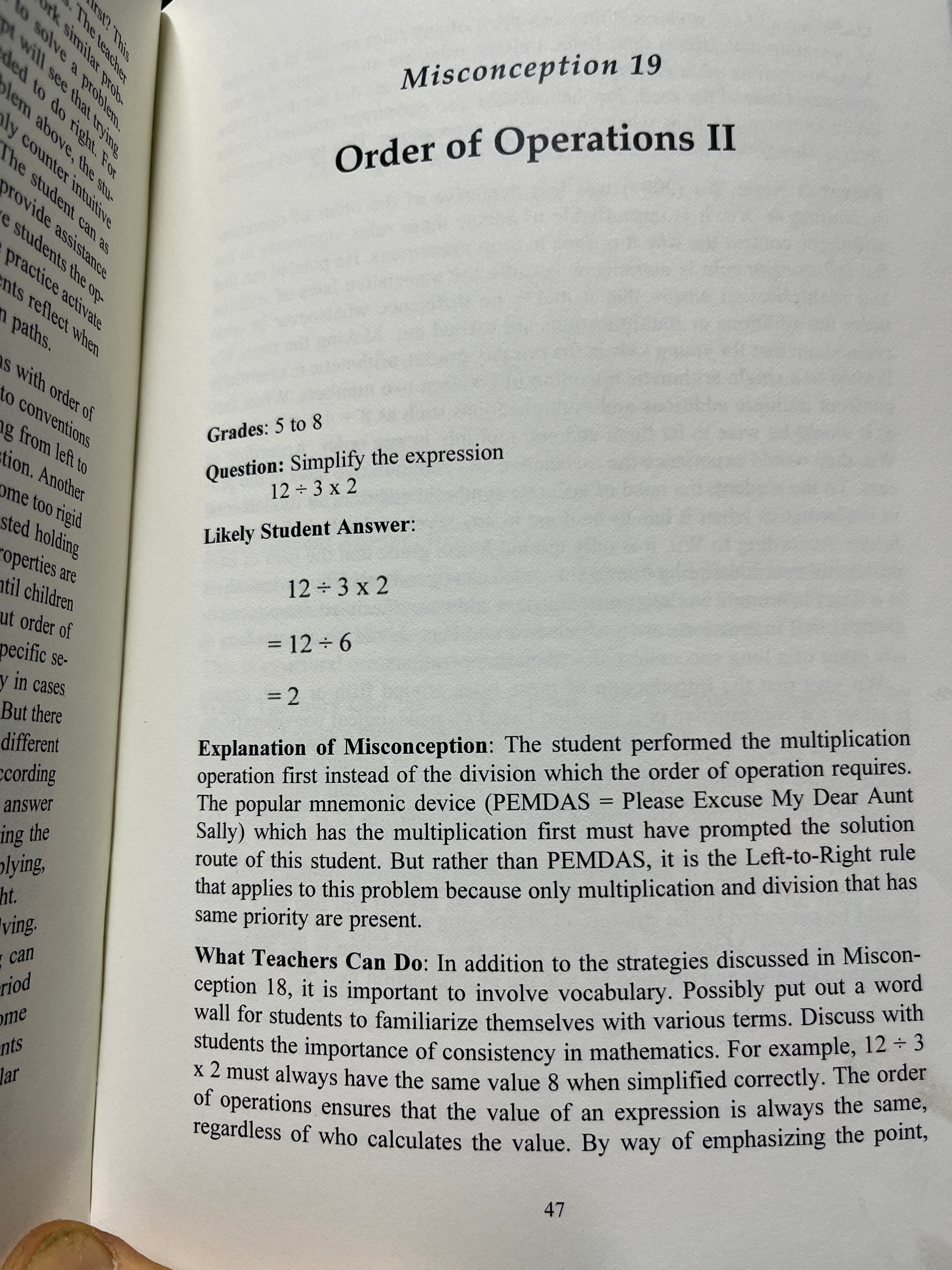
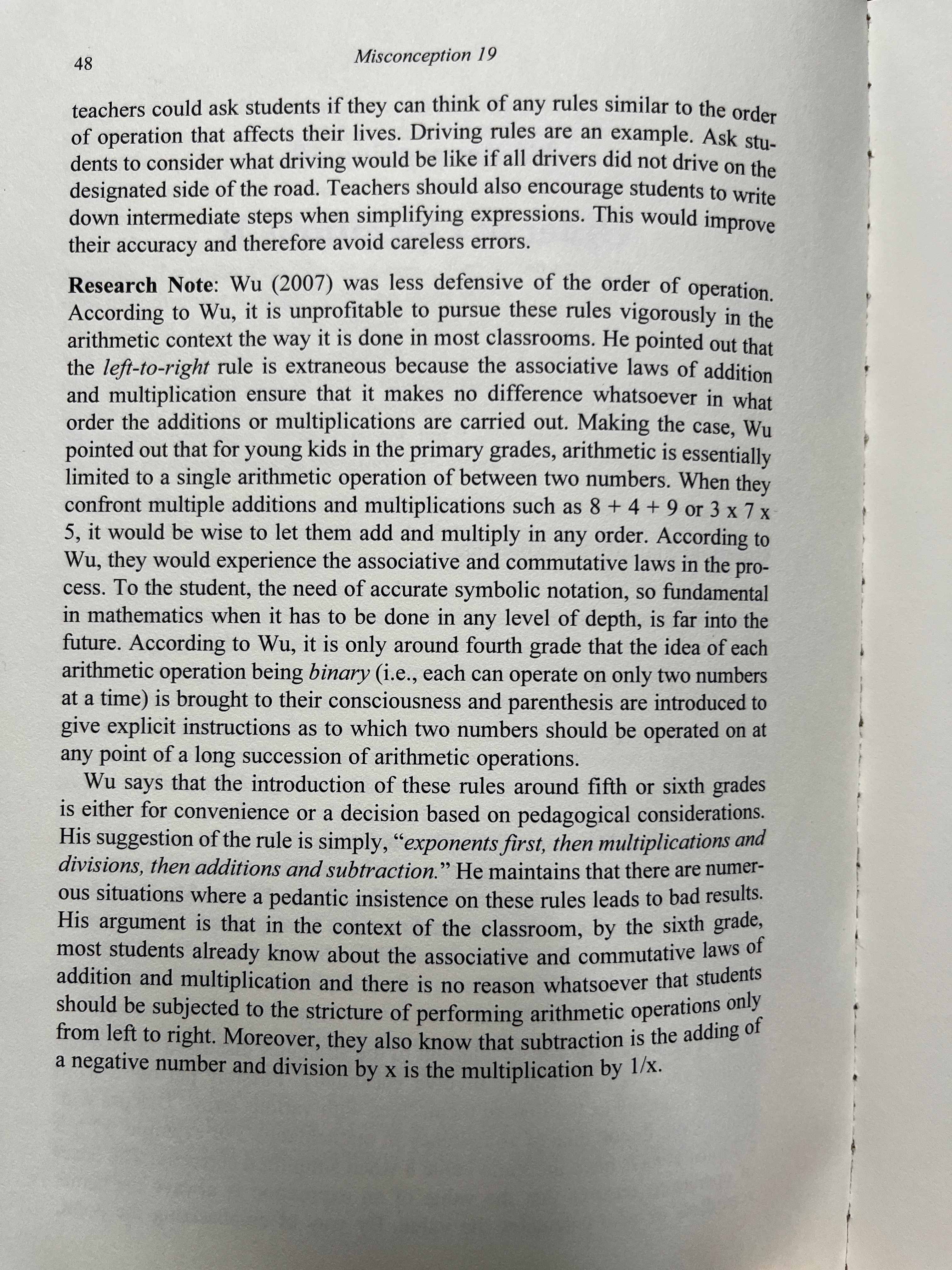
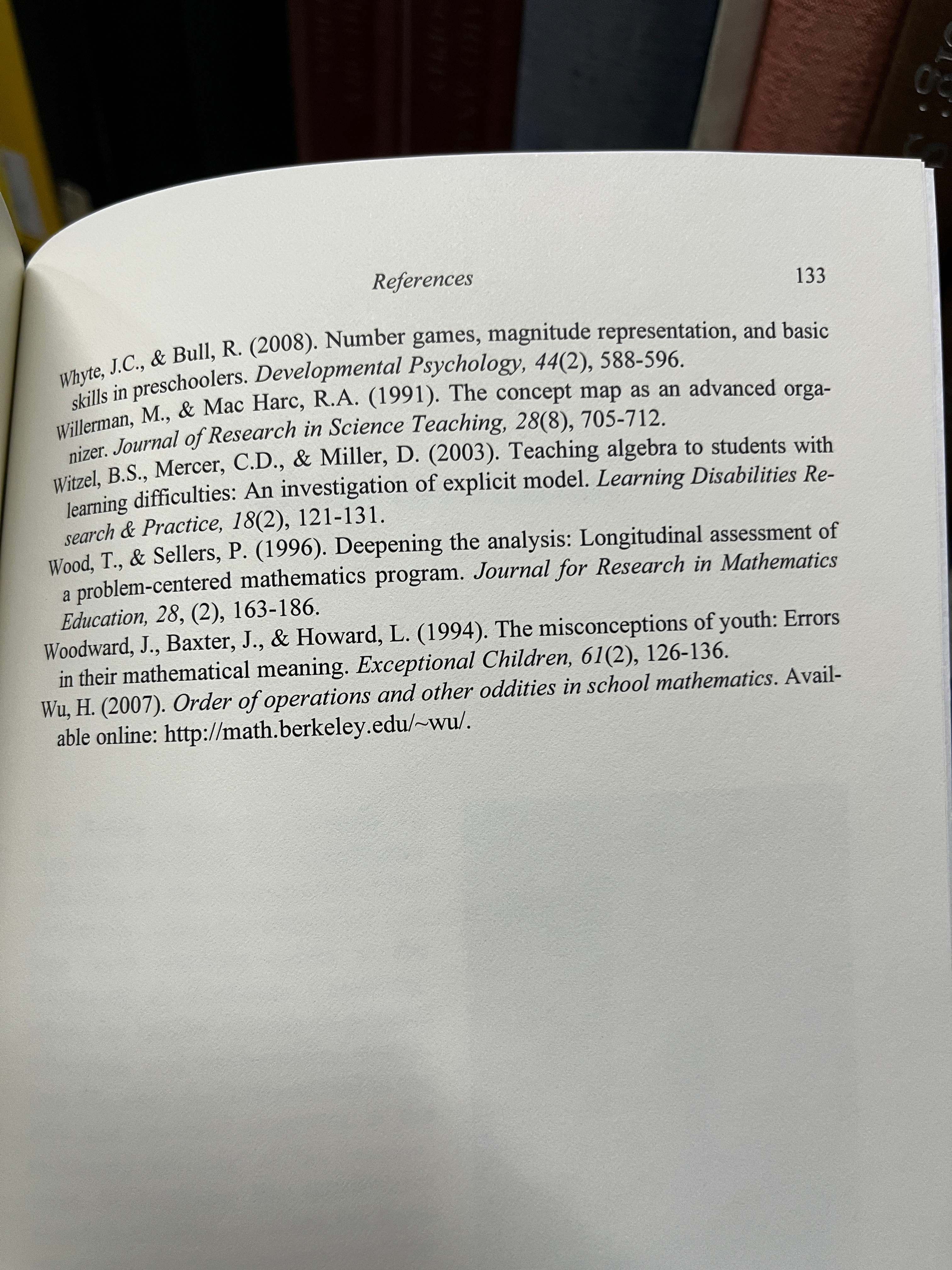
Here are some pages of a book, I found recently while browsing the Cabot library stacks. It deals with the PEMDAS issue. I personally strongly disagree with any attempts to impose syntactic language rules which are not honored by the vast majority of people. It produces gotcha moments. Language is a social construct. And mathematics is not different. Everybody of course can impose new rules, grammar or syntax but without pointing out the assumption, there will be miscommunication. This is especially brutal in educational settings, like for homework or exams. (With wars involving not only students and teachers but also parents!) It is very simple: in case something has a chance to be misunderstood, even in expressions like 1/3+2 which can be misunderstood as 1/5 (even so there is absolutely no dispute that it should be 7/3), it is better to write it as (1/3)+2 or 2 + 1/3 (which is less likely misunderstood as 3/3). Here is a 2 page write up about this from last year. For the next pages, click on a picture to see it large
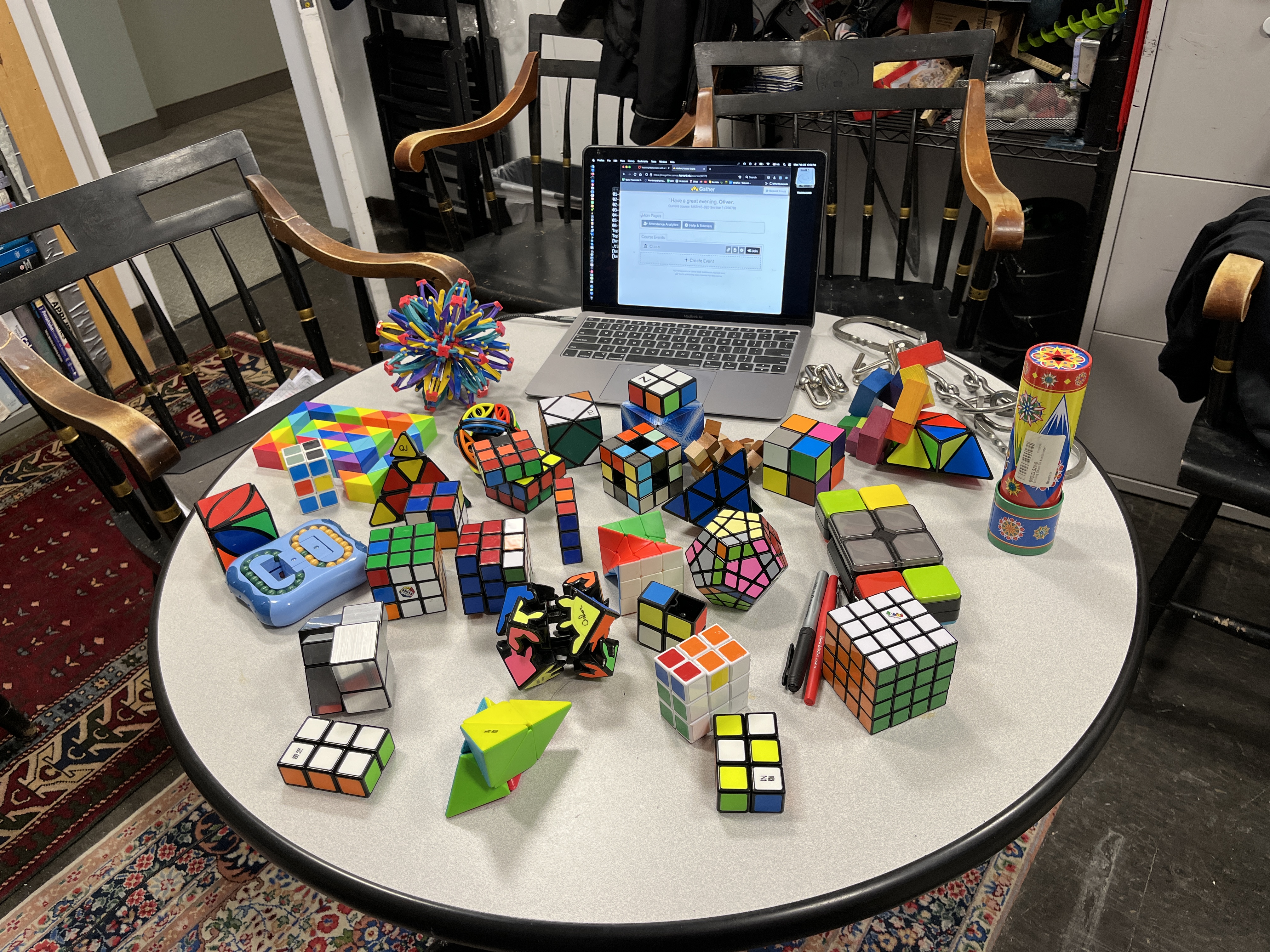
Displaying my puzzle collection before class: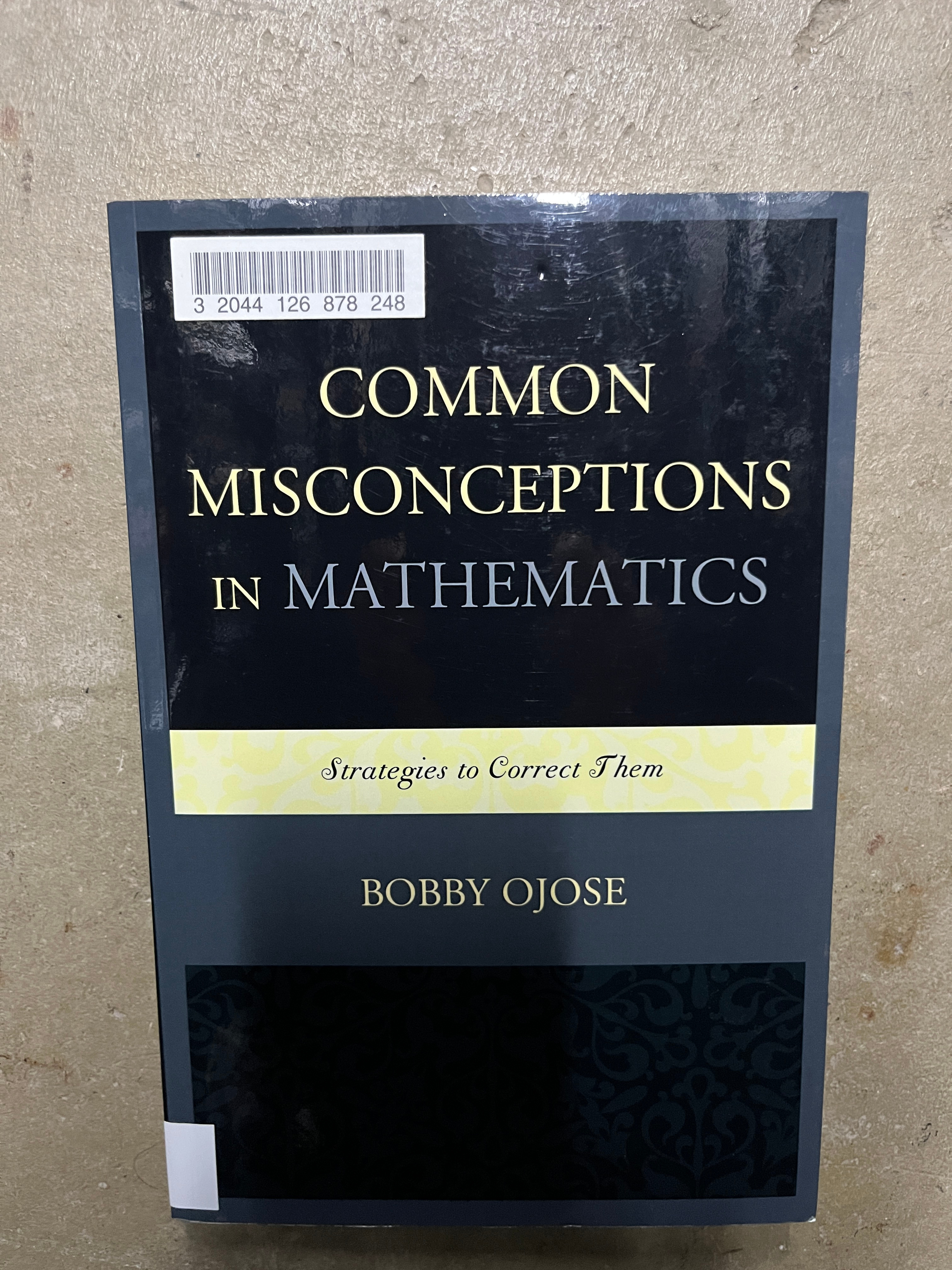
Lecture 4: Number Theory
The fourth lecture covered some number theory.- DEFINITIONS! The question when prime numbers appeared first in mathematics is not known. We have seen that on the Ishango bone, all the primes between 10 and 20 are listed one one side. Definitely Greek mathematicians have been fascinated by prime numbers and factorization questions like perfect numbers have been formulated. Euclid played an important role.
- We looked also at some movie clips where prime numbers appeared in classroom
scenes in movies. One of the definitions, one can see is that a ``prime number is
a number which is only divisible by 1 or itself". With this definition, also 1 would
be considered prime. As some in the class have pointed out, early on, 1 was considered
a prime. Daley mentioned the article "Is 1 a Prime Number: Developing Teacher Knowledge
through Concept Study," published in September 2008 in the journal Mathematics Teaching in the Middle School. There are also some good answers in
this stackexchange thread
where also some historical references are given.
One key pedagogical tool addressed in this question to value ``open definitions".
This is an important point. If one has a definition of an object, one should explore what
happens if one deforms the definition. However, it is also important to settle for one
definition. A good guide line is that good definitions are simple and good definitions
lead to natural theorems. Good definitions is important also in geometric set-ups.
What is a polygon, what is a polyhedron? The theorem
Every number has an up to order unique prime factorization. is only true if 1 is not considered a prime number. The theoremA polygon in the plane divides the plane into an inside and outside. is only true if one defines a polygon not to have self intersections. The theoremV-E+F = 2 for polyhedra depends on the definition of polyhedra and what parts are considered faces. It fails for some Kepler polyhedra. We will come back to this when we study polyhedra. -
THEOREMS!
Here is a selection of theorems. The closest match between a book selecting those
and my list is the book "Elementary number theory" by Underwood Dudley:
-
PROBLEMS!
Here is a selection of open problems in number theory. We will see many other topics in mathematics still but
number theory, the queen of mathematics is singled out as the field in which accessible problems appear.
Many of them (the ABC and Riemann hypothesis probably as an exception) can be understood in middle school.
I learned about prime numbers first in middle school but the Goldbach conjecture came only up early in in high school
Here are slides from a
presentation from 2018. I wrote also a small Note on
encounters with Goldbach in 2007 at the occasion of the 300th birthday of Euler. And in 2016, I spent a summer on
doing some experiments in number theory, especially a
Goldbach conjecture for Gaussian integers.

Here is a video about Harald Helfgott who proved the weak Goldbach conjecture. The video is also a good example of showing how modern mathematicians think or how they workLecture 3: Geometry
Here is a graphical overview of the chronology of Greek mathematicians from the book ``Geometry by its History" by Alexander Ostermann and Gerhard Wanner:
- In the case of Hippocrates theorem there are various variants or special cases. The Lunes of Halhazen for example is just turning the picture so that the moons are vertical or horizontal. A picture in Wikipedia.
- One question was what historically the first proof looked like. Was it using the Pythagorean theorem as we did. Most likely. Unfortunately, the ``Elements", the book of geometry which Hippocrates authored is lost as are follow up texts. In the Wikipedia article, a proof is given in the case of a 45-45-90 degree triangle. In that case, if the hypothenuse has length 2, the area of the triangle is 1 and the area of the moons is π - (π -1) which is also 1. Similarly as with Thales theorem, the special case is much less surprising than the general case. It might well be that the more general case was first only considered by Alhazen. According to Heath (``A history of Greek mathematics (1921) (page 539) the quadratures of the lunes by Hippocrates was contained in Simplicius's commentary on Aristotle's Physics. In that text, it is also mentioned that it was first in 1870, when the more modern time started to pay attention to the theorem.
- It is always interesting to see whether a theorem was considered in a special case only or whether it was done in full generality. The Pythagorean theorem for example was considered already in special cases in Babylonian clay tablet texts as we have seen (and in detail in the case of the 45-45-90 degree triangle). Other Babylonian triples have appeared on Plimpton 322 as we have pointed out too. This is only a proto version of a Pythagorean theorem. As we have seen in a movie clip, the Pythagorean theorem is not just a theorem about specific examples of triangles; it is a theorem about all triangles which have a right angle. The same applies for the Hippocrates theorem. It is a theorem which holds for all right angle triangles. The other theorem we have seen, the theorem of Thales also holds for a general line segment. The case of a right angle case is very easy to see by doubling the triangle and not so exciting.
- Here is an article in live science which is quite a good article but which is misleading in the title "Babylonians used Pythagorean theorem 1,000 years before it was 'invented' in ancient Greece". This is a gross misunderstanding. We have to distinguish between `experiments', `data collection', `conjecture' and `theorem'. Giving a list of primes does not prove yet that there are infinitely many. And it is still far also from conjecturing that a2+b2=c2 holds for all right angle triangles. And even if something is conjectured, this is still far from actually proving it. Similar mistakes have been done by claiming that the Pyhagorean triples actually produce ``trigonometry". Writing down some right angle triangle ratios does not mean to have invented trig functions. Of course, the ratios would later be interpreted as values of a trig function but predating trigonometry like this is maybe good for popular science but it is a historical distortion of facts. To cite Eleanor Robson from an article on Plimpton 322 who applied the statement for 3 particular questions in her article but which is a good rule in general: Internal mathematical evidence alone clearly isn't enough. We need to develop some criteria for assessing historical merit. In general, we can say that the successful theory should not only be mathematically valid but historically, archaeologically, and linguistically sensitive too..
- About Morley's theorem: there are several proofs and it will be interesting what in the assignment comes up
as the most popular one. There are a few contenders as a web search quickly reveals. Also, the Morley theorem
can be looked at in special cases. A very simple case is the equilateral triangle, in which case we have
by symmetry an equilateral triangle in the middle.
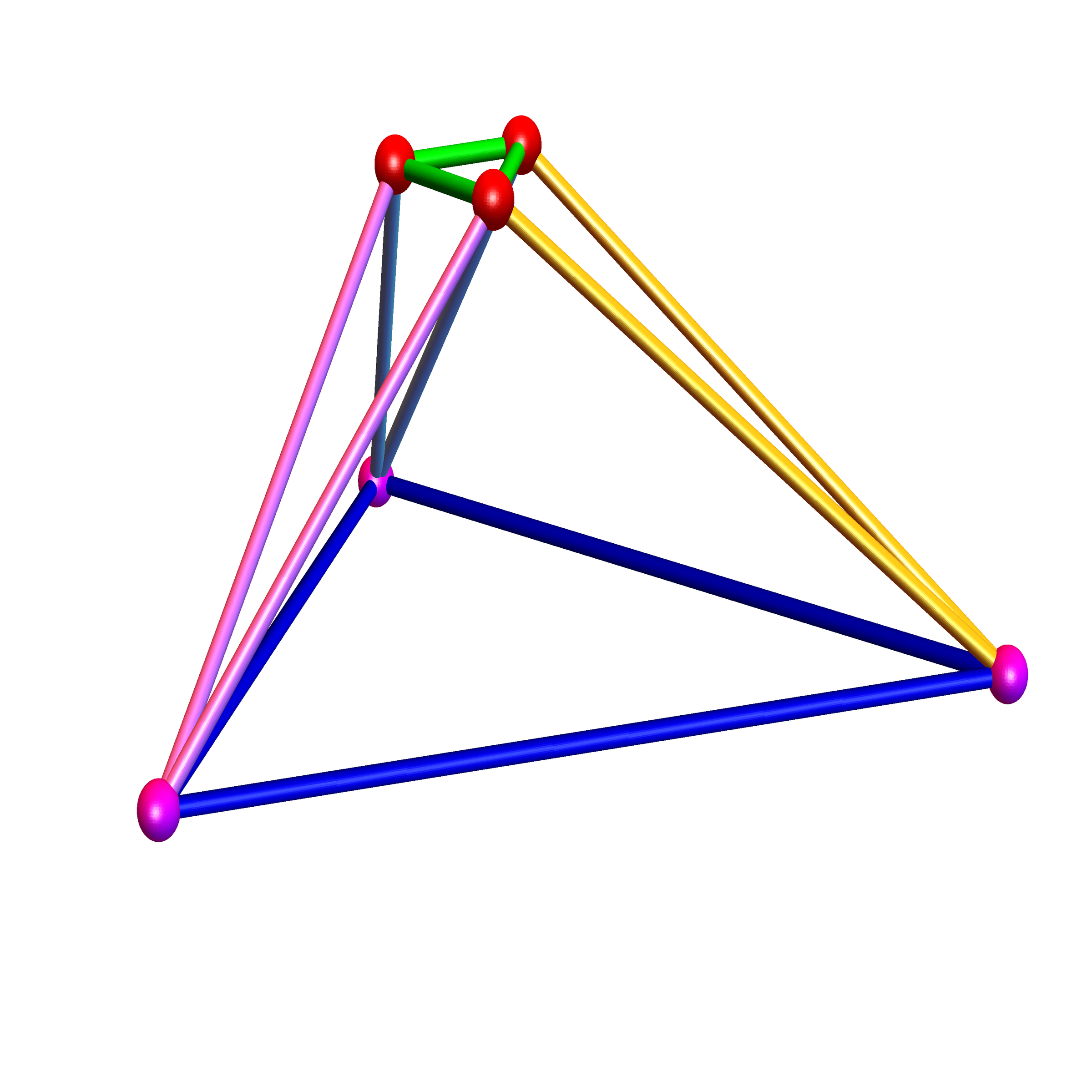
Hammond was looking at whether there is a way to see Morley's theorem as coming from a 3-dimensional object.
This would be an exciting approach. Here is a picture which tries to draw the idea out.

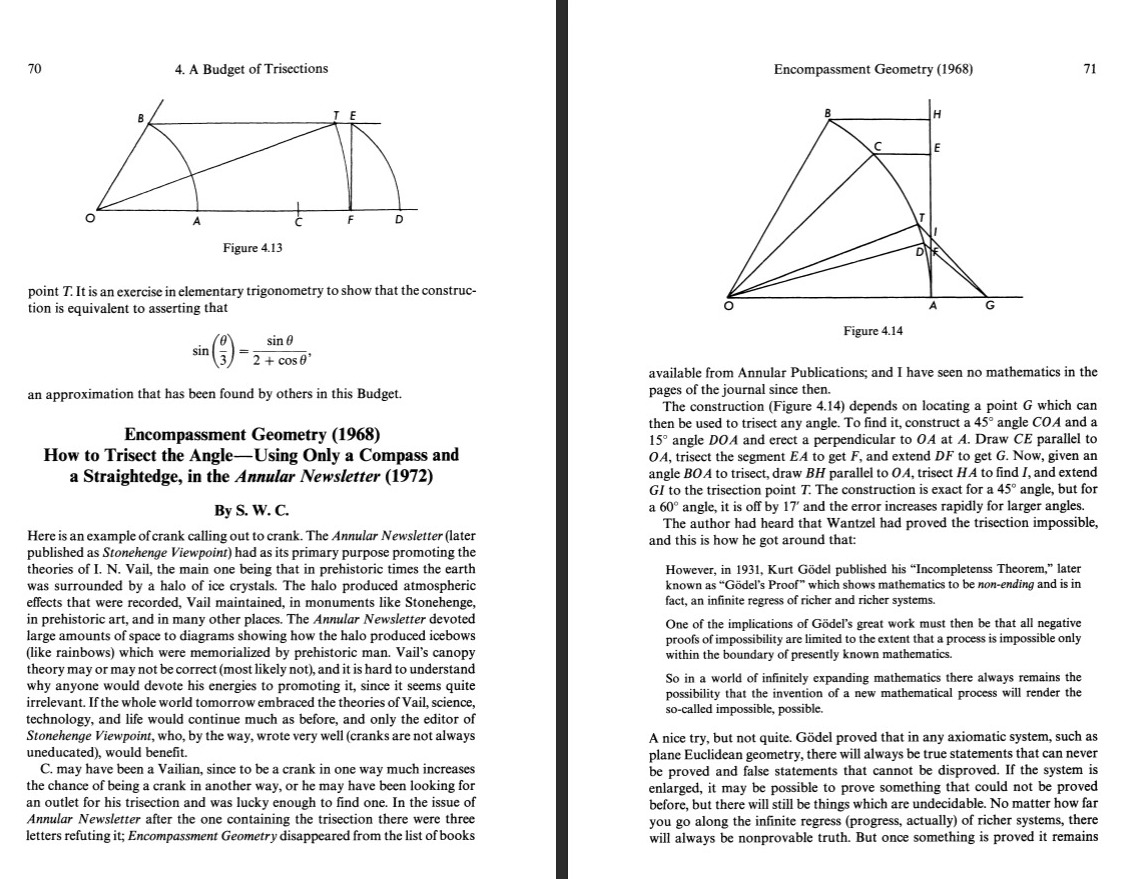
- During class and by emails the problem of angle trisecting came up. The reason was Morley's theorem which is a result about angle thirds. It had been a famous open problem to trisect angles with ruler and compass. The book ``The trisectors" by Underwood Dudley gives a panorama over attempts doing so. We will come back to this in the algebra lecture and mention why it is not possible to trisect an angle with ruler and compass. Below is a page from that book (from the first edition of the book called ``A budget of trisections".)
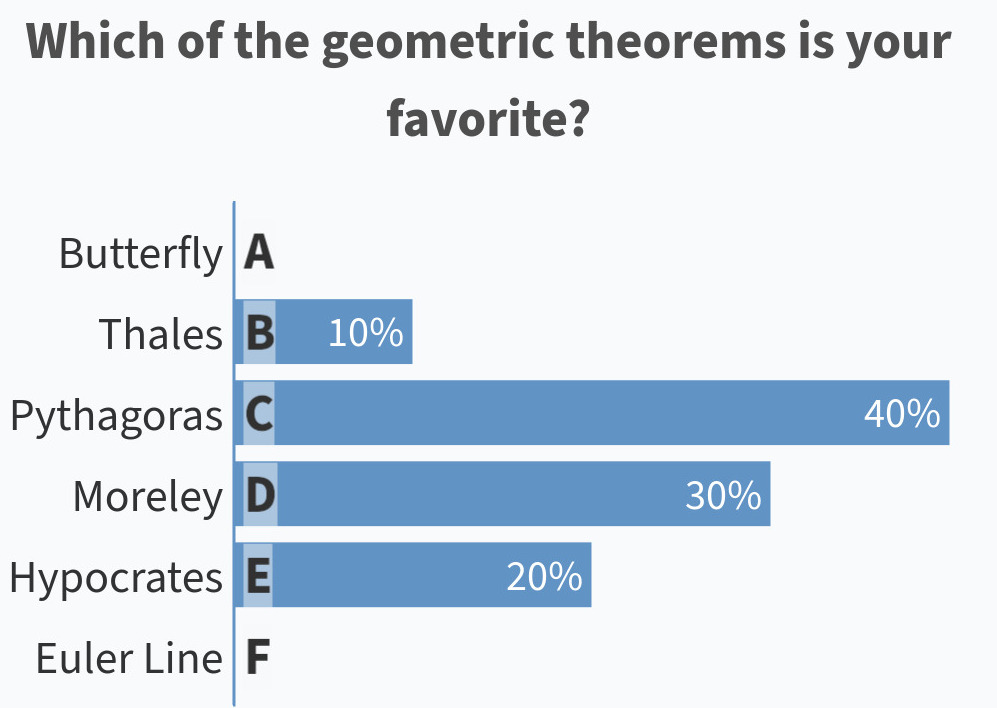
- Poll taken at the start of the number theory lecture. Pythagoras eventually won:

 Here is the top 10 Theorems in planar geometry slide show:
Lecture 2: Arithmetic
Several interesting questions and observations have come up during class and office hour.- We have learned that the Mayan numerals have base 20. This is called a vigesimal system.
Fortunately, this place-valued system had a notation of zero so that it had been easy to write numbers
like 400 = 1*202 + 0*201 + 0*200. They would call 400 one "bak". It would
look as follows
 .
 O
 O
For the Sumerians who did not have zero, writing a number like 3600 was harder. It would be something like 3600 = 1*602 + 0*601 + 0*600.| 0 0
But as they did not have zero, the only way to write it was leaving out space|
which of course could be confused with numbers like 60 or 1. How do we know that a space is there and not just the end of the text is reached? Back to the Mayans: there is also some discussion where the symbol for 0 actually comes from. Is it a turtle, a sea shell or based on an olive. The dot could be a cocoa bean.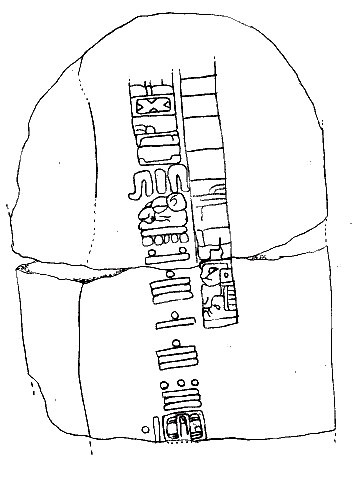 some discussion on a blog.
Daley mentioned that also a hybrid 60 based system had been used
by the Mayans. While this is mentioned also in this
article that the above number 400 could be interpreted as 360. This is used in the
Mesoamerican Long COunt Calendar.
The Wikipedia article on Maya numerals
speculates that this could be related to the fact that 360 is closer to the number of
days in a year than 400 but the article also points out that the Maya had an accurate estimate of 365.2422 days
for the solar year. This makes it a bit unlikely that they would bend the number system to 360 just because of that.
I still have to look up more literature but I'm not aware of any example, where the reduced version 360
in Mayan calendars appears in stead of 400. A most astounding document is the Dresden Codex which
we have seen mentioned in a movie clip. An example, where the long count calendar was used is
here.
some discussion on a blog.
Daley mentioned that also a hybrid 60 based system had been used
by the Mayans. While this is mentioned also in this
article that the above number 400 could be interpreted as 360. This is used in the
Mesoamerican Long COunt Calendar.
The Wikipedia article on Maya numerals
speculates that this could be related to the fact that 360 is closer to the number of
days in a year than 400 but the article also points out that the Maya had an accurate estimate of 365.2422 days
for the solar year. This makes it a bit unlikely that they would bend the number system to 360 just because of that.
I still have to look up more literature but I'm not aware of any example, where the reduced version 360
in Mayan calendars appears in stead of 400. A most astounding document is the Dresden Codex which
we have seen mentioned in a movie clip. An example, where the long count calendar was used is
here.
 The Dresden Codex. Source: Wikimedia.
-
In the context of hieroglyphs, which is not a place valued system, the question came up, whether
it actually happened that like in the homework problem, the different symbols would be scrambled around.
The Romans also had a non-place valued system, which (at least when not using subtractive notation like
IX for 9) also could be scrambled. The roman number
V X M
for example can still be understood as 1015. The Egyptians would have written for this a Lotus flower L, a bent arc A and five sticks I. But also there, it would not matter whether we would writeL A IIIII
orIIIII A L
It clearly still represents the number 1015. Addition is easier to do in this system (as long as there is no carry over). This is similar to the Abakus. Also the Quipu could just add more knots. Well, when there was a carry over, also some knots would have to be opened again.
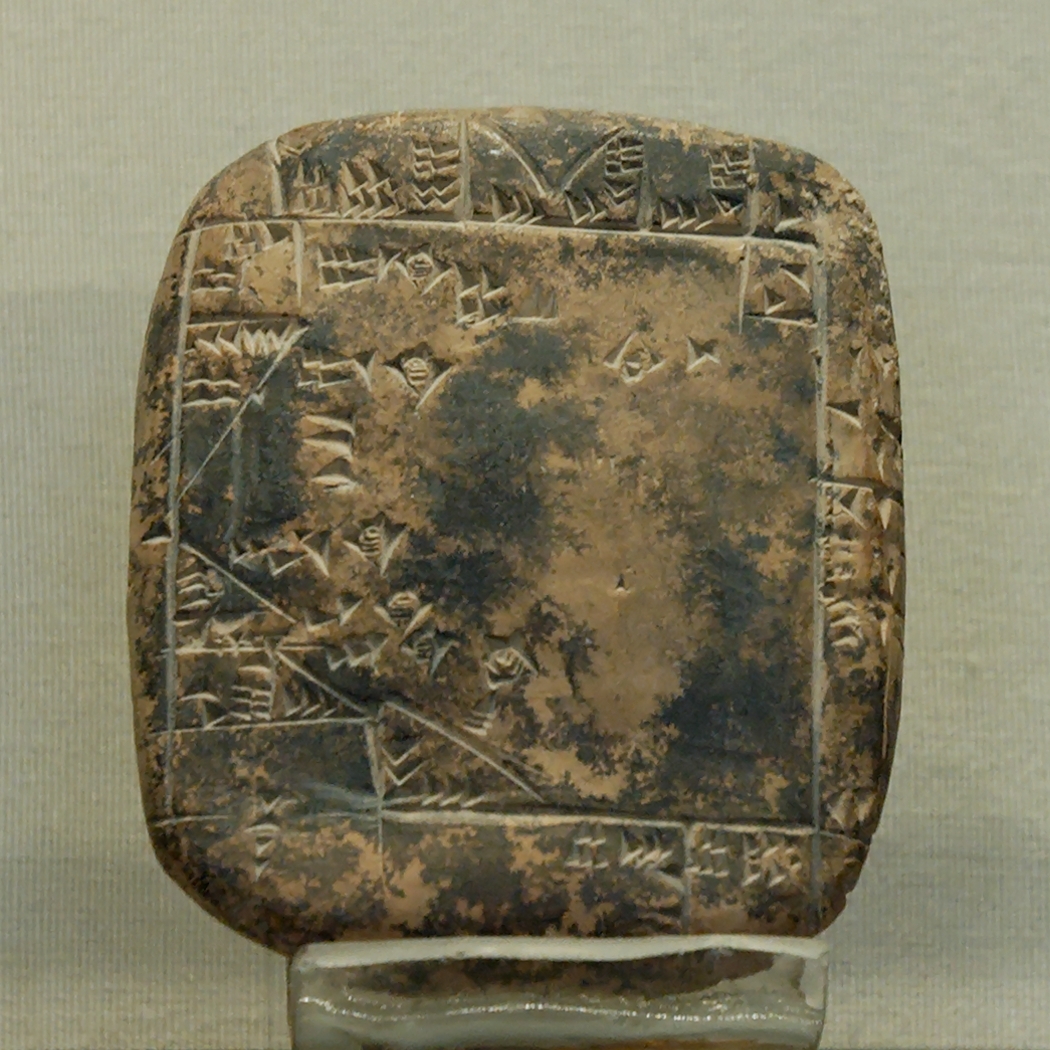
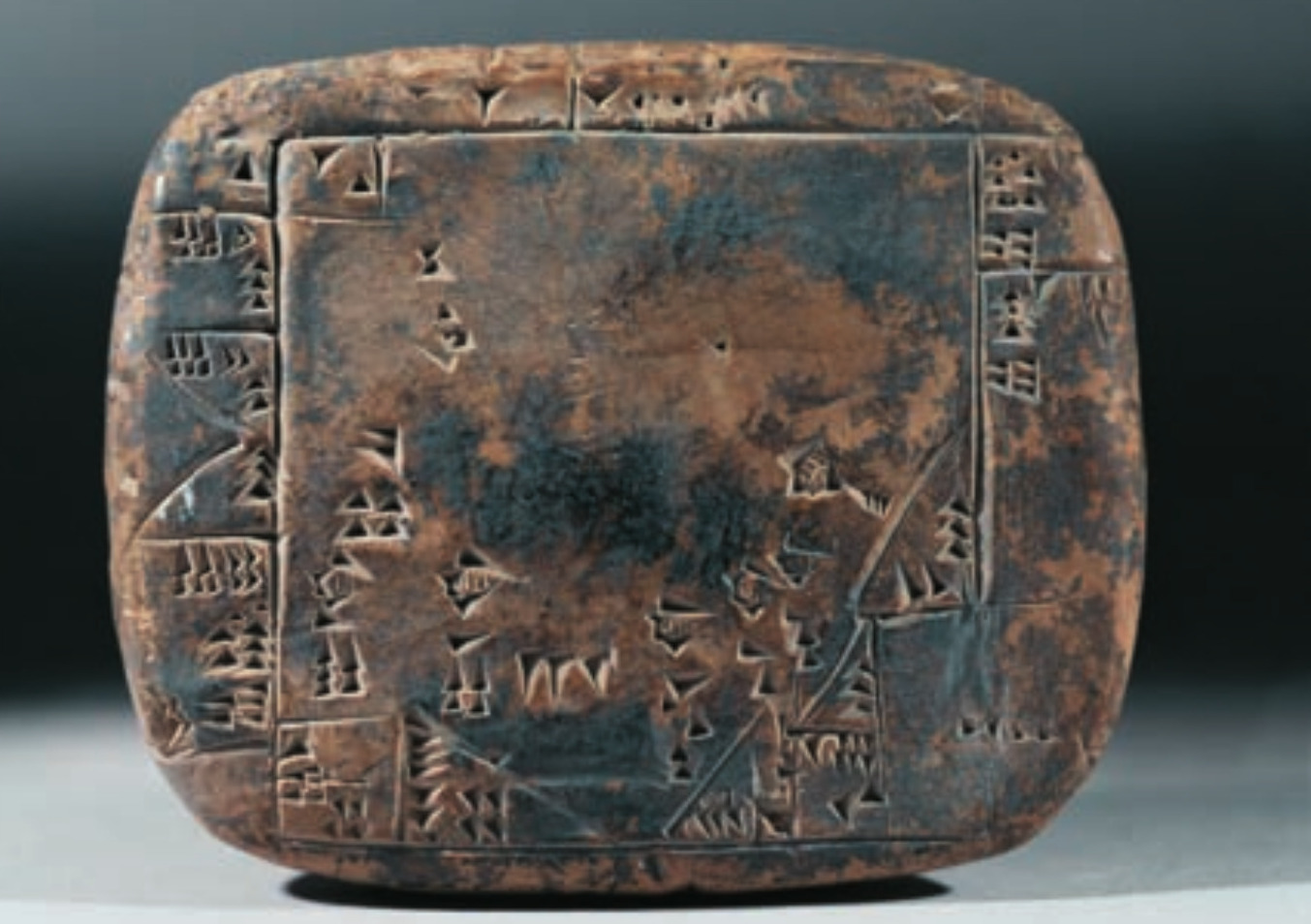 But there seems something wrong with the picture. If you search for it, here is the
same tablet in Wikipedia. It is there turned by 90 degrees and labeled as a map of a property belonging to the city
of Umma, indicating the acreage of each parcel.
Which one is right? The first, the second, both (you have to turn the tablet in order to see
different parts) or none (an other rotation) .
But there seems something wrong with the picture. If you search for it, here is the
same tablet in Wikipedia. It is there turned by 90 degrees and labeled as a map of a property belonging to the city
of Umma, indicating the acreage of each parcel.
Which one is right? The first, the second, both (you have to turn the tablet in order to see
different parts) or none (an other rotation) .
 Here is a page from the Wolfram
History of Math project built 2020-2021.
Here is a page from the Wolfram
History of Math project built 2020-2021.
Lecture 1: What is mathematics
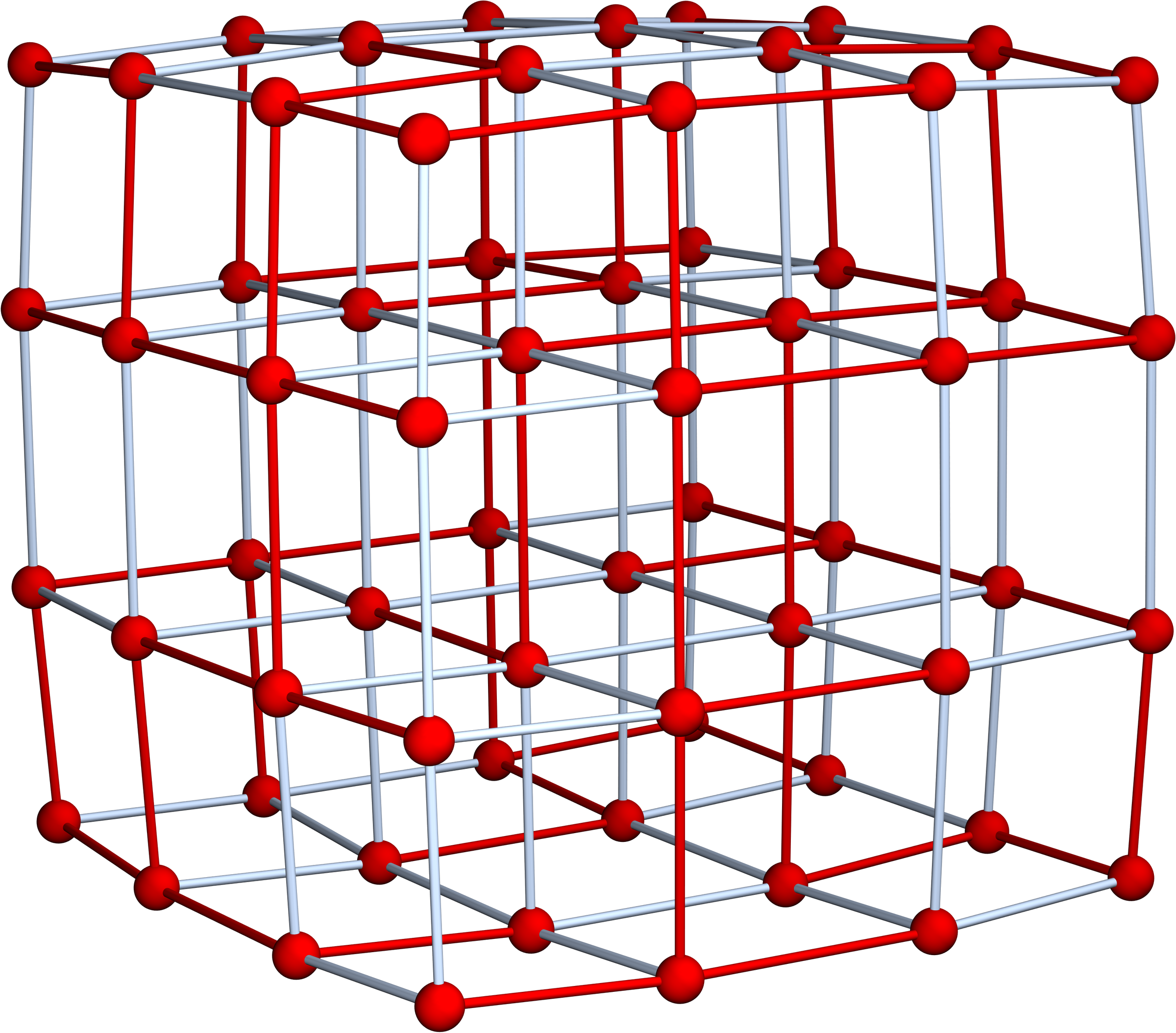
We looked in the first lecture at the mathematics of Mazes. Here is an other scene from the movie Labyrinth 1986 in which a maze plays an important role. In class we first defined a maze as a spanning tree G in a network K and learned a lemma telling that the number of nodes of a tree is always one larger than then number of edge. Then we defined the dual spanning tree G' of the dual network K'. Since V + F = V(G) + V(G') = E(G)+1 + E(G')+1 E(G)+ E(G') = E(K) and V(G')=F, we have V-E+F=2 which is the Euler Gem formula. In class, we illustrated this with a spanning tree in a cube graph.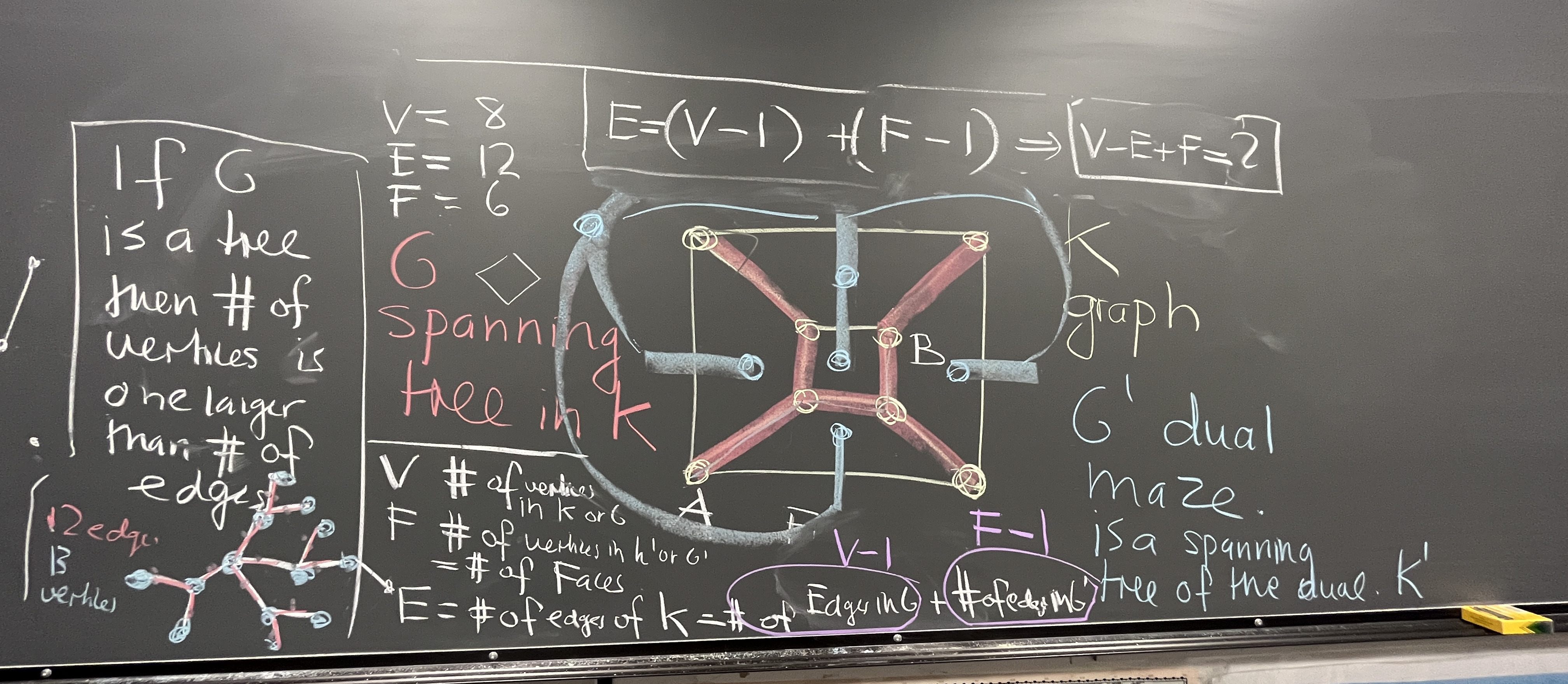
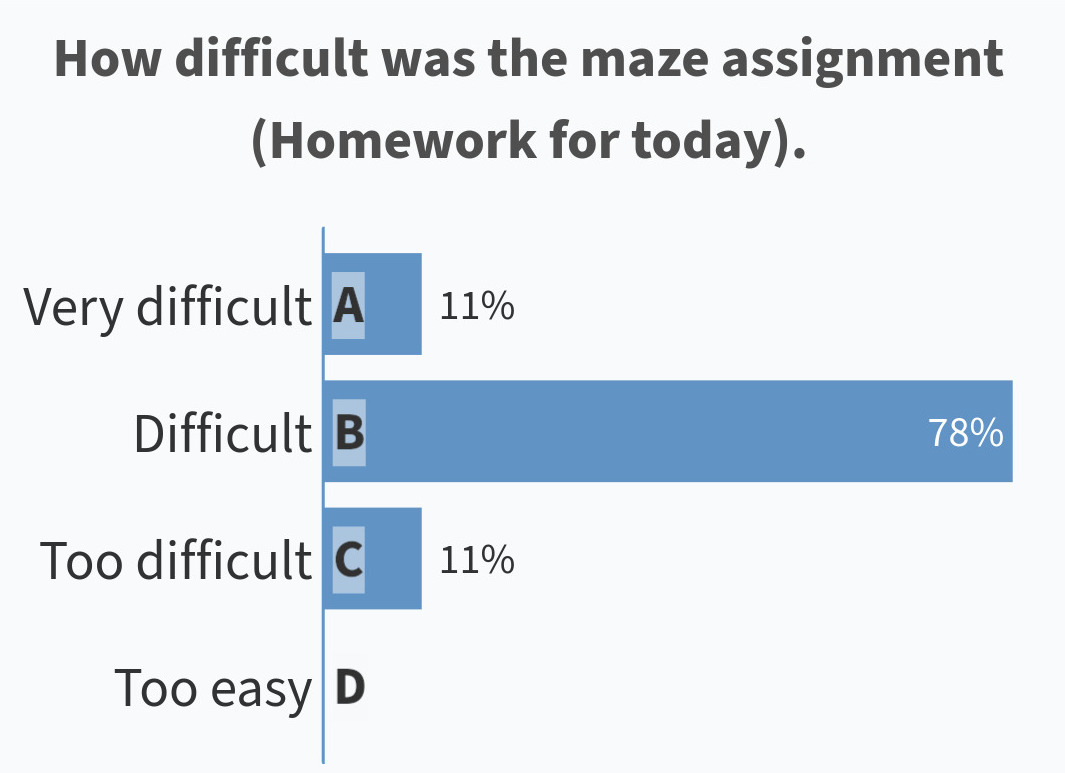 The maze assignment has been considered difficult (see poll)
which makes sense: our approach to mazes is quite original and one can not just
look it up. Mazes have come up in my own work on
analytic torsion for networks. For networks which are two dimensional spheres
the torsion turns out to be V/F, where V is the number of vertices and F is the number of
faces. For two dimensional spheres, one has the Euler relation V-E+F=2, which will be discussed
more in the topology lecture. I talked about the maze theorem here. It is not quite high school
level yet as it also deals with matrices and determinants but the result is very accessible:
let me try to explain the story in words.
The maze assignment has been considered difficult (see poll)
which makes sense: our approach to mazes is quite original and one can not just
look it up. Mazes have come up in my own work on
analytic torsion for networks. For networks which are two dimensional spheres
the torsion turns out to be V/F, where V is the number of vertices and F is the number of
faces. For two dimensional spheres, one has the Euler relation V-E+F=2, which will be discussed
more in the topology lecture. I talked about the maze theorem here. It is not quite high school
level yet as it also deals with matrices and determinants but the result is very accessible:
let me try to explain the story in words.
A finite simple graph is also considered a network. This is a geometric object which does not need any explanation. It is burned into our brains already as little kids. We know street networks, we play ``connecting the dots" games as tiny little kids. But this structure produces an extremely powerful geometry, much more so than say our two or three dimensional space. With networks we can describe any compact topological space using finitely many nodes placed so close that it fits our need for accuracy. Take any surface like a balloon. We think of it as a two dimensional surface which resembles the good old Euclidean plane but it is made of latex, which consists of polymer molecule structures which themselves are networks of atoms. Working with networks is not only what nature does when building up our world, it is also mathematically more honest to deal with finite data and not pretending there exists an infinity. We can never look at infinite structures. Infinity is an idealization which we use to make the mathematics easier. We will discuss infinity in the lecture on logic. But lets get to the reason, I'm interested in ``mazes":
A group of nodes which are all linked together is called a clique. Geometers call this a ``simplex". If we assign functions to these cliques, we get ``fields". This is quite physical. Assigning numbers to nodes produce potentials, assigning numbers to edges produces vector potentials like the electro magnetic potential, assigning numbers to triangles produces vector fields like the electro-magnetic field like ``light". Then there is a notion of derivative d which assigns from fields on k-node cliques a field on (k+1) node cliques. For example, given an edge (a,b) and a function f on the vertices, the derivative is f(b)-f(a). It is the change when going from a to b. This is called the ``gradient". If f would be pressure, then df would be the pressure gradient, telling how much the pressure changes when going from a to b. There is also the adjoint d* which goes backwards. If f is a function on edges for example and x is a node than d* f is the divergence of f. It adds up all the changes which go into f and gives the net change. In an electric network for example, where f is the current going through the edges = wires, the divergence at every node is zero because no electricity leaks. The same would be the case for a sewage water network. These notions are very fundamental. The electro-magnetic field (=``light") on a network for example is a function F on triangles. The Maxwell equations tell that dF =0 and d^* F = j, where j is called the current, a function on edges. Think of j incorporating both charges and electric fields. actually happens for nice networks like two-dimensional spheres is that dF=0 implies F=dA, where A is the electromagnetic potential which can be chosen to satisfy d*A = 0 (Coulomb gauge). Then, L A = d* d + d d* A =j which is called the Poisson equation. If there is no electric charge, nor any current then L A = 0, which is the wave equation. The solution A defines consists of electromagnetic waves and F=dA is the electromagnetic field. This formalism is mathematically the same which one uses when describing electromagnetic waves in 4-dimensional space but it happens on a rather arbitrary networks. Just to say also gravity has its best formulation as L φ = σ where σ is the mass density, a function on nodes and φ is the gravitational potential. Then F = dφ is the gravitational field. This gives d* d φ = L φ. This description in the continuum leads in three dimensional space immediately to the Newton law telling that the strength of the gravitational field decays like 1/distance. But again, this gravitational frame work is already built in on any network. The point is that given a network, we have for each level k a Laplacian Lk. When looking on level 0, meaning the level of nodes, one has the gravitational frame work. The Laplacian L0 has been defined already in the 1840ies by Kirchhoff. The Laplacian L1 which operates on the level of edges leads to the electromagnetic frame work. Now comes a bit of algebra: the determinant of a matrix L is the product of the eigenvalues of L. If we take the product of the non-zero eigenvalues, we get the pseudo determinant Det. This is important for networks. The pseudo determinant Det(L0) of L0 is the number of rooted trees in a network. Rooted means that we take a tree and single out one of the nodes to make it the base (root) of the tree. As there are V nodes, Det(L0)/V is the number of trees in a network. This is the famous matrix tree theorem, going back to Cayley and also to the mid 19th century. Now comes a symmetry which has been found only in the second half of the 20th century. It is called super symmetry. The term ``Super" means that we ``Super count" instead of simply ``Count". If we have objects which have even or odd nature, we can add up the number of even ones and subtract the number of odd ones. We will come to that when looking at polyhedra but already Rene Descartes has super counted simplices in polyhedra. Add up the zero and two dimensional ones and subtract the odd dimensional ones. The famous formula V-E+F = 2 tells that the super count of simplices in a polyhedron gives 2, the Euler characteristic. Given the matrices Lk we can super count eigenvalues which is called ``super trace" or supercount products which is the ``super determinant". One of the amazing consequences of super symmetry is that in full generality, the super pseudo determinant of the matrices L defined on the various cliques levels is always 1. This means Det(L0) Det(L2)/Det(L1) = 1 The analytic torsion Det(L1)/(Det(L0)0 Det(L2)2) can be written as det(L2)/det(L0)) which is the number of rooted trees in the dual graph divided by the number of rooted trees in the graph. As the number of trees in the dual graph and graph agree, this reduces to V/F. It is quite an amazing story, not only because mazes appear but because various symmetries and centuries of mathematics have appeared: duality notions going back to the Greeks, super symmetry notions coming up in the second half of the 20th century as well as tree dualities which depend on topological notions like the Jordan curve theorem.
Some previous blogs: 2021, 2017, 2016, 2015 (fall), 2015 (spring), 2014, 2013, 2012, 2011, 2010.
- I could no more identify the following figure in the list of animated people.
It is Thales of Miletus 624 BC - 547 BC.
Actually, a guess how Thales could have looked like.
See the Mac Tutor biography


