



Blog from 2026
Again chronologically.- The Simpsons paradox is based on a simple arithmetic paradoxon that (a+e)/(b+f) < (c+g)/(d+h) can coexist with a/b > c/d and e/f > g/h. You can have situations where you split up data into two groups and get a different narrative than if the data are combined. We are in a replication crisis in data driven parts of science, and there is no surprise. The lesson we learned is that one has to publish all raw data and not just conclusions or because some expert tells "because I told you so". This especially applies to policy driving science, especially in health care and sociology. One can not just cherry pick and chose a partition of the data which supports the narrative. Such fallacies are often only detected by the wisdom of crowds. In the last couple of years, we have learned to distrust so called "experts" and rightly so, especially if they support censoring other point of views. Public trust in science is at a low (and deservedly so, as one has to lament). An "expert" in some field like virology is not necessarily also an expert in statistics or economics. And even as an expert in statistics, it is possible to make fundamental mistakes. As a mathematician, I know that I can make mistakes and I often do, especially in probabilistic settings. Sometimes, there are different models that can coexist. This is illustrated in Bertrand's paradox. Having done mathematics for 40 years in a professional capacity does not prevent me from falling into traps. Statistics can be tricky. Probability theory can be counter intuitive. It is necessary to be aware of the pitfalls and allow discussions. And in order for studies to be verified and reproduced, it is necessary to include all data and code. If data are split into categories, it is still important to look also at the overall data.
- Volume of balls and spheres in one minute. The result is almost
selfevident when looking at the recursion B(n) = S(n-1)/n (integrate with respect to r) and S(n) = 2π B(n-1)
(use the Archimedes area preserving cylinder projection map from the sphere S(n) to the cylinder S(1) x B(n-1) ).
The use the induction assumption B(0)=1 and S(0)=2 to get the general result. Once one can understand it, this is a
one minute task, as the short video demonstrates.
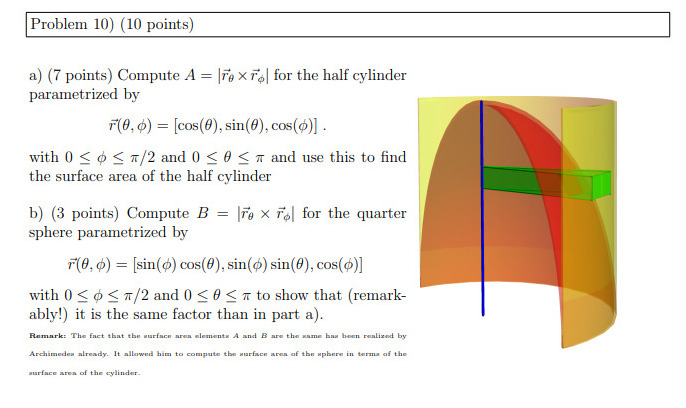
[Side remark: I had used the Archimedes trick to compute the surface area of the sphere maybe since our
Thinking like Archimedes [PDF] project
with Liz Slavkovsky from 2013. Also in exams:
this practice exam from 2021
Problem 10. (It was written earlier I used to rotate the practice exam problems
every year and write new exam problems every year. I had taught in the summer school from 2002 to 2025 for 24 summers
in a row and it had always been a "on campus" course, except for
2020 and
2021, where the pandemic had forced the course
online for two summers. It had been an interesting experience to teach also larger courses online.
In 2021, smaller summaries were
added cover the entire course in less than 2 hours. There still were 6 hours of Zoom classes every week.
This year, the summer school will have maths21a with an online component which will of course boost enrollment
and so profit significantly. For me was no more an option and having taught it 24 times in a row,is maybe enough
even so I had enjoyed also the last
course from 2025 very much.
I will definitely miss this course. In the age of AI, online teaching that counts for credit looks like a dead end to me.
I predict that the course will no more be eligible for credit an other universities (or even at Harvard), once
one will realize that online testing in a competitive setting
does not work. I feel that in a time of AI, it is necessary to test in person if the stakes are higher
(many of these students will apply for colleges and need letters of recommendations).
The problem with hybrid options is that there
is a two-tear system. Students who are on campus are of in a huge disadvantage and can get frustrated by
"supernatural students" online. Of course, it still makes sense to have online courses, especially for
small courses like my extension classes, where the online teaching was possible.
Also offering online courses for larger classes can make sense, if it is low stakes. I have taken in high school already an online
(TV based) course in electronics; but I had not been tested in person and it was not for any credit. That is going to happen with the
large online courses like CS 50 or now MathS21a. The course will be taken "for fun" and not "for credit".
Also in the math for teaching program, teaching in person had been nicer and more rewarding. Online teaching worked also worked quite
well there, as the students are highly motivated (mostly adults) and as they were not under pressure to be "the best". The worst experience
for me had been "hybrid versions" which I did for a couple of years. And students would (especially in winter with snow) opt for
seeing it online. There is a fundamental difference to see something in person or just watch it on youtube.
(Also in a concert, movie or theater). I never, ever had the same experiences with online talks than when
seeing a person talk live. I still remember most talks and classes from college I had been physically present. I forgot most things I have
seen only in a web-browser or where I only read the notes. ]
- A list of 10 paradoxa (we discussed such paradoxa in the second lecture of this course). We looked at the vitali example (a video from 2025) in the first class.
- The Curlicue animation which was shown at the start of the semester on this page. I had programmed it in 2015. The mathematics is very interesting and has relations with dynamical systems theory, with dependent stochastic processes. I got interested in that in the context of Birkhoff sums (2012) which are stationary stochastic processes for which one does not assume independence. Every stationary stochastic process (a sequence of random variables that have the same distribution) is given by a dynamical system. There is a probability space, an automorphism of this space and a single random variable f, such that X(k) = f(Tk). The law of large numbers now generalizes to this if the automorphism is ergodic. Ergodicity means that every event that is fixed by the automorphism either has measure 0 or 1. Ergodicity can be quite weak. An irrational rotation on the circle for example is ergodic. It is far from producing independent random variables however. See also my mostly expository golden rotations talk from 2015 .
Blog from 2025
- Is it true that if X,Y are independent, then X+Y, X-Y are independent? We will discuss this a bit in class both in discrete and continuous settings.
- Also during discussions, the question came up whether any pair of sets A,B that are independent in the product probability space [0,1] x [0,1] must be of the form A = U x [0,1], B=[0,1] x V or be of the form A=U x [0,1], B=V x [0,1] with independent U,V in [0,1] or of the form A=[0,1] x U and B=[0,1] x V with independent U,V in [0,1]. In a continuum space, if we have positively correlated sets P[A cap B] > P[A] P[B] and negatively correlated sets P[A cap B] < P[A] P[B] then by the intermediate value theorem we can get uncorrelated sets by interpolation. If we require the deformation to be translation there can be rigidity: take any two disjoint disks A,B of the same radius in the square [0,1] x [0,1] for example. Their intersection has measure 0. By moving one to the other, we achieve A=B and P[A cap B] = P[A] greater than P[A] P[B] But if we have two congruent sets that are disjoint, P[A cap B] = 0 smaller than P[A] P[B]. By the intermediate value theorem, there is a moment during the deformation for which P[A cap B] = P[A] P[B]. Maya looked at the problem which rectangles work and it turns out that we can take arbitrary rectangles A = U x V, B = P x Q in the square [0,1] x [0,1] which can be made independent by moving them around in the square. Not all shapes work however. If A=B is the inscribed disk in [0,1] x [0,1], then we can not shift things around. Oliver looked at the combinatorial problem of which subsets of {1,2,..,n} x {1,...,n} are independent. There are M=2(n2) subsets and M(M-1)/2 possible pairs of subsets. For n=3 and n=4, no sets were found which are not of the form A = U x {1,2,...,n}, B = {1,2,...,n} x V or A= U x {1,2,...,n}, B=V x {1,2.,..,n}, where U,V are already independent in {1,2,...,n} like U={1,2}, V={2,3} in {1,2,3,4}. It looks like an interesting combinatorial problem to see how many independent pairs of subsets there are in a finite uniform probability space (Omega ={1,2,3,...,n}, 2Omega,P[A]=|A|/n).
- We discussed once whether there are Dynkin systems (=λ-systems) that are not σ-algebras. The line of thoughts were:
in a Dynkin system we can take complements and nested unions and so take arbitrary unions. With arbitrary unions we can take
intersections as A intersected B is the complement of the union of the complements of A and B.
The key part missed in this was cleared up by Maya: having closure under the union of a
nested sequence of sets is not equivalent to have the arbitrary union. (There had been a question in
class about this (I think it was Max) and I had told then that taking arbitrary union could be derived from
nested unions. This is not correct however.
Here is an example of a Dynkin system that is not a sigma algebra. It is the set of half infinite or double infinite intervals in the real line. That is I = { (a,b) or [a,b) or (a,b] where either a or b is infinite. } This is a Dynkin system as an arbitrary nested sequence of sets in this system is still in the system and because the complement of a set is in the system and because Omega=(-infty,infty) is in the system. But it is not a sigma algebra. It is not even a pi-system. - Here is Mathematica recursion to compute the volume of
an n dimensional ball and n dimensional sphere (always radius r=1).
This appeared in HW 1.
What happens is that one can differentiate the formula for the ball with respect to r
to get the sphere volume. This gives S(n-1) = n B(n). For example,
d/dr 4 π r3/3 = 4 π r2. Then one can integrate
up balls to get the sphere. For example, a circle is 2pi times the volume 1 of a 0-ball
or a 2-sphere is 2pi times the volume 2 of a 1-ball.
B[n_]:=S[n-1]/n; S[n_]:=2Pi B[n-1]; S[0_]:=2; B[0_]:=1;
It is simply amazing is that both the volume of n dimensional balls and spheres goes after peaking around dimension 5 (rsp 6) to zero very rapidly. Large dimensional balls are tiny! Here is the page from my notes showing this "inflation phenomenon". From Lecture 26 of Math 22 PDF:
Game=Tuples[Range[3], 4];
Hands=Subsets[Game,{3}];
M[x_,y_]:=If[x==y,x,Complement[Range[3],{x,y}]];
P[X_,Y_]:=Flatten[Table[M[X[[k]],Y[[k]]],{k,4}]];
SetQ[{X_,Y_,Z_}]:=P[X,Y]==Z;
Sets=Select[Hands,SetQ[#] &];
Length[Sets]/Length[Hands]
|