Noam's Mathematical Miscellany:
Geometrical morsels
A5:
New observations on an old puzzle
cos1, cos2: Dissections showing the Law of Cosines
c2 = a2 + b2 - 2ab cos C
for a triangle with an obtuse
(PS,
PDF)
or acute
(PS,
PDF)
angle at C. In the former case,
attach two copies of the triangle to a square on side c,
then translate and remove them so the remaining area
can be dissected into squares on sides a,b and two parallelograms
each of area -ab cos C.
In the latter case, attach two parallelograms of area
ab cos C and three copies of the triangle
to a square on side c, then translate and remove the triangles
to leave behind disjoint squares on sides a,b.
Either of these generalizes an ancient dissection picture
for the Pythagorean theorem, which can be recovered
by making C a right angle.
Added Feb.2004: not surprisingly,
it turns out that I was not the first to discover these dissections
when I found them about 10 years ago -- at least in the obtuse case,
where one doesn't need to borrow a third triangle.
Douglas Rogers writes:
Here is an appearance from
Math. Gaz., 12 (1924-1925), 107,
I happen to have on file.
As a tiling pattern, this picture has a long history:
Leonhard Sohncke has it in connection with his crystallographic studies
in Crelle's Journal in 1873 (mentioned, for example,
in the book of Granbaum and Shephard on tilings, in 1987);
but as a floor pattern it may well be very early.
[...] For more on this dissection for the Law of Cosines,
do please see Greg Frederickson's book
Dissections: Plain and Fancy, pp. 38-39,
where he cites work of Rudolf Hunger and Erwin Dintzl
(the book was reissued in paperback in 2003
by the Cambridge University Press).
rect1, rect2: Beware of dissection proofs!
This picture
purports to show the same two pairs of triangles
fit into the same 9-by-20 rectangle in four ways,
in each case with two rectangles left over.
In each case, then, the sum of the two rectangles' areas
should be the difference between 9*20 and the sum of the areas
of the four triangles. But in each of the four dissections,
the rectangles have a different total sum: 88, 89, 90, 91.
Here the two rectangles
of area 44 are decomposed into five polyominoes that can be recombined
to form the remaining rectangle pairs with one, two, or three
unit-square holes. Do we have a proof that 88=89=90=91?
The 88=89=90 part is a known doubling of an illusion
that goes back to Dudeney. In February 2004,
Joe Buhler showed me a physical realization by
Helaman Ferguson:
an 8-by-21 rectangle that can be filled by four triangles and a number
of polyominoes, leaving room for zero, one, or two unit squares.
While trying to fit the second square in, I tried a configuration
that corresponds to the fourth picture, and failed miserably;
but the next day I found that this variation with a 9-by-20 works.
Puzzles
[See also the “quickie” in the section of one-page papers.]
- Natural numbers a,b,c,d between 1 and a xillion
are chosen at random, with each of the xillion-to-the-fourth-power
possible quadruples equally likely. What is the probability that
gcd(a,b)=gcd(c,d) ?
SOLUTION
- Circles C and C' meet at points P and Q.
A line tangent to both circles meets them at points A and A'.
Consider the triangle T whose vertices are P, Q,
and the midpoint of the line segment AA'.
Given the radii r and r' of C and C',
how large can the area of T be?
SOLUTION
- Using each of digits 1, 2, 3 once, and only
basic arithmetic operations, write a formula for 19.
(The only "basic arithmetic operations" here are
add/subtract/divide/multiply, powers and roots, and factorials;
in particular, no decimals or greatest-integer functions.)
SOLUTION
- If that was too easy (or too silly),
use 2, 5, 7 and basic arithmetic to write 181.
SOLUTION
- If 32 Knights are placed on all the light squares of a
standard 8-by-8 chess board, no two Knights observe each other.
Likewise, of course, if we use all the dark squares instead.
It has long been known that 32 is the maximum,
and that those are the only configurations that attain it
[Newman, Patenaude, and Greenberg: Problem E1585 and solutions,
Amer. Math. Monthly 71, Feb.1964].
A) Instead of requiring each Knight to be unobserved, suppose
we relax the condition by allowing each Knight to be either
unobserved or observed by just one other Knight.
How many Knights can the 8-by-8 board accommodate now?
B) What if we require that each Knight be observed by
exactly one other Knight?
SOLUTION
- [From a recent Mathematics GRE]
Is there a well-ordered uncountable set of real numbers?
(Recall that a set is well-ordered when every nonempty subset
has a least element. That is, S is well-ordered when every
nonempty subset S' of S has an element x smaller than every other
element of S'. Every finite set is well-ordered.
The classic example of an infinite well-ordered set is {1,2,3,...},
which is infinite but of course only countable.)
SOLUTION
- [A problem I contributed to the 1988 Qualifying Exam at Harvard]
Prove that a finite group of 8k elements (k=1,2,3,...)
must have at least five conjugacy classes.
SOLUTION
- For positive x<1, consider the alternating sum
S(x) =
x -
x2 +
x4 -
x8 +
x16 -
x32 + - ...
Does S(x) approach a limit
as x approaches 1 from below,
and if so what is this limit?
SOLUTION
- The following picture
appeared without explanation on a web page
for John Derbyshire's
Prime Obsession.
What does it represent?
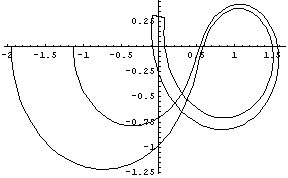
SOLUTION
- A unit cube has twelve pairs of vertices at distance 1 (the sides)
and four pairs at distance 31/2 (the body diagonals).
Must every of eight points with the same configuration of
twelve unit distances and 4 distances of 31/2
be a unit cube? (NB it is not required that
the remaining twelve distancess equal 21/2.)
SOLUTION
- Round to the nearest integer:
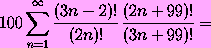
 SOLUTION
- What does each of the following pairs share
(besides having the same sum)?
| (3, 3, 12) |
= |
(1, 8, 9) |
| (4, 8, 9, 21) |
= |
(3, 7, 14, 18) |
| (4, 7, 21, 36) |
= |
(1, 12, 27, 28) |
| (5, 7, 10, 14, 27) |
= |
(3, 6, 15, 18, 21) |
| (5, 85, 85, 169, 425) |
= |
(13, 17, 125, 289, 325) |
| (17, 21, 24, 48, 54, 238) |
= |
(3, 4, 14, 119, 126, 136) |
SOLUTION
- (In honor of Elwyn Berlekamp and the
Mathematical Sciences
Research Institute) Solve the cryptarithm
MS / RI = .ELWYNELWYNELWYNELWYN...
[That is, find distinct digits M,S,R,I,E,L,W,Y,N that make
MS/RI=.ELWYNELWYNELWYNELWYN... a true equation.]
SOLUTION
PostScript tricks
eratosthenes:
Runs the Sieve of Eratosthenes to find and print all primes up to 2000.
(Here's the short PostScript file
to prove I'm not cheating.)
expsum:
A surprisingly short
PostScript file to generate this picture;
go
here for the explanation.
ford:
A PostScript file that recursively draws Ford circles: a system
of non-overlapping circles each tangent to infinitely many others
and to a given line. (The line and Ford circles are in black;
see below for the blue semicircles.) You can inspect the
Postscript file to see that I'm actually
recursing rather than getting the circles from a formula (see below)
or list. Suitable arcs on these circles are used
as contours of integration in obtaining Rademacher's series
for the partition function and related formulas.
If the line segment is identified with the interval [0,1],
the circles are tangent to the segment at the Farey fractions m/n
and have diameters 1/n2.
The blue semicircles are orthogonal to the Ford circles
at their points of tangency. If we identify the right half-plane
with the Poincaré model of the hyperbolic plane,
the blue semicircles become hyperbolic lines,
and the Ford circles are horocycles.
gasket1,
gasket2:
A similar but more complicated recursion.
These PostScript files recursively draw Apollonian gaskets
(gasket1 with trilateral symmetry,
gasket2 showing a closeup of a three-cornered wedge).
Again you can consult the PostScript files
here and here
to see that I'm actually recursing
rather than specifying each circle's position individually.
To draw more and smaller circles, increase the threshold M
(currently 150).
1dca:
Henry Cohn's PostScript code for pictures
of 1-dimensional cellular automata. For instance,
this file shows the mysterious
“Rule 30” in action.
One-page papers
A8:
The isomorphism between the groups
GL4(Z/2Z)
and A8 via the projective plane of order 2.
LaTeX, DVI, PDF
abel:
Elementary calculus proof of Abel's formula for the power series
of the inverse function of ye-y
and of arbitrary powers of this function
(which can also be obtained as a scaled limit from the next paper).
LaTeX, DVI, PDF
catalan:
Elementary calculus proof of the formula for the coefficients
of the power series of the inverse function of
y(1-y)t
(generalized Catalan numbers)
and of arbitrary powers of this function.
LaTeX, DVI, PDF
catalan2:
Yet another proof,
one that uses only basic power-series manipulations
(no derivatives, even), but at the expense of requiring that the answer
be known or guessed in advance.
LaTeX, DVI, PDF
Again a proof for Abel's formula can be obtained as a scaled limit;
the resulting argument was given by Richard Stanley in his
Enumerative Combinatorics (Volume 2, bottom of p.28),
and Stanley's method is the key ingredient in this proof for
the generalized Catalan numbers.
E8:
At an AIM workshop,
Griess asked for all known proofs of the result, apparently first proved
by Mordell in 1938, that the E8 root lattice is the unique
even unimodular lattice of rank 8 (the smallest rank possible).
I realized the next day that the n=8 case of my
characterization of the Zn lattice
could be used to construct yet another proof.
This proof is elementary except for the use of theta functions
in my Zn paper; even so, the argument
is arguably still simpler than in previous theta-function proofs.
LaTeX, DVI, PDF
hilbert:
The parametrization of Pythagorean triples (integer solutions of
x2 + y2 = z2)
as a special case of Hilbert's Theorem 90.
[The same method applies to
x2 + axy + by2 = z2
for any constants a, b
except those for which a2 - 4b
is a square; for instance, Hilbert 90 can be used to parametrize
rational triangles with a 60- or 120-degree angle.]
LaTeX, DVI, PDF
Thanks to F.Lemmermeyer for recognizing the Pythagorean case
of this proof from the beginning of Olga Taussky's “Sums of Squares”,
American Mathematical Monthly, Vol.77 (1970), 805-830.
Lemmermeyer notes that Ono gives the same proof in his book
Variations on a Theme of Euler: Quadratic Forms, Elliptic Curves
and Hopf Maps. There's no reference to O.Taussky there either,
so presumably Ono also discovered this independently.
hsgraph:
Outline of a different proof of existence and uniqueness of the
Hoffman-Singleton graph (the regular graph on 50 vertices
of degree 7, diameter 2, and girth 5).
LaTeX, DVI, PDF
innaz:
A different derivation of Euler's integral formula for n!,
by Inna Zakharevich (Harvard '06).
LaTeX, DVI, PDF
corrected 10/2003 to fix a typo spotted by David Leep;
fortunately the derivation is unaffected.
mahler:
A direct proof, using generating functions,
of Mahler's theorem on continuous p-adic maps.
LaTeX, DVI, PDF
pi10:
Why is Pi so close to the square root of 10?
[Published as a “boxed filler”
in the American Mathematical Monthly, Vol.110 #7
(Aug.-Sep. 2003), page 592]
LaTeX, DVI, PDF
quickie:
I proposed this problem to the American Math Monthly.
The Problems editor rejected it on the advice of both referees --
one of whom thought the problem unfairly difficult,
the other thought it trivial! What do you think?
LaTeX, DVI, PDF