Puzzle 11: Solution
Q
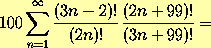
Round to the nearest integer:

A
Zero -- but only barely. This expression comes to
0.499999999999999999953396...
The n-th term in the sum is the integral from 0 to 1 of
cn(x(1-x)2)n(1-x)99dx/2x,
where cn=(3n-2)! / n!(2n-1)!
is the yn coefficient
of the expansion of x in powers of y=x(1-x)2.
Switching sum and integral (which is legitimate since all integrands
are positive), we seem to get 100 times the integral of
x(1-x)99dx/2x=(1-x)99dx/2,
which is 100/200 = 0.5 exactly.
But the sum of cnyn converges to x
only up to the critical point 1/3 of y(x). [At that point, y'(x)=0,
and y(x)=2/27 is the radius of convergence of the power series.]
For larger x, the series converges to some x'<x
which is the other positive solution of y(x')=y(x).
Therefore the integral is smaller than the expected 1/200.
The difference, however, is very small: it is the integral of
(x-x')(1-x)99dx/2x
over x in [1/3,1], where the integrand is always smaller than
3(2/3)99 -- which is tiny.
[In fact, since x-x'=0 at x=1/3, the integral turns out to be
several orders of magnitude smaller than (2/3)99:
approximately 2(2/3)100/1002.]
This explains why our original expression is just below 1/2.
In general, for M>0 the sum of
(3n-2)!(2n+M-1)! / (2n)!(3n+M-1)!
is less than 1/2M, but the difference decreases exponentially
as M grows, and is asymptotic to
2(2/3)M/M2;
and likewise for the sum of
((t+1)n-2)!(tn+M-1)! / (tn)!((t+1)n+M-1)!
for any t>0: it is less than 1/tM
by an amount that's asymptotically proportional to
(t / (t+1))M / M2.
The proof is similar, using the power series for the inverse function
of y(1-y)t.
This question is modeled on the following problem by Ramanujan
[Question 526 in the Journal of the Indian Mathematical Society
(VI,39), as reported in Ramanujan's Collected Papers
(Amer. Math. Society: Providence, 2000), p.329],
which Don Zagier told me some years ago and again at an Oberwolfach
meeting in 2003:
If M is positive shew that
1/M > 1/(M+1) + 1/(M+2)2
+ 3/(M+3)3 + 42/(M+4)4
+ 53/(M+5)5 + ... ;
and find approximately the difference when M is great.
Hence shew that
1/1001 + 1/10022 + 3/10033
+ 42/10044 + 53/10055 + ...
is less than 1/1000 by approximately 10-440.
[I renamed Ramanujan's parameter n as M so that n could be used
as a summation index.]
I did not find a solution in the Collected Papers.
The following solution should look familiar.
Each term nn-2/(M+n)n is the integral of
(nn-1/n!)(xe-x)ne-Mxdx/x
over the positive real axis.
This time nn-1/n! is the zn coefficient
of the expansion of x in powers of z=xe-x.
So we seem to get the integral of
xe-Mxdx/x=e-Mxdx,
which equals 1/M exactly; and indeed, if we expand each term
nn-2/(M+n)n in a power series in 1/M
and sum over n, then we get 1/M.
[Direct proof: for k>0, the M-k coefficient
is the (k-1)st finite difference
of the (k-2)nd degree polynomial nk-2.
In the same way it can be seen that the power series for
((t+1)n-2)!(tn+M-1)! / (tn)!((t+1)n+M-1)!
sum to 1/tM.] But this shows only that the difference between 1/M and
1/(M+1)+1/(M+2)2+3/(M+3)3+...
decreases faster than any power of 1/M.
Once more the punchline is the power series in z converges to x
only up to the critical point, which here is (x,z)=(1,1/e);
for x>1 the series converges to the other, smaller, positive solution
x' of z(x')=z(x). So the sum is smaller than 1/M, but only
by the integral of (x-x')e-Mxdx/x over x>1,
which is asymptotic to 2e-Me/M2 for large M,
and in particular is approximately 10-440 for M=1000.
Don Zagier also notes another devious pitfall in the Ramanujan series:
it doesn't converge nearly as fast as the first few terms suggest.
For large n we have
nn-2 / (M+n)n =
n-2 e-M
exp(M2/2n + O(M3/n2)),
so the terms quickly fall below exp(-M) but it takes about
eh terms to approximate the sum to within exp(-(M+h)).
This behavior, too, is shared by the terms
((t+1)n-2)!(tn+M-1)! / (tn)!((t+1)n+M-1)!
in our analogous sums above.