Computer science as a branch of mathematics:
The last lecture on computer science will be a rather pictorial overview over the history
of computing and computing devices. Computer science has always been close to mathematics.
History shows that Math-CS connections were always strong: the Antitykhera device already produced
a Fourier approximation of orbits of planets, Jost Bürgi (clocks or logarithm tables)
or Johannes Kepler (i.e. triquetrum, tellurium, or celestial globes) can be seen as analog computing devices
for astronomical purposes: Blaise Pascal and Gottfried Leibniz (both prototypical pure mathematicians)
have built mechanical computers, John von Neumann or Alan Turing which were pure mathematician at their time,
are pioneers in computer science. Their names entered nomenclature like the
von Neumann architecture
which is a more practical version of what Turing designed.
The Turing proof that the Halting problem can not
be solved parallels Gödels proof of the incompleteness theorem. Turing's work was 7 years after Goedels but
is much simpler and started the field of Computability theory.
History of computer hardware:
the actual exposition for lecture 13 has always also been rather personal. I have owned close to
100 computing devices and at this very moment, there are 10 computing devices in a 1 meter vicinity of me.
They are used both by me and my wife:
3 linux computers, 4 macs, 2 phones, 2 ipads, an apple watch) and a couple of others in decommission (maybe an other 10, laptops, ipads,
old working but obsolete, there are others in the closet, some machines never died and were decommissioned after working, sometimes
for a decade even (Next or Sun workstations).
My first real computing device I owned was a TI57, which was programmed in an assembler type
language by placing numerical values into memory units. One of my high school buddy, Daniel Stieger (who had been in a parallel class)
had at that time figured out how to reprogram the EPROM of these devices so that we we were able to rewrite the
basic operations of the machine. Early jailbreaking! Pushing the cos button would run a different program.
For the TI59 it was then possible to store things on magnetic strips.
In high school classes, we had programs for any type of physics problems. Exams were easy to do using these devices.
I also did surgery on a TI59 adding a joy stick and an
interface for controlling lights in my room. This was the internet of things in the 1970ies!
When PC like computers came, hacking did not stop, we would for example change the dialogues of computer games
by Hex-editing the binary.
Programming languages:
I might also mention programming languages. It is good to be fluent in as many as possible. This website for example
is written in a combination of Perl and Shell scripts (old but extremely reliable and trusty
technology used also for Rhetorik.ch and
Rheinfall.com where were build similarly from scratch and are up reliably
since 23 years with zero down time!
At the moment, I program mostly in Mathematica,
Povray, Javascript and shellscripts to automatize my workflows. For the prelecture, I counted the languages in which I have
worked with extensively and it is certainly more than 20. I used even to write PS files directly,
like here.
I think to have programmed in about 100 languages, in dozens for hundreds of hours and for a dozen or so for
many thousands of hours. It is typical these days to use the right tool at the right time for the right thing.
When I had my first real computer (a TRS-clone with similar capabilities like the Commodore), the only thing
you could do with the computer is to program in Basic. I used this machine for all the computations
done for this project on Partitions of
numbers. Now, we have a lot of choices to program and the idea to use only one frame work is completely
ridiculous.
Operating systems:
Diversity has also entered operating systems. We are not aware that we use different operating systems any more
as they are very similar. Operating systems can be emulated by others. The only really important thing is to have an
extremely stable platform which does not bother you and where you have control about every little thing.
I myself use linux as a platform for most tasks like writing this blog, use the mac for
video stuff, the phone and ipad for communication, the iwatch. Then there are operating systems built into cameras
and drones. Finally, one can emulate other operating systems (I have used VMware, parallels or now mostly Wine
to execute windows binaries). The actual structure of the operating
system has become less and less important as we can run other systems on it. I still do most things on the
command line and do not rely on visual interfaces. This means for example that I can have work flows on the commandline
which look exactly the same than when I was a freshmen math student who would telnet to Cern (browsers like Mosaik would
come only 10 years later!) or telnet to printers to print.
Working with primitive tools much much faster, as it can also be automatized. I type ``make"
in a folder containing my course and the documents are compiled by latex and then updated on the website without further
intervention. I used to write email even from the command line until we switched away from our own mail servers.
Communication has become more and more complex as more people use it. Algorithms have to deal with spam for example.
As a student, we could still use the unit ``talk" to write directly to any other unix user. Completely unthinkable today.
Lecture 12: Dynamical systems
In the second last lecture, we look at dynamical systems. The theory of dynamical systems
is the theory of ``time" and ``time evolutions". As illustrated during lecture there is a huge fascination with
the concept of ``time":
For a mathematician, time is just an operation of natural numbers or positive real axes on a space. For every integer
or real number we get the position x(t) at time t.
We either have a discrete rule which maps a state x to a new state T(x) or then we have a differential equation which produces a continuous deformation x(t) of the state. In the first case, time consists of the natural numbers, in the second case, time is the positive real axes. Sometimes, dynamical systems also can be reversed but most of the time we can not. The motion of the planets or the Schroedinger evolution of a quantum state are
examples which can be reversed. Other systems like heat evolution, diffusion or many number theoretical evolutions like the Collatz map T(x)=x/2 if x is even and T(x)=3x+1 if x is odd are not reversible.
Especially intriguing when looking at time evolutions is that even so everything is completely
deterministic, the system can produce chaos: the system can be proven to generate randomness.
A prototype is T(x) = 4x(1-x), which is a map on the interval [0,1]. If you apply this map
T for 60 times on a starting number like x=0.4, then the outcome is different than if you use
the map S(x) = 4x-4x2 with the same starting number. While T(x)=S(x), obviously, it
is no more true that T60(x) = S^60(x) if you compute this on a computer.
You can try this out with this Desmos
applet I have written for a data project in
this single variable course. Go to that applet, you see that
T60(0.81) = 0.93295901419. If you change the function to S(x) = 4x-4x2,
then S60(0.81) = 0.451831018858. This is not a problem with Desmos. Any programming
language working with say 16 digit accuracy has this problem. The reason is that
the map T is chaotic. Its Kolmogorov Sinai entropy is Log(2) meaning that in average, errors
double in each step. Now, 260/1017 is larger than 1 meaning that a small
initial change (and a swap from T(x)=4x(1-x) to S(x) = 4x-4x2 produces such
variations on the level of the accuracy) produces an error which is macroscopic already after
60 steps. If we would use 100 digit accuracy for the computation, we would would see the same
after 330 iterations.
In the pre-lecture, we look at 10 dynamical systems and open problems. Some things appear already in a
talk on "intriguing open problems in Hamiltonian
dynamics from October 19, 2000 given in the beautiful town of Bozeman in Montana. Then, 20 years ago,
I had used Mathematica 4 and Povray 3.0. Now, things were done in Mathematica 12 and Povray 3.7. I made use of
some work done for the website dynamical-systems.org which I wrote in 1999. For Vlasov, see
this existence result or Section 5.4
in this book.
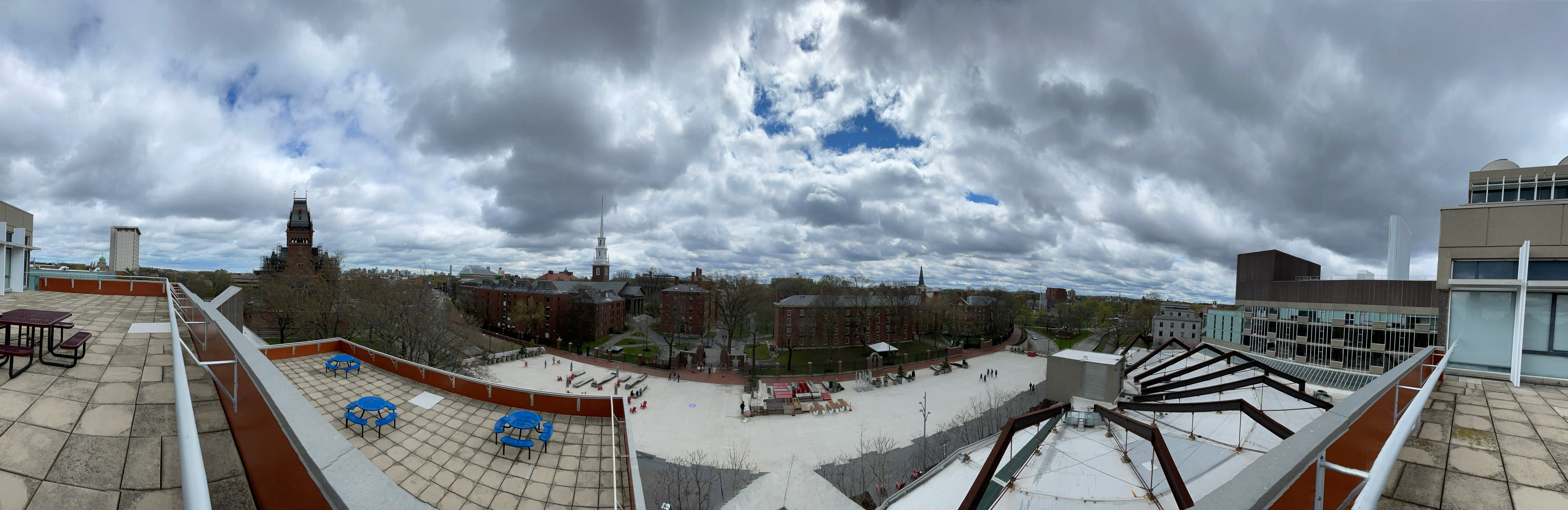
A panorama from the science center (click for a large 11K pixel panorama)
P.S. on a bit more meta level: I had been asked what the purpose of the pre-videos is.
One of the things I consider extremely important in teaching
is that one gets into a class not only prepared but also pepped up and energized, especially if one has
taught something a lot already.
This means starting to think about a subject several days before. Doing
these pre-lectures is for me also an opportunity to push the envelope in using technology for teaching.
This year, I explore especially the use of demonstration objects in video.
This has been done before for expensive TV productions. New is that it is possible today
to do this alone with relatively little short time (in this case maybe 40 hours of work for a 15 minutes of video,
with a 18 hour essentially non-stop finish done on Saturday for recording and cutting).
This is not counting the hundreds of hours of programming which in this case, as I reuse and reran with
better quality also code I have written over decades. This was done over a couple of days. Some of the animations
take hours to complete. The final movie (15 minutes) was 59 Gig big when submitted to youtube. The final cut directory
has 357 Gig (1/3 of a TByte). The source videos (which are kept separate are an additional 140 Gig. In total, this
small project alone covers 550 gig in my macmini (the cheapest version with 256 Gig harddrive which I had to buy in an
emergency, due to a machine failure). Of course, this requires
to work on external drives all the time. Since also the source files are large, the entire process needs to be
orchestrated, working on different things at the same time, like when waiting to render the 360 degree camera
stuff or then for copying the files. And then things need to be backed up as even modern stuff can have hick ups.
Like in rock climbing, where at any time two body
parts have to be on the rock, I keep at any moment of time always two copies. There is an exception just when recording
but that is, where the multiple cameras come in. Even in the case of an SD card or camera failure, the other camera footage could still
work. I don't have time for a second shot and a fixed time window in which this has to be done (we get access to
the department by preregistration and of course by testing). Why not at home? Well that needs negotiations with the partner.
Here is a Video of a coupled systems of oscillators,
found by Stephen.
Lecture 11: Cryptology
Cryptology is a part of mathematics which affects us daily. We will look at various encryption
systems. We use pretty much a chronological approach starting with simple alphabet swaps and reach modern
systems like RSA or DES.
Cryptology appears at first more to be something like
an engineering task. Indeed, crypto systems like
DES are rather arbitrary. However, more modern crypto systems which
are based on modular arithmetic are more natural, more beautiful,
more mathematical and related to fundamental questions in mathematics:
how fast can we factor integers in principle?
We currently do not know how to factor say a 1000 digit
integer that is the product of two 500 digit primes. An other unrelated
question is how fast we can solve the logarithm problem in a finite field:
if ax = b mod (p). How do we compute x = loga(b)?
Also this problem appears to be difficult and can not be tackled say for a
1000 digit prime p. Both of these problems are fundamental obstacles of
cracking RSA. The discrete log problem also appears in the Diffie-Hellman
key exchange system. Both of these fundamental problems are natural.
An other society on an other planet would probably come up with these systems
too. They would however very unlikely invent something as ugly as the
data encryption standard DES. There would be much more to cryptology.
The subject has moved much also to algebraic geometry with the advent of
elliptic curves as cryptosystems. The idea is the same. Rather than using
the multiplicative group of a finite field, one can use elliptic curves over
finite fields and do exactly the same. One can use elliptic curves also to
factor integers.
In the lecture, we look at 10 crypto systems
Crypto system
Discovery
Math
Polybius
300 BC
Alphabet swap
Scytale
700 BC
Scrambling of entire text
Caesar
70 BC
Alphabet permutation
Trithemius
1508
Polyalphabetic substitutions
Viginere
1553
Polyalphabetic with key
Ottendorf
1780
Book cypher (common reference)
Enigma
1918
Polyalphabetic with dynamic swap
RSA
1977
Modular arithmetic, Factoring
Diffie-Hellman
1976
Modular arithmetic, discrete log
DES
1970
Block cipher
Some comments on the video. The drone footage was also filmed on Saturday. The drone flew to the quad losing there connection
(it then starts to return by itself). The app complained about radar and other interferences.
Definitely, in urban areas, the flight distance can be dramatically reduced. The 5 mile distances seen on youtube videos
happen in relatively deserted areas.
[Something unrelated and a bit funny: youtube itself is a
crypto riddle. The ``like counter" does currently not work
on this one. I know that because some family members who are among the handful
of my ``fans" are not able to cast their vote on
this movie. Such an incidence doesn't boos confidence in
social media metrics. Of course, for me as a teacher this does
not matter as I just need to reach my students, but for a business,
metrics can be important.
How do we know social metrics work? In my case,
with single digit likes, I can experimentally check whether it does,
in general, we have to trust.
Here is a screen shot of the stuck counter.]
Lecture 10: Analysis
Analysis is a huge area of mathematics. It contains subfields like real and complex analysis
which is calculus using real or complex numbers, then Harmonic analysis which deals with
decompositions of functions into natural components, then partial differential equations which
looks at time evolutions of spacial extended objects, then functional analysis which deals
with spaces of functions containing typically very strange ones, like the Weierstrass curve as
an example of a continuous function. Then there is the calculus of variations which looks at
objects minimizing a quantity. Extremization is a principle on which one can build essentially
all laws we know describing nature. Sometimes these extrema are nice like sphere minimizing the
enclosed surface area for a fixed surface area. With some constraints the minima can already become
more interesting are in general not smooth any more and there are many extrema which are
of fractal nature, like the path traced by a lightening flash.
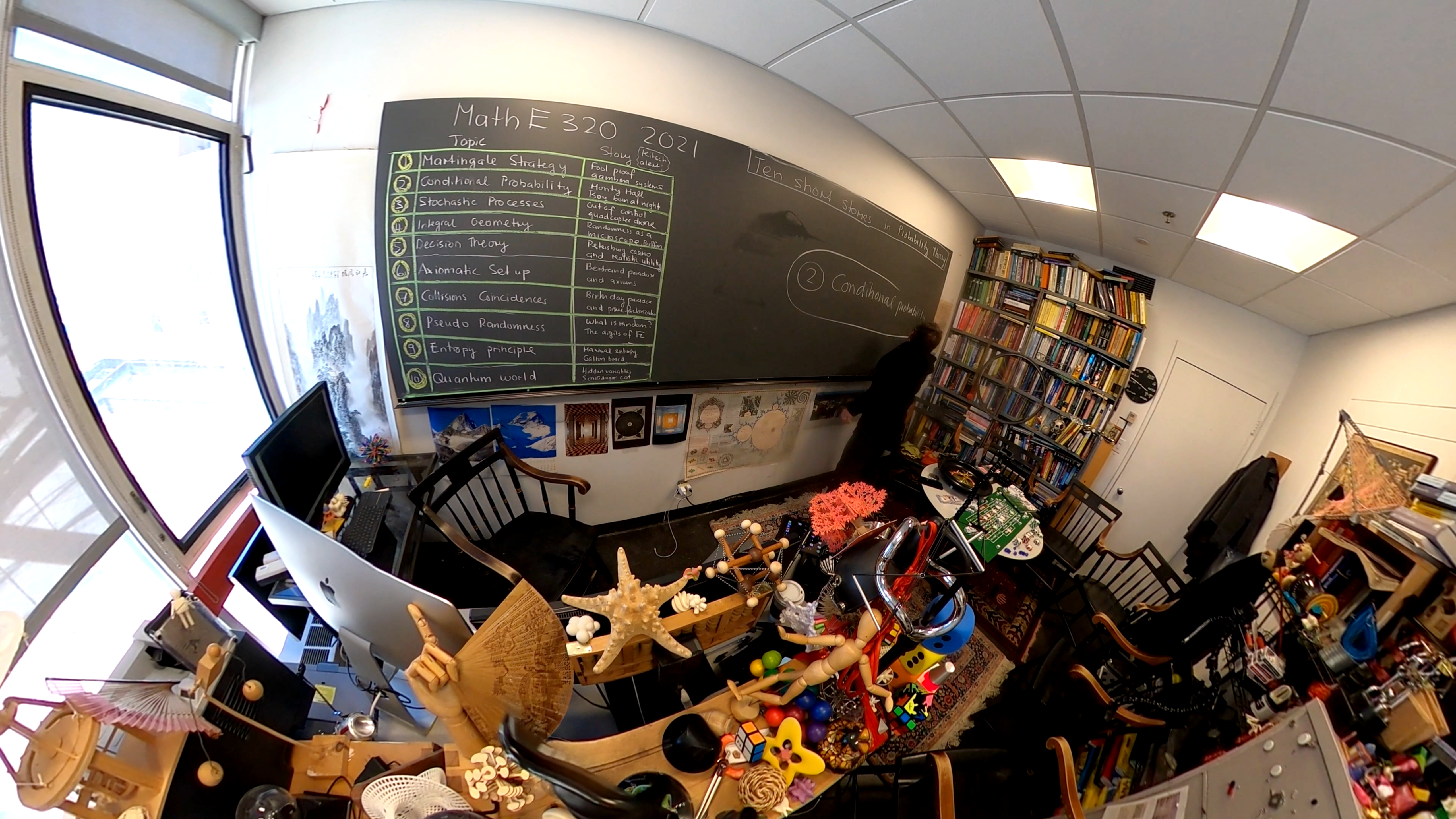
In the movie recorded on Easter in my office,
we cover 10 fractals:
Fractal
Discovery
Dimension
Math
1) Cantor-Smith Set
1874-1883
log(2)/log(3)
2-adic integers
2) Koch snowflake
1904
log(4)/log(3)
dimension theory
3) Sierpinski carpet
1916
log(8)/log(3)
universal for 2d curves
4) Menger sponge
1926
log(20)/log(3)
universal for 3d curves
5) Weierstrass function
1872
1-log(a)/log(b)
harmonic analysis
6) Lorenz attractor
1963
numerical 2.4
differential equations
7) Diffusion limited aggregation
1981
numerical 1.71
stochastic processes
8) Barnsley fern
1988
1.45
L-systesms, IFS
9) Mandelbrot set
1978-1980
2
Complex dynamics
10) Mandelbulb
1988-2009
?
Spherical geometry
There would have been many more to mention. Good to include would have been the Hofstadter butterfly,
the burning ship, the mandelbar, some Kleinian group fractal, some limiting perculation clusters,
some phase space fractal chaotic sea in Hamiltonian dynamics or the KAM attractor or then say
more about Brownian motion or cantor spectrum for operators. Well, maybe something for an other time.
In the description of the movie, we mention that Povray allows to compute the Mandelbrot set in 2 lines.
Here is an example:
It is a solution to the homework assignment to produce a picture of the Mandelbrot set.
I personally am a big fan of short code. A programming language needs to be designed in such a way
that one can do things with little amount of code and as little libraries. If possible no libraries
at all. I program since 45 years. Libraries are the main reason why programs start to fail, especially
after some time. An other poison is redesign of the language making standard things obsolete. Worse
even are small changes of routines. I love the programming language C, but already there, the use of
libraries can be a curse. Look at Hello World in C:
#include
int main() { printf("Hello, World!"); return 0; }
In comparison, the above two lines of Povray code produce a movie of the Mandelbrot set in which the
level surfaces and color are adapted to the zoom level. It places the mandelbrot set onto a plane and
then films it moving the camera closer and closer. Here is a 3 line code for Mathematica. It does not
produce a movie yet, but just a single frame:
In the topology lecture, we look at `rubber geometry".
Traditionally we have in this course focused class work on
polyhedra and Euler characteristic. This is not completely off.
The birth crib of topology are graphs (Koenigsberg bridge problem) and algebraic
topology essentially makes simplicial decomposition to a tool allowing to prove
things. Discrete approximations of the continuum are surprisingly
accessible, illustrated by the fact that Platonic solids were considered very early
in mathematics. So, rather than look at the 10 open problems like in number theory
or 10 miracles like in geometry or 10 results in set theory or 10 stories in probability
theory, we look at the 10 most beautiful objects in topology. Topology is closely
related to visual art.
1
sphere (hopf fibration as a visualizatiion of the 3-sphere)
2
torus (3d Torus visualization as the office with opposite sides identified)
3
polytopes (all 6 regular platonic 3-polytopes, 5,8,16,24,120 and 160 cells)
4
varieties (we see a Decic and a Calabi-Yau)
5
moebius strip (build it with clay)
6
klein bottle (we build it with pledo)
7
jordan curve (peano type case)
8
antoine's neckless (and alexander sphere)
9
knots (no knots in 4 dimensional space)
10
networks (graphs, we see 100 fullerene)
Here is a screen shot of a recording done in my office
and the board photo (click for larger versions):
Lecture 8: Probability theory
We look at probability theory. In number theory, the open problems
were most exciting, in set theory the theorems. In probability theory it is the
huge amount of popular stories which make it exciting. We tell
10 stories in 22 minutes:
Update May 16, 2021: Numberphile has a longer
20 minute video on the doubling strategy. One always points out that the odds for red and black are not
equal. But that does not skew the argument: You win with the Martingale strategy (in a mathematical sense)
also if the odds are 10 to 1 or a million to 1 against you!
You just always double until you win. The funny thing is that the topic is more psychological:
the martingale problem is obviously a mathematical problem but people always refer to the practical implementations (the bank
has a finite amount of money or betting limits). That is not the point. It is like you would argue the harmonic series
converges because it is not possible to get in any reasonable time to 1000 by counting up (which is also a practical
implementation. The silly fact is that there, the practical limitations are never pointed out.
The mathematical fact is that if the doubling strategy works and the math is very simple as the Numberphile video explains well.
There is an other interesting, more psychological point. I used in my video 100
dollars and not 1 pound like in the Numberphile video. But if you bet with 1000 dollars then you win with
a reasonable chance 1000 dollars within a few games. The chance of dying by some disease or having an accident
is bigger. Now, on a grand scale, the martingale strategy is used in finance all the time and if you gamble
with a lot of money, you also win big (usually!). There of course, the odds of losing are almost zero if you are attached
to a hedge fund with extremely fast efficient trading possibilities.
Built into the theory. God does not play dice? The Schroedinger bear.
Each of the stories might be a bit worn out by itself. But as a whole, the
collection however illustrates the richness of the theory. Let me mention something related:
humans assess risks or probabilities rather poorly in general. The concept of risk is at the heart of
probability theory, statistics and interpretation of data. Game theoretically it is the question how much we
want to pay for an expected item. In real life, we dismiss seemingly small risks which could be devastating
(like nuclear war, asteroid hit, climate change) and overestimate temporary risks (terrorism 911), communism (
McCarthy),
fear of foreign cultures (racism),
nuclear war in 1950ies (duck and cover)
or a rush into wars (usually
enthusiastically supported
by the population and also by news media). Probability theory allows to cut through this by
building models based on data gathered from history and experience.
For example, since nuclear weapons were put in place, there were several
close calls. In cases like
Able Archer
or Cuba,
there was one person standing between a nuclear catastrophe. We completely ignore such risks these days.
(Maybe not: there is just a story about this)
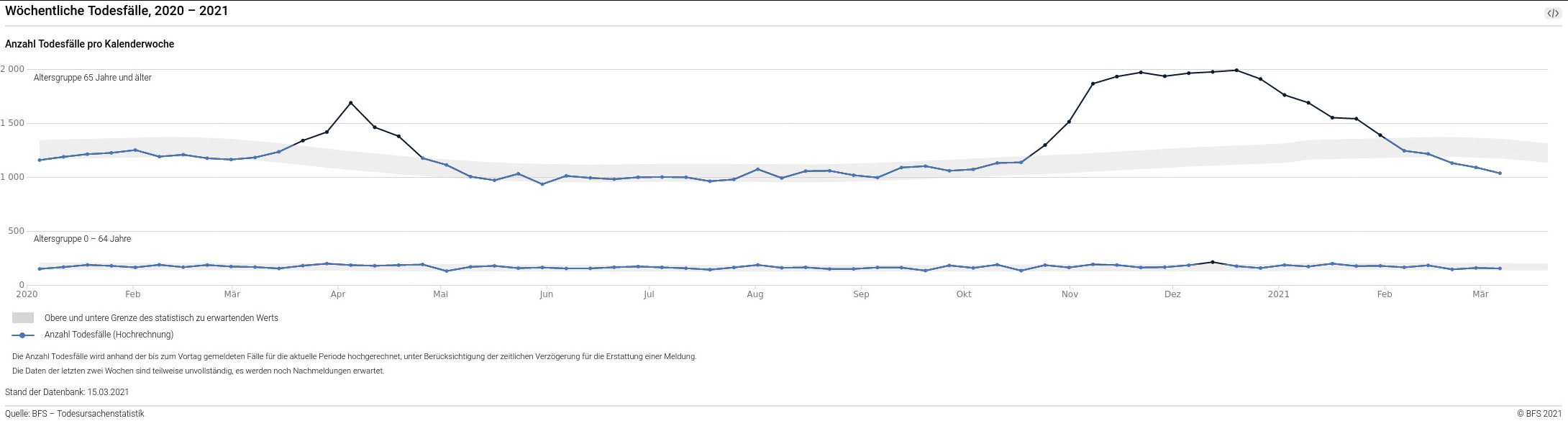
On the other hand, we tend to hype or over-estimate other dangers. Switzerland is still in a lock-down mode,
despite the fact that the mortality rate has dropped far below average
also for 65+ year old people and the 0-64 year olds wever never, ever in any danger during the entire last year.
Switzerland has probably the world best statistical data (and fantastic statisticians, many educated
at stellar universities like ETH). Lets look at the excess death data there:
In the US, our underfunded CDC does not release such data. Mortality data like climate data are very
reliable and look similar in similar countries. The cause of death is a matter of interpretation which is
illustrated by the vast fluctuations between different countries. Excess death data correlate well with
real dangers and current state of health care systems.
Here are the data
from the Swiss statistics bureau. But as the above stories in probability theory show, risk and decision making
is not the strongest ability of humans. Collectively we are dumb when it comes to making good choices. Policies are
done in a social context (peer pressure and fear),
game theoretical phenomena (strong, hawkish, repressive and tough leaders tend to be popular and push each
other into a Nash equilibrium of doom), censorship effectively enforced today by social media as well as
in academia. To the later, I personally got reported by an anonymous coward for commenting on public data last year.
Crisis always brings out the worst of humanity), self-interest
(news outlets, rich people (me included as I have a job, a roof above my head and
enough cash to buy books and electronic equipment to teach), or big technology companies are all
winners of the current crisis). But the situation has deteriorated for others. We have a socially accepted path to
even bigger income inequalies. Issues like
failing education,
devastated existences and job losses,
women rights,
domestic violence surge,
fatalities due to
untreated other conditions,
depression (tripled)
due to isolation and drug use surge,
crumbling infrastructure (like failing power grids)
and lack of money for health care
(funds for modernizing health care are even less likely allocated in the future).
bankruptcies,
tumbling economies worldwide, leading to
migration crisis, or ignoring climate issues
and avoiding public transport systems,
genocides, or wars
are ignored. We are so dumb when it comes to assess risks. No, I myself am not smarter. I would probably join
similar decisions than current leaders, simply because there is no choice in a Nash equilibrium, where
dissent leads to removal and scientific discussion is shouted down (I'm ashamed to call me a scientist these days where
data are ignored, and news outlets shamelessly use phrases like ``experts say" without reference nor data backup. All
principles we indoctrinate students about data (where do they come from, how were they obtained, how reliable are they,
what is cause and what is effect are completely ignored).
It is a devastating
multiple prisoner dilemma,
as modeled in game theory or evolutionary dynamics.
Scientists will analyze the current situation more calmly in the future and hopefully find a way to avoid the same mistakes.
But enough of this: also the 20th of march was a great day. First day of spring coming up.
A panorama from the science center (click for a large 11K pixel panorama)
Lecture 7: Set theory
During class, when discussing paradoxa, Stephen pointed out the star trek episode with the liars paradox
Just added it to the math in movies
collection.
As always, also this set theory lecture"
is split up into sections. We discuss the algebra of sets, infinities, paradoxa and incompleteness. The
topic is very much at the heart of the foundations of mathematics. There is
not only philosophical drama (are our foundations solid?) but
pedagogical dispute (like "new math") or more recently the infiltration of category
theory into mathematics and the question whether it can replace set theory as
a foundation. There are immediate gems to be harvested from set theory:
like that there are different types of infinities. Here is my personal top 10 list (as of now):
Rank
Result
Pop Culture
1.
Incompleteness theorem
Goedel-Escher-Bach
2.
Uncountable reals
Aleph n bottles of beer on the wall!
3.
Cantor-Schroeder-Bernstein
Infinity plus one is infinity
4.
Well ordering theorem
Greatest Math Controversy of all times
5.
Boolean Algebra
Everything is zero's or ones
6.
Laws of thought
Thieves are humans, ergo, great thieves are great humans
7.
Sets are universal
Venn Diagrams: New math!
8.
Russel's paradox
"I always lie!"
9.
Cantor pairing
Hilbert's Hotel
10.
Independence of C and CH
Banach-Tarski
click for larger (4K or 11K) pictures.
Like many insights and examples, the example ``thieves are humans, ergo, good thieves are good humans" is
from Ernst Specker, from whom I learned linear algebra (2 semesters),
logic and model theory (and much more as his lectures were unscripted, and full of little gems). Teachers
at the Poly like him made studying math valuable. Content can be read or
acquired everywhere; taste, humor and insight and guidance what to look at and what not, needs good teachers.
The 13th was again a wonderful day. Just one day before
Pi day.
A panorama from the 5th floor science center
(click for a large 11K pixel panorama)
Lecture 6: Calculus
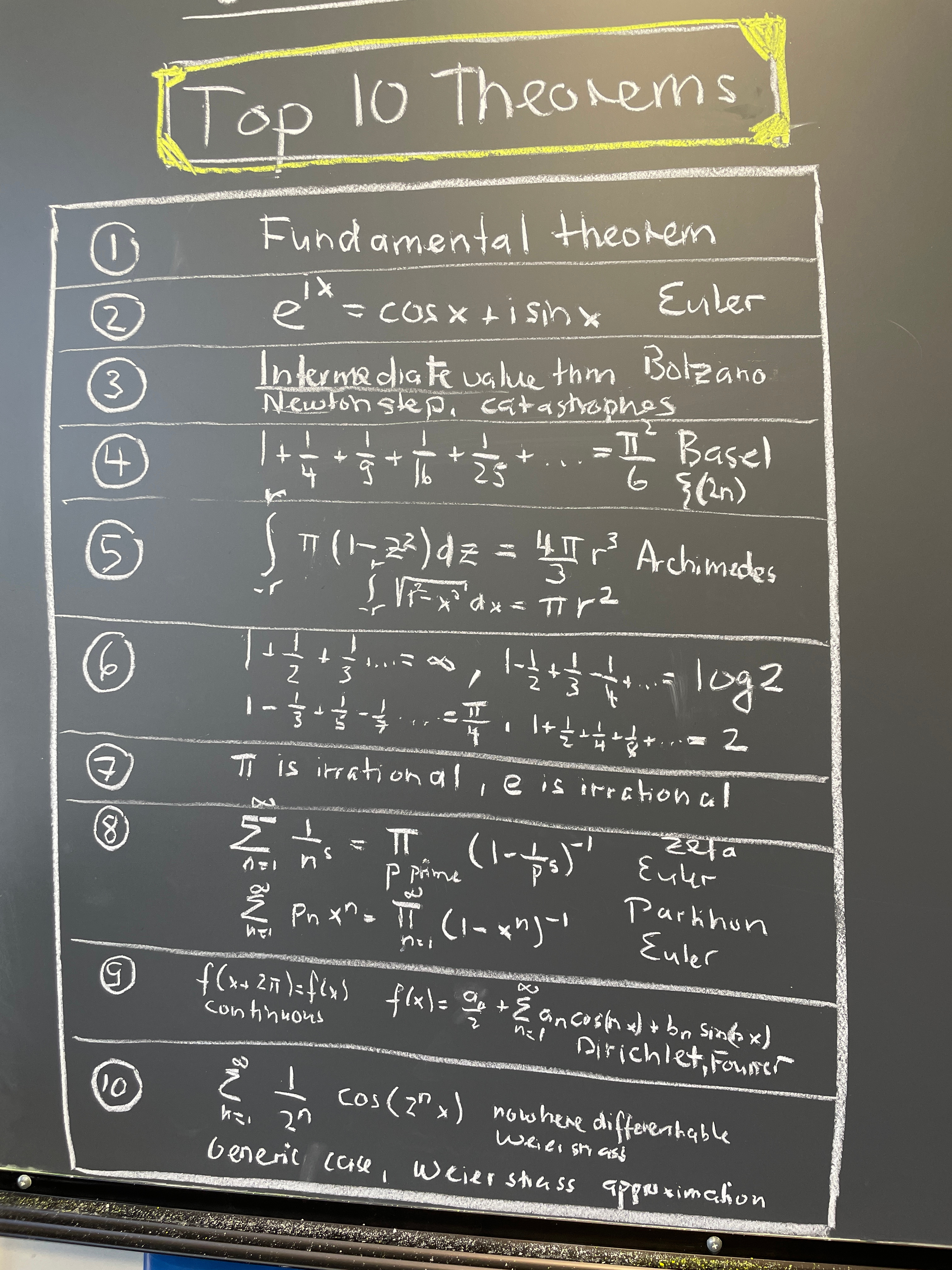
As mentioned in the preparation lecture
recorded in my office, there are many of heavy books on calculus. How can we discuss such a
huge subject in a 2 hour class? History also here softens the blow. There are many interesting stories
starting with the Greeks (Zeno, Archimedes). The fact that much of calculus is very accessible is the
huge impact it makes on pop culture which by definition makes it accessible for a larger audience:
Rank
Result
Pop Culture
1.
Fundamental theorem of calculus
Newton-Leibniz rivalry, Newton apple, gravity
2.
Euler formula
ei π+1=0 most beautiful formula in math
3.
Intermediate value theorem
Wobbly table, catastrophes, chaos
4.
Euler formula Basel problem
ζ(2)=π2/6, Riemann hypoth. or ζ(-1)=1+2+3+4+...=-1/12
5.
Volume of sphere
Archimedes: cone complement in cylinder, Heureka!
6.
Harmonic series
ζ(-1)=product 1/(1+p) over primes, stacking books
7.
Irrational π
movie Pi, open problem: is πe rational?
8.
Golden key, Partition function
primes, man who knew infinity.
9.
Fourier series
MP3, JPG, MPG image and movie compression
10.
Weierstrass function
Fractals, most things are not smooth
click for larger picture.
It was a beautiful day when recording the lecture. Here is a view from the 4th floor science center
(click for a large 11K pixel panorama)
Lecture 5: Algebra
In the algebra lecture, we will make a bridge from solutions to quadratic, cubic, quartic
equations to group theory and puzzles like the famous Rubik cube. While the solutions of
the quadratic equation x2+bx+c=0 is well known as 2x=-b+(b2-4c)1/2
and 2x=-b-(b2-4c)1/2, how was the more complicated formula for the cubic
equation x3 +ax2+bx+c=0 obtained? How did Cardano get to the seemingly insane
solution formula:
What are the corresponding formulas for the quartic or quintic? This
brings in symmetries and group theory. We will look at a zoo of Rubik type puzzles. Here is a computation of its size
of the classical Rubik cube with GAP. This puzzle could be related to a polynomial of degree 48 (there are 6 faces,
each having 8 colored stickers and these places are permuted when playing the game).
How does one attack solving these puzzles? We will look at much smaller ones in order to find out.
Click for a large picture
Here is a short animation explaining the 2x2x1 puzzle
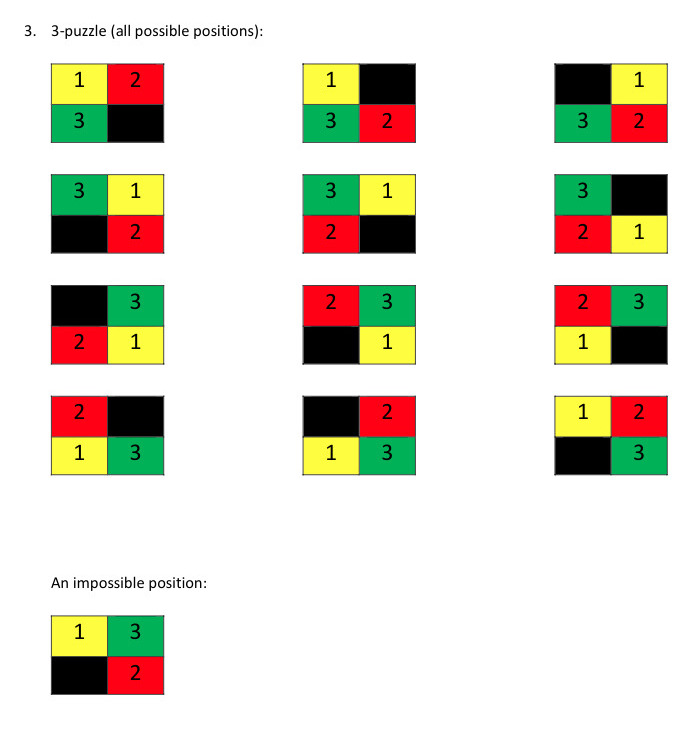
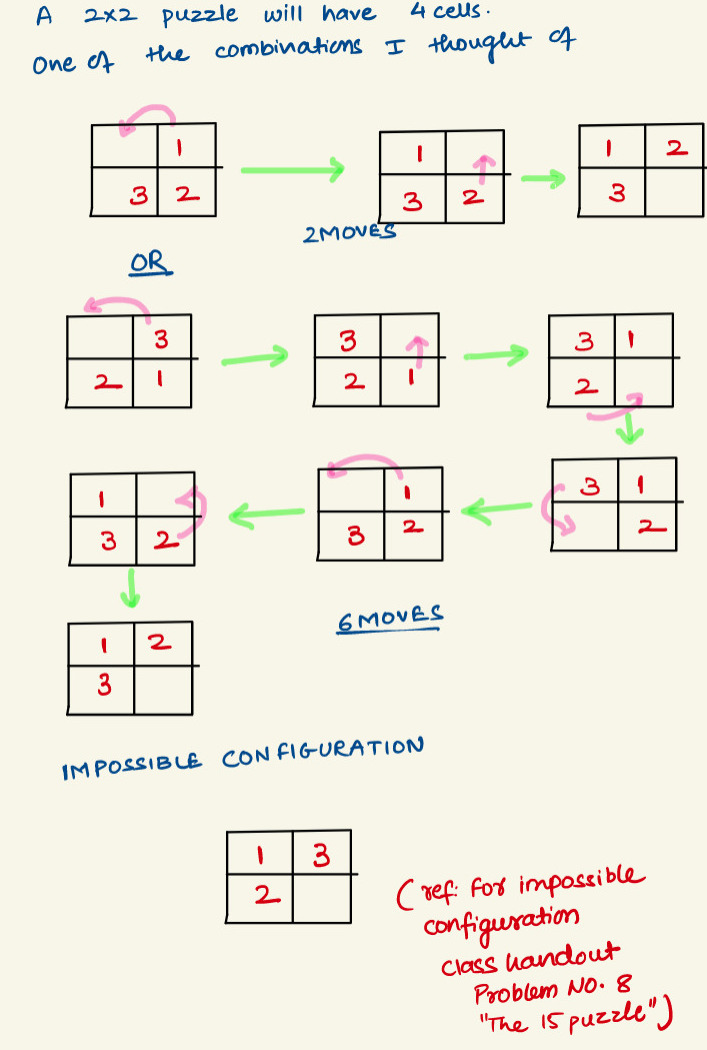
Here are two nice solutions from the class presenting the solution of the 3-puzzle
(the 2x2 analogue of the 15 puzzle)
Lecture 4: Number Theory
Update March 13, 2021:
A new solution to x3+y3+z3=3.:
569936821221962380720^3 + (-569936821113563493509)^3 + (-472715493453327032)^3 = 3. Of course, there is the trivial solution x=y=z=1 and
x=y=4, y=-5 because 64+64-125=2. Mordell had asked in 1953, whether there is an other one. This has now been found by Brooker and Sutherland:
(article).
Top 10 in Number Theory
Ranking
Conjecture
1
Perfect
2
Landau
3
Goldbach
4
Twin
5
Riemann
6
ABC
7
Beal
8
Legendre
9
Andrica
10
Gilbreath
Ranking
Theorem
1
Fundamental
2
Fermat
3
Wilson
4
Prime number
5
Reciprocity
6
Christmas
7
Perfect
8
Lagrange
9
Dirichlet
10
Chinese
In the video, I briefly mentioned why the Riemann hypothesis RH could be wrong. Littlewood, who got the
problem as a thesis problem (!) is rumored to have believed that it is wrong (maybe to protect himself from
the embarresment not to be able to solve it ....). As a way to think intuitively about RH,
already Littlewood has pointed to the fact if the Moebius function were ``random", the law of iterated
log would give RH. Andrew Odlyzko (whom I met about 20
years ago when he visited the department and who has disproved the Mertens conjectures and has computed
millions of zeros of zeta especially to get evidence for the Montgomery pair correlation conjecture),
told me then about curious correlations for the Moebius function. The number theoretical functions which need to be ``random"
might not be as random as they might need to be. The Hilbert-Polya conjecture (find a self-adjoint operator for which
the spectrum give the roots) is also often given as evidence for RH.
It has been tried by heavyweights like Connes. Odlyzko has some
Historical pointers to the Hilbert-Polya point.
See also this book written by experts on experimental math.
P.S. Update February 23: The Moebius function was just mentioned in a
new blog entry
of Tao. I myself am very fond of the Moebius function. One reason is that it is a Poincare-Hopf index of a Morse
build-up of the integers. (See my paper On Primes, Graphs and Cohomology.
(I learned later that of Bjoerners work: A cell complex in number theory.)
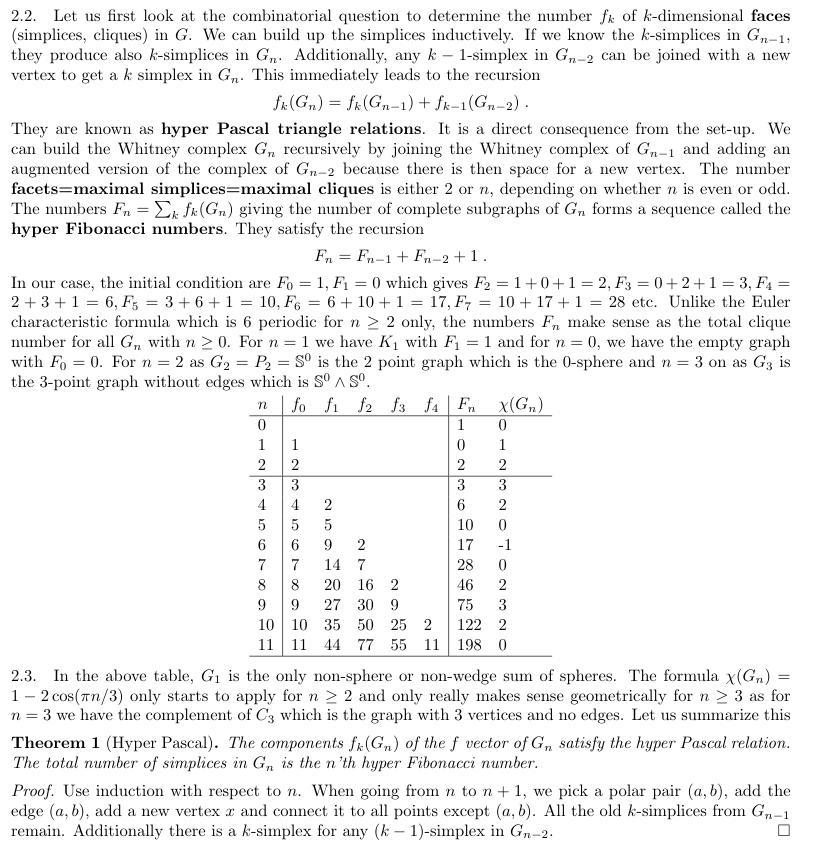
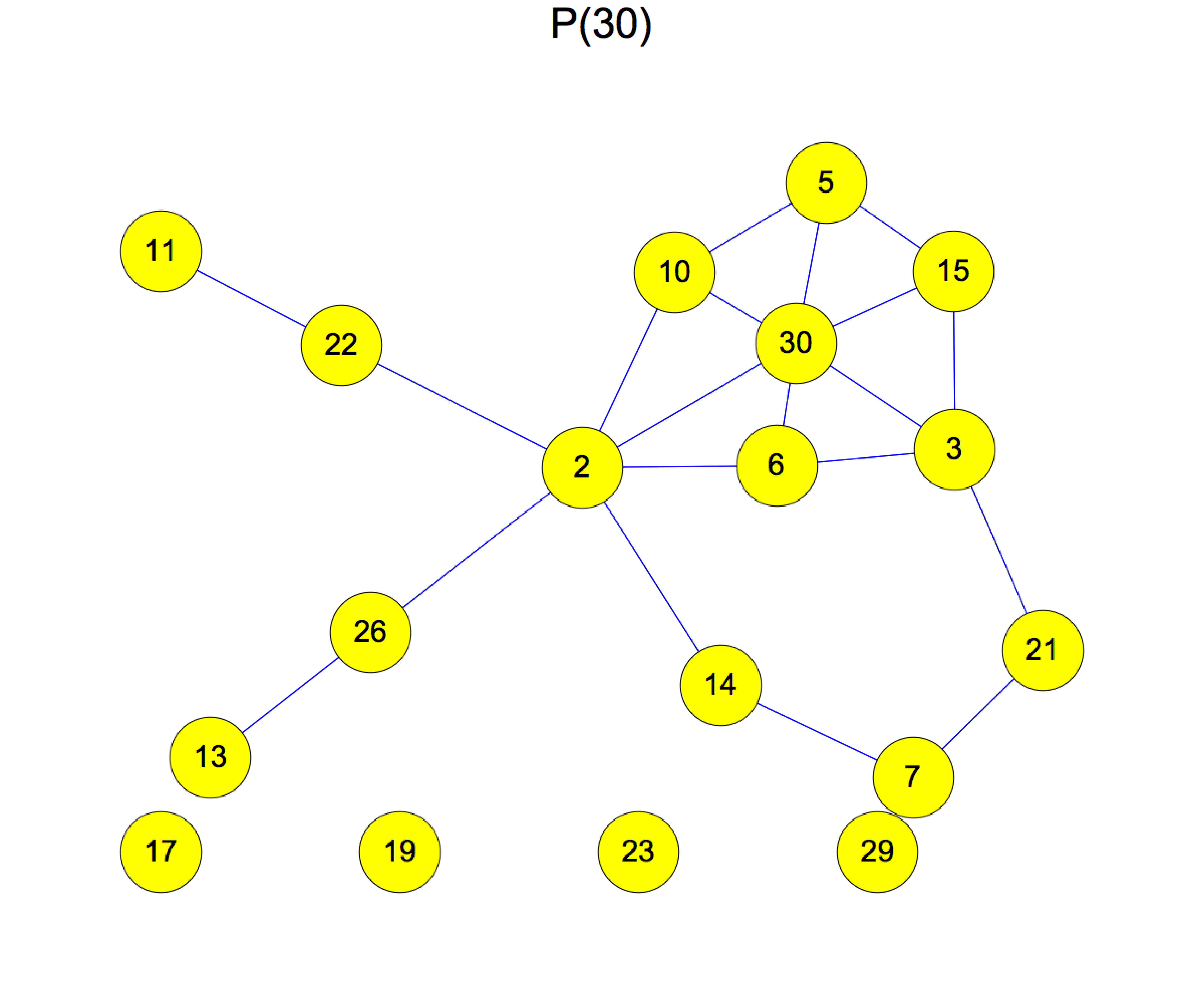
To the right is the geometric illustration of the number 30. All numbers until 30 are drawn. Two are connected if one is
divisible by the other. When adding a new number, the Euler characteristic changes according to the value of the
Moebius function. Understanding the growth rate of the Euler characteristic would settle RH.
This picture combines number theory, combinatorial topology and differential topology (Morse theory).
If the Moebius function were ``random", then the Riemann hypothesis would hold. It appears however that the Moebius function
is not so random after all. Whether it is enough random for the law of iterated log is just the Riemann hypothesis. I personally
tend to believe that RH is false also because we have seen many, many times, that wishful thinking in symmetries were wrong,
parity (= reflection symmetry in space) in physics is an example, the latest is super symmetry, where the
world best people have been completely wrong (The Large Hadron collider has not found super symmetry despite promises from the
elite of physicists that it would be seen).
If there is no compelling reason for a symmetry, it might well be
broken.
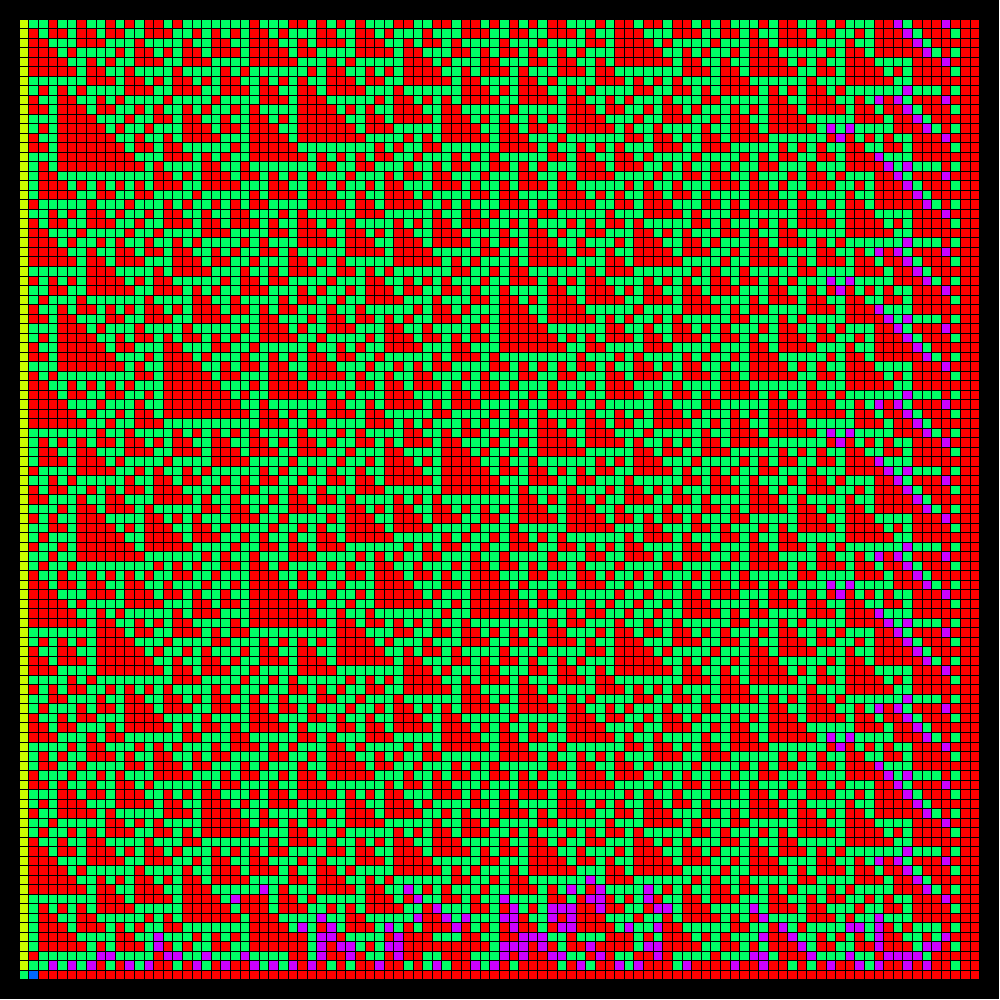
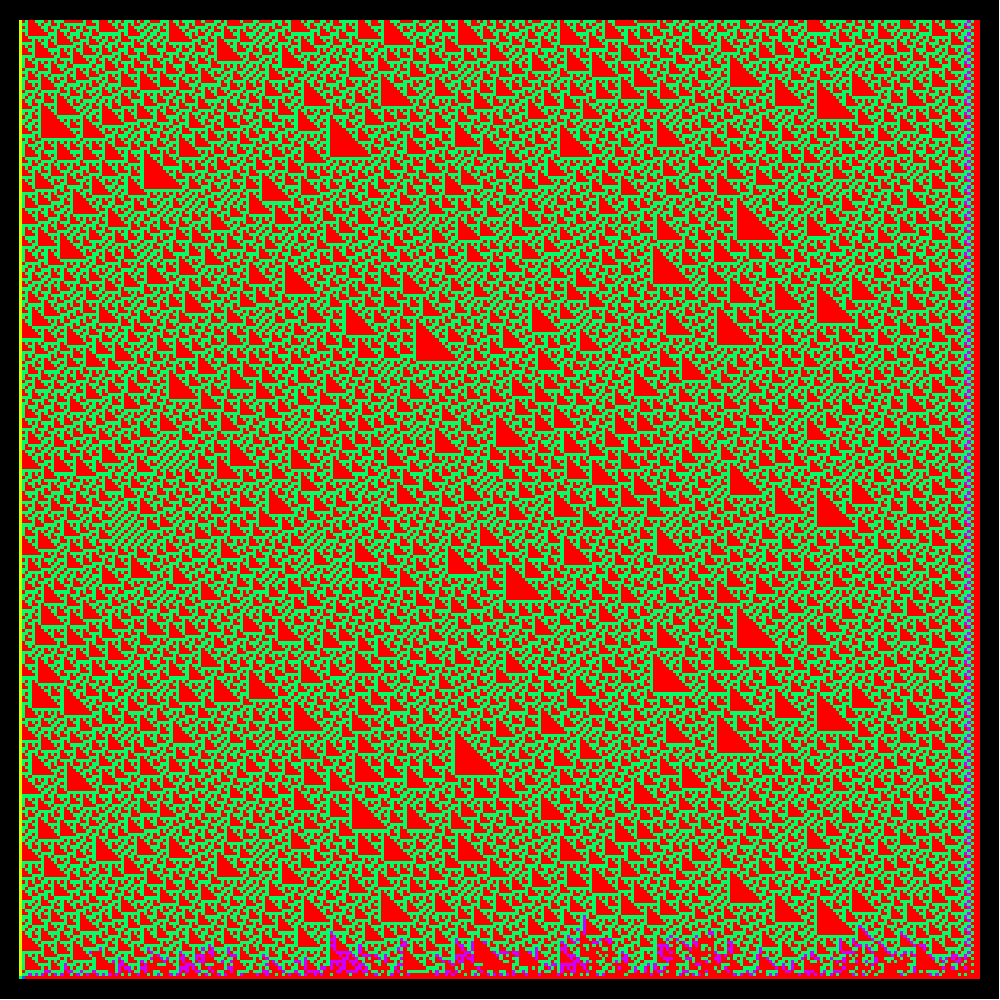
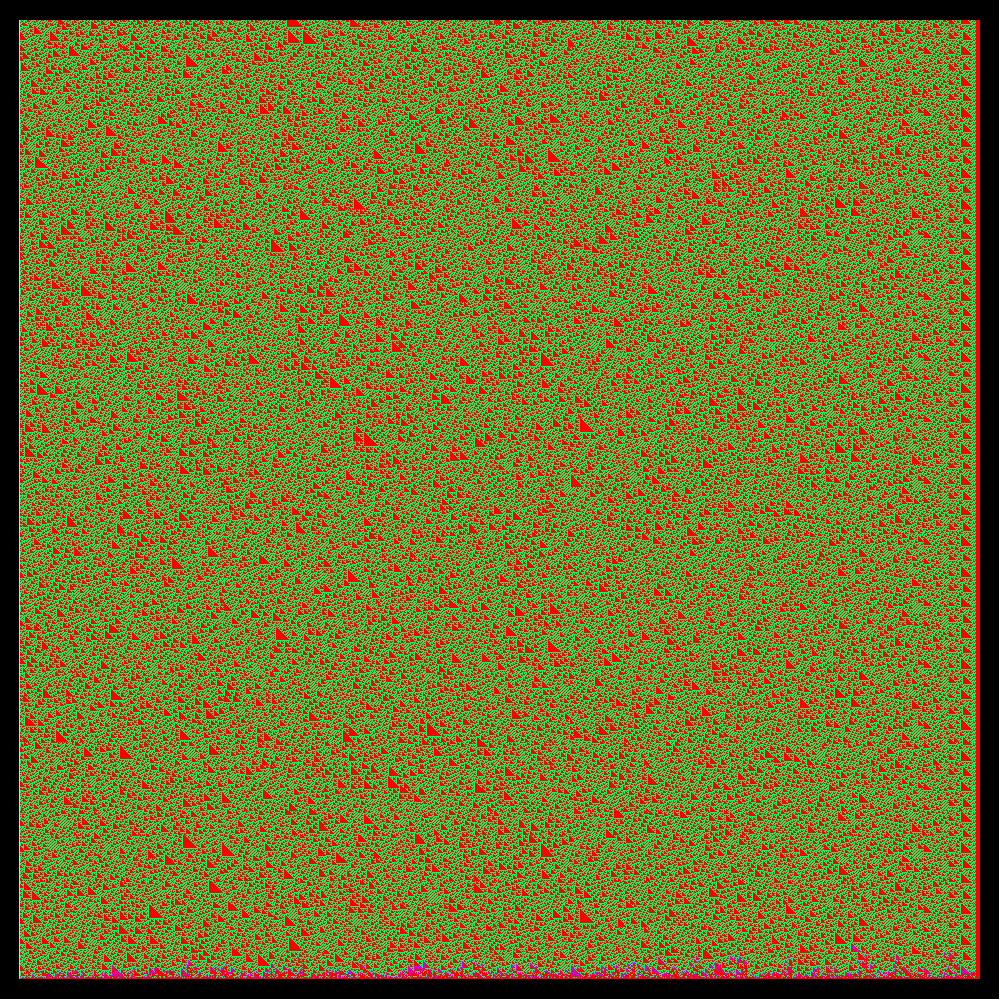
Here is an illustration of the Gilbreath conjecture. The pictures look a bit like cellular automata. Indeed
they are.
In class, we mostly focused on primes, the Wilson and little Fermat theorem. The
existence of arbitrary large prime gaps and the proof of Wilson's theorem were done in
group. Very well. We had a bit little time left for the proof of the little Fermat theorem.
Two parts of the presentation were done, one on open problems (which is covered in the
pre-presentation below) and some unit on the Chinese remainder theorem, a topic which one
can cover even pre-highschool level (I presented once in the Harvard math circle for kids).
Here is a website about this from 2014.
An exercise in the
Mazur-Stein book
prompted me to do some experiments in number theory.
Lecture 3: Geometry
In the geometry lecture we have limited us mostly some theorems in good old planimetry.
This had been done already 10 years ago, when starting this course and it is a rich
enough play field. It is the first time that in group work Thales theorem was proven in
teams, this year without much preparation. And many succeeded to prove it.
Trying to defining geometry as a theory of shape, size and symmetry can be a bit of a stretch.
It tries to incorporate that it deals with quantitative measurements (like area, length or volume)
of objects in some space and then use Klein's Erlanger program as a guide to distinguish different
geometries (like Euclidean geometry or projective geometry).
In modern times, geometers often either algebraic geometers (often actually quite
abstract commutative algebra or category theorists) or differential geometers (operating with rather
heavy analytic machinery including partial differential equations).
Closely related to geometry is topology (which we will cover later) and combinatorics, where the
geometric objects are discrete. And then there is a growing
area of computational geometry, especially related to computer science like in computer vision
or game development. The geometric problems there are very concrete and often
engineering type in the sense that one does not necessary aim for the most elegant solutions
or beautiful theorems but for the fastest way to realize, simulate and navigate a given virtual world.
The last century also has developed more and more non-commutative geometries.
The passage is most natural when translating geometric problems first into algebra (like a commutative ring,
as Descartes already did) and then see how much of the theory goes over to non-commutative rings like
operator algebras. The theory of C* algebras for example is a natural generalization of topology and
the theory of von Neumann algebras a natural generalization of probability theory. For geometry it is a bit
more tricky and Connes extends it using spectral triples.
There is a recent
youtube video
about
Lockhart's famous article ``A Mathematician's Lament". In that video
the Thales theorem is mentioned but again only in the case when the base is the
diagonal. Here is again the animation of the Thales theorem.
The animation had been written in 2010. I just upgraded it to 3D graphics:
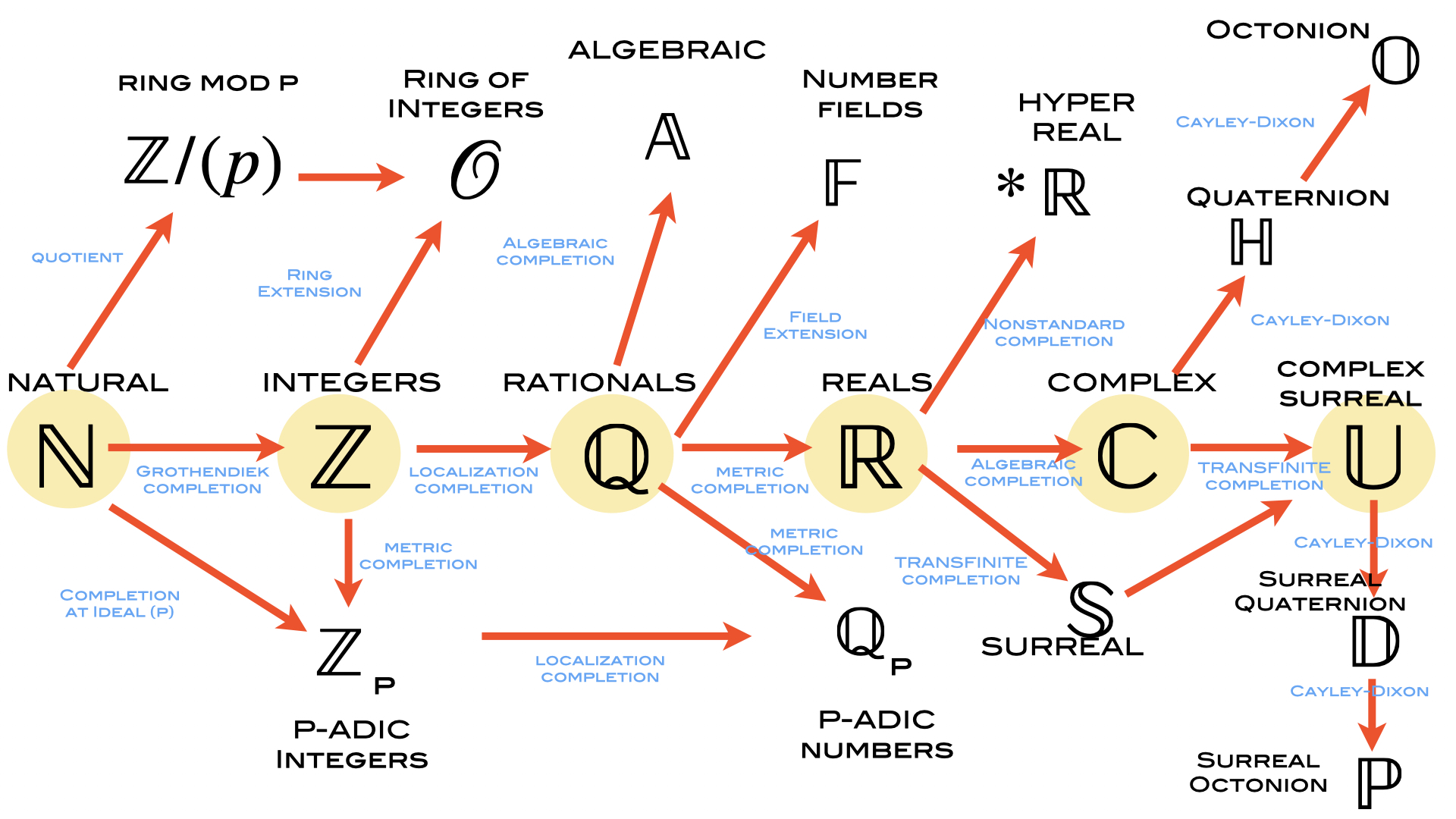
Here is an other attempt to outline the structure of modern number
systems. Some of the things are a bit strange at first, like the p-adic
world. The interest there is mostly from number theory and algebra.
We will talk in class about the metric completion of the rational numbers
to the real numbers. That is something very natural as we see numbers
like pi or the square root of 2 which are not rational numbers. One can
however complete the rational numbers with respect to other distances
and it turns out that there are not many such completions. There is one
for every prime p and then there is the Archimedian completion which is
given by the usual distance between numbers. We might quickly look at
surreal numbers, introduced by John Conway which are also quite natural
as they generalize to games. The hyper reals are used in non-standard
mathematics. The quaternions and Octonions are natural as they complete
the world of division algebras. Algebraic numbers are natural
as these are numbers we can access with a finite amount of information,
the integer coefficients of a polynomial. The modular arithmetic Z/(n)
will appear for us later when we look at cryptology.
As usual, the Wikipedia source on
numbers is good with a
picture illustrating the main number systems N,Z,Q,R,C.
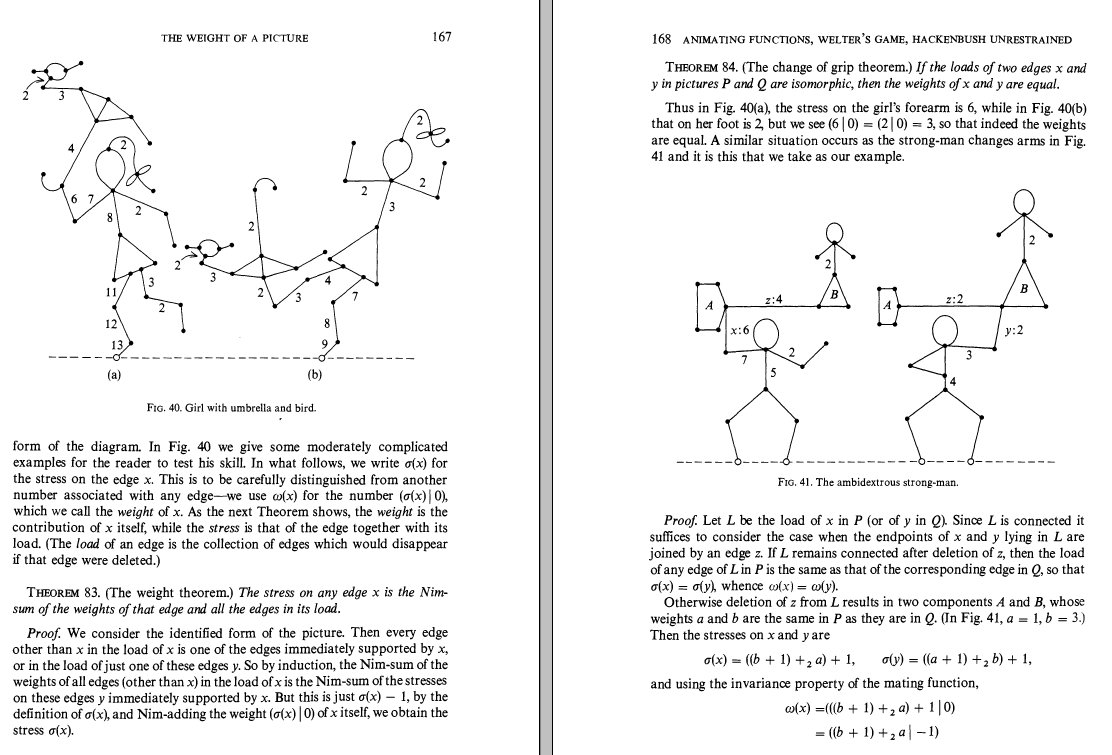
Finally, lets mention an extension of numbers to ``games". It is covered in a book
of John Conway: ``Numbers and Games". Just to wet the appetite, here is a page
from that book
Lecture 1: What is mathematics
The world of map mentioned in class is here (youtube).
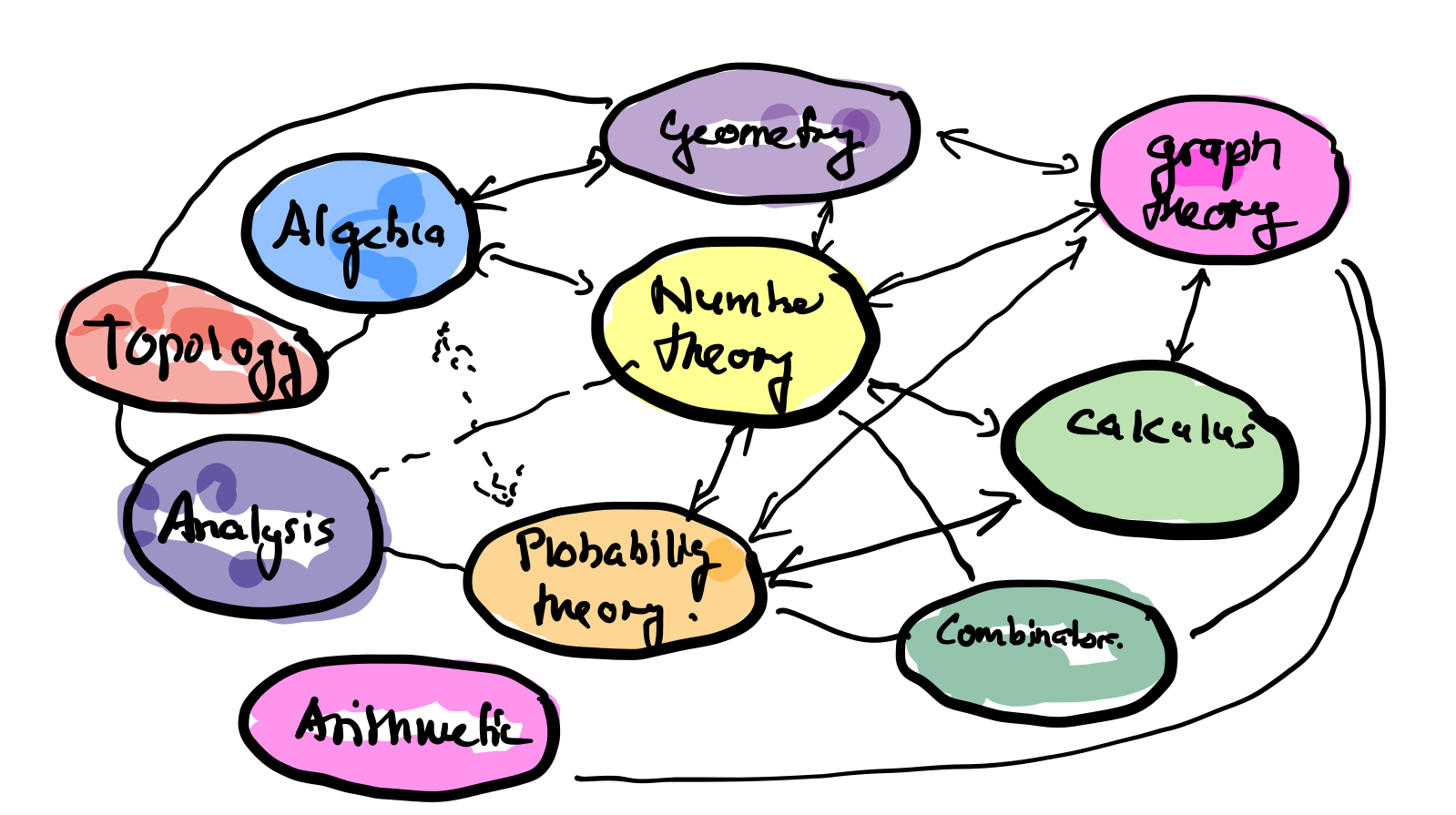
We will actually cover almost all topics mentioned. Our own quick mindmap done today in class is to the right.
About the taxonomy of the 7 liberal arts and sciences: there is an
exhibit on the drawing of Harrad of Landsberg.
Drawing the diagonals of a polygon seems to be a pretty dull thing to do.
But it is very interesting. I myself worked over the winter break on this
youtube slides.
We looked at the triangle on page 8 of
this document or simply
click on the thumbnail to the right to see that part.
Here is the worksheet.

 P.S. on a bit more meta level: I had been asked what the purpose of the pre-videos is.
One of the things I consider extremely important in teaching
is that one gets into a class not only prepared but also pepped up and energized, especially if one has
taught something a lot already.
This means starting to think about a subject several days before. Doing
these pre-lectures is for me also an opportunity to push the envelope in using technology for teaching.
This year, I explore especially the use of demonstration objects in video.
This has been done before for expensive TV productions. New is that it is possible today
to do this alone with relatively little short time (in this case maybe 40 hours of work for a 15 minutes of video,
with a 18 hour essentially non-stop finish done on Saturday for recording and cutting).
This is not counting the hundreds of hours of programming which in this case, as I reuse and reran with
better quality also code I have written over decades. This was done over a couple of days. Some of the animations
take hours to complete. The final movie (15 minutes) was 59 Gig big when submitted to youtube. The final cut directory
has 357 Gig (1/3 of a TByte). The source videos (which are kept separate are an additional 140 Gig. In total, this
small project alone covers 550 gig in my macmini (the cheapest version with 256 Gig harddrive which I had to buy in an
emergency, due to a machine failure). Of course, this requires
to work on external drives all the time. Since also the source files are large, the entire process needs to be
orchestrated, working on different things at the same time, like when waiting to render the 360 degree camera
stuff or then for copying the files. And then things need to be backed up as even modern stuff can have hick ups.
Like in rock climbing, where at any time two body
parts have to be on the rock, I keep at any moment of time always two copies. There is an exception just when recording
but that is, where the multiple cameras come in. Even in the case of an SD card or camera failure, the other camera footage could still
work. I don't have time for a second shot and a fixed time window in which this has to be done (we get access to
the department by preregistration and of course by testing). Why not at home? Well that needs negotiations with the partner.
P.S. on a bit more meta level: I had been asked what the purpose of the pre-videos is.
One of the things I consider extremely important in teaching
is that one gets into a class not only prepared but also pepped up and energized, especially if one has
taught something a lot already.
This means starting to think about a subject several days before. Doing
these pre-lectures is for me also an opportunity to push the envelope in using technology for teaching.
This year, I explore especially the use of demonstration objects in video.
This has been done before for expensive TV productions. New is that it is possible today
to do this alone with relatively little short time (in this case maybe 40 hours of work for a 15 minutes of video,
with a 18 hour essentially non-stop finish done on Saturday for recording and cutting).
This is not counting the hundreds of hours of programming which in this case, as I reuse and reran with
better quality also code I have written over decades. This was done over a couple of days. Some of the animations
take hours to complete. The final movie (15 minutes) was 59 Gig big when submitted to youtube. The final cut directory
has 357 Gig (1/3 of a TByte). The source videos (which are kept separate are an additional 140 Gig. In total, this
small project alone covers 550 gig in my macmini (the cheapest version with 256 Gig harddrive which I had to buy in an
emergency, due to a machine failure). Of course, this requires
to work on external drives all the time. Since also the source files are large, the entire process needs to be
orchestrated, working on different things at the same time, like when waiting to render the 360 degree camera
stuff or then for copying the files. And then things need to be backed up as even modern stuff can have hick ups.
Like in rock climbing, where at any time two body
parts have to be on the rock, I keep at any moment of time always two copies. There is an exception just when recording
but that is, where the multiple cameras come in. Even in the case of an SD card or camera failure, the other camera footage could still
work. I don't have time for a second shot and a fixed time window in which this has to be done (we get access to
the department by preregistration and of course by testing). Why not at home? Well that needs negotiations with the partner. 








 As usual, the Wikipedia source on
numbers is good with a
picture illustrating the main number systems N,Z,Q,R,C.
Finally, lets mention an extension of numbers to ``games". It is covered in a book
of John Conway: ``Numbers and Games". Just to wet the appetite, here is a page
from that book
As usual, the Wikipedia source on
numbers is good with a
picture illustrating the main number systems N,Z,Q,R,C.
Finally, lets mention an extension of numbers to ``games". It is covered in a book
of John Conway: ``Numbers and Games". Just to wet the appetite, here is a page
from that book