Math E-320: Spring 2015
Teaching Math with a Historical Perspective
Mathematics E-320:
Instructor: Oliver Knill
Office: SciCtr 432
Email: knill@math.harvard.edu
| To exploit vulnerable connections, attackers must use the number field sieve algorithm to precompute data. Once they have completed that task, they can use it to perform man-in-the-middle attacks against vulnerable connections in real time. Using academic-level hardware, the researchers required just two weeks to generate data needed to attack the two most commonly called prime numbers 512-bit Diffie-Hellman uses to negotiate ephemeral keys. Those two data sets allow the attackers to compromise about 92 percent of sites supporting the export cipher. It wouldn't require much additional work to generate data needed to attack the remaining sites. The work required to precompute data needed to attack 768- and 1024-bit primes is orders of magnitude harder, but the researchers said the load is nonetheless within the means of state-sponsored eavesdroppers. In a research paper titled Imperfect Forward Secrecy: How Diffie-Hellman Fails in Practice, the researchers speculate the technique may be the means the National Security Agency reportedly uses to routinely break millions of encrypted connections. Documents leaked by former NSA subcontractor Edward Snowden revealed the mass crypto attacks but didn't say how they're carried out. Besides attacking HTTPS-protected Web and e-mail sessions, the researchers said, the same technique may be used to break SSH and VPN connections, too. |

"Dave has two kids. One is a boy. What is the probability that the other is a boy?" gives 1/3In the first case we have the probability space X = { BB,GB,BG,GG }, where we look at the event {BB} within {BB,BG,GB} which has probability 1/3. In the second we have the probability space { BB,Bb,BG,Bg,bB,bb,bG,bg,GB,Gb,GG,Gg,gB,gb,gG,gg } and look at the event {BB,Bb,bB} in {BB,Bb,BG,Bg,bB,GB,gB}
"Dave has two kids. One is a boy born at night. What is the probability that the other is a boy?" gives 3/7

| Origin | Egyptians | Babylonians | Mayan | Roman | Hindu-Arabic | Americas |
|---|---|---|---|---|---|---|
| System | Papyrus | Clay tablets | Maya script | Roman numerals | Modern numerals | Quipu knots |
| Place value | No | Yes | Yes | No | Yes | Yes |
| Zero | No | Only space | Yes | No | Yes | Only space |
| Base | 10 | 60 | 20 | 5(10) | 10 | 10 |
 They have always been important for teachers, as they provide a ``guide" on what to look for. And everybody naturally makes
up their own taxonomies. Teaching is very personal and practical. The Bloom taxonomy is such a fixture in education that it
borders the brink of obsession. It had been developed by Benjamin Bloom.
Bloom was a theoretical psychologist. His taxonomy has been modified and
is now called revised Taxonomy.
It can boil down to "Knowledge, Understanding, Application and Modification", or shortly
"What, Why, How" and "Why not?" Moore has put "Evaluate" on top of this but
it can make more sense to put "evaluation" out of this and apply evaluation to all the four parts.
(For example: for arithmetic, a student first has to know the symbols for the numbers, then see whether two numbers
can be multiplied. The third part is to understand the structure like why 5 * 7 = 7 * 5 or why there are numbers
which can not be written as the product of two numbers larger than 1. Eventually, the fourth "why not" part could explore whether
one can build structures, where x * y = y * x is no more true. The answer is yes and that this is how nature indeed operates
on a fundamental level (quantum mechanics)). Now, each part can be evaluated: one can ask a kid first whether it can read the numbers
("What is this"), then ask to add numbers ("How is this done"), then ask more conceptual parts like whether it understands that
(3+4)+5 is the same than 3+(4+5) ("Why is that true?") and finally test creativity by asking whether one could look at
other numbers too ("Why not?"). My critics with putting the evaluation into the mix is that most of the teaching we do
deals with the "What" and "How" part. Already the "Why" is the holy grail of education and only folks who have never taught can
believe that this is easy. The creative part is almost unreachable. There are teaching methods which aim for it, like the Montessori
system but often creativity in reality boils down to have students just copy already known things.
Its hard to teach creativity. Some try to build tips.
If you look at this (which appeared also as a slide, you
realize how hard it is for example to be creative as a designer. Most just copy each other.
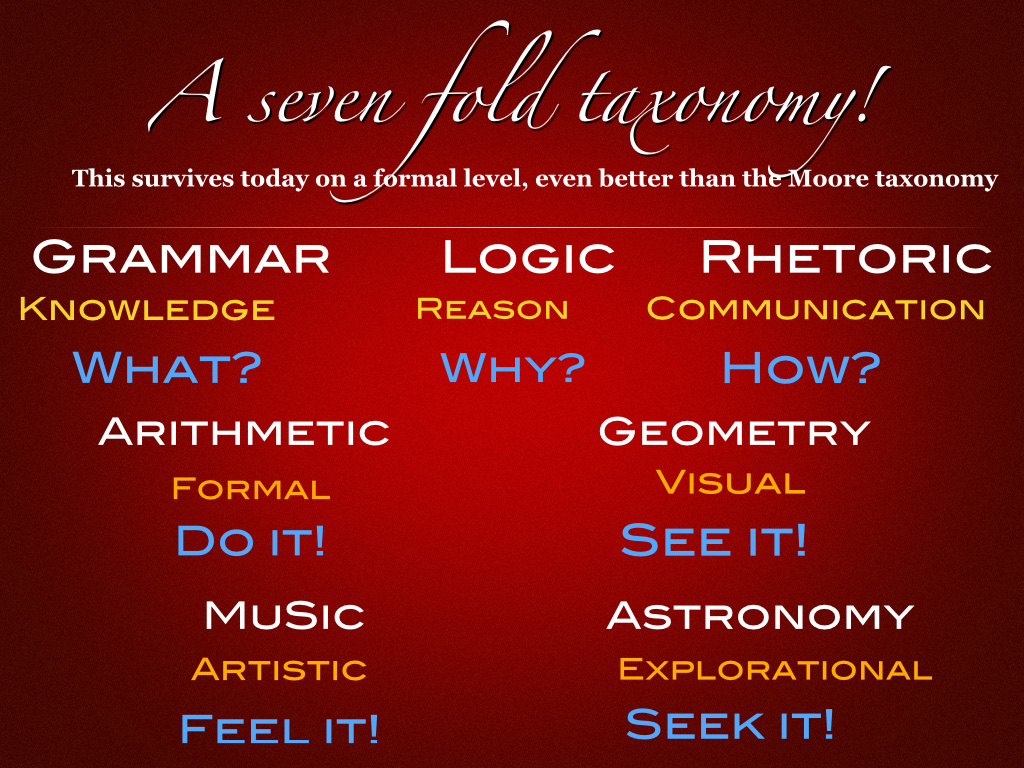
The liberal arts and sciences provide a metaphor for an other taxonomy: as pointed out in the slide,
one can see Grammar as a metaphor for "What", Rhetorik as a "How", and Logic as a "Why". The creative part is not in the Trivium.
But the quadrivium includes it and even more. Arithmetic can be seen as a metaphor for "Doing things", Geometry to "See things",
Music to "Feel things" and Astronomy as "Seek new things". Any way, this bending of the 7 liberal arts and sciences to a taxonomy
shows how arbitrary taxonomies can be. So, here is an advise: make your own taxonomy and test it in the field.
They have always been important for teachers, as they provide a ``guide" on what to look for. And everybody naturally makes
up their own taxonomies. Teaching is very personal and practical. The Bloom taxonomy is such a fixture in education that it
borders the brink of obsession. It had been developed by Benjamin Bloom.
Bloom was a theoretical psychologist. His taxonomy has been modified and
is now called revised Taxonomy.
It can boil down to "Knowledge, Understanding, Application and Modification", or shortly
"What, Why, How" and "Why not?" Moore has put "Evaluate" on top of this but
it can make more sense to put "evaluation" out of this and apply evaluation to all the four parts.
(For example: for arithmetic, a student first has to know the symbols for the numbers, then see whether two numbers
can be multiplied. The third part is to understand the structure like why 5 * 7 = 7 * 5 or why there are numbers
which can not be written as the product of two numbers larger than 1. Eventually, the fourth "why not" part could explore whether
one can build structures, where x * y = y * x is no more true. The answer is yes and that this is how nature indeed operates
on a fundamental level (quantum mechanics)). Now, each part can be evaluated: one can ask a kid first whether it can read the numbers
("What is this"), then ask to add numbers ("How is this done"), then ask more conceptual parts like whether it understands that
(3+4)+5 is the same than 3+(4+5) ("Why is that true?") and finally test creativity by asking whether one could look at
other numbers too ("Why not?"). My critics with putting the evaluation into the mix is that most of the teaching we do
deals with the "What" and "How" part. Already the "Why" is the holy grail of education and only folks who have never taught can
believe that this is easy. The creative part is almost unreachable. There are teaching methods which aim for it, like the Montessori
system but often creativity in reality boils down to have students just copy already known things.
Its hard to teach creativity. Some try to build tips.
If you look at this (which appeared also as a slide, you
realize how hard it is for example to be creative as a designer. Most just copy each other.
The liberal arts and sciences provide a metaphor for an other taxonomy: as pointed out in the slide,
one can see Grammar as a metaphor for "What", Rhetorik as a "How", and Logic as a "Why". The creative part is not in the Trivium.
But the quadrivium includes it and even more. Arithmetic can be seen as a metaphor for "Doing things", Geometry to "See things",
Music to "Feel things" and Astronomy as "Seek new things". Any way, this bending of the 7 liberal arts and sciences to a taxonomy
shows how arbitrary taxonomies can be. So, here is an advise: make your own taxonomy and test it in the field.