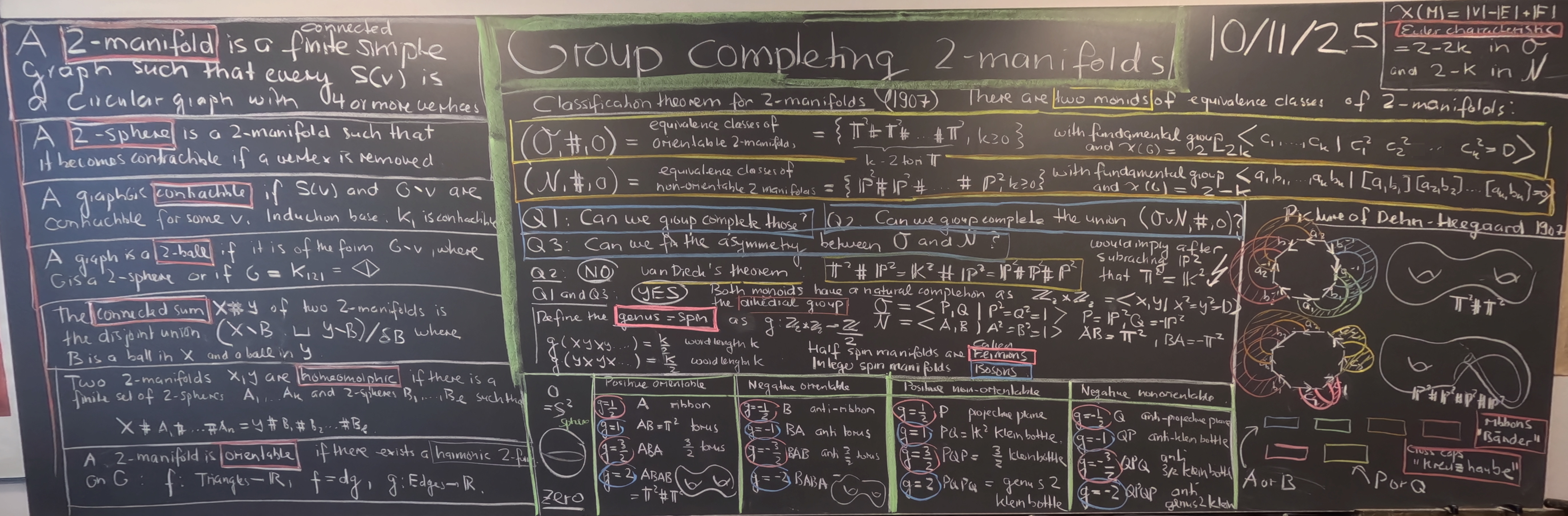
You might have seen in algebra the concept of group completion. It is a very general
concept which you know from primary school when learning about negative numbers. Grotendieck
formalized it in full generality. Manifolds have a natural "arithmetic" in the form of the
connected sum. The 0 element is the sphere. When we add a torus to a torus we get a genus 2
surface. If we add a projective plane to a projective plane we get the Klein bottle.
You have once in a homework classified 1-manifolds. Every connected compact 1-manifold
is a circle. Also for 2-manifolds, we know the classification. Every 2-manifold is either
a directed sum of tori or then a directed sum of projective planes. The Klein bottle for
example is the connected sum of two projective planes. The proof of the classification needs
a little bit of group theory because the fundamental group plays an important role. We have
for example the strange property that if we add a projective plane to a torus, we get the
same thing than adding the projective plane to a Klein bottle (van Dyck's theorem).
The last week, I wondered, how to naturally build a group of manifolds, where also negative
manifolds are allowed. The topological van Dyck identity P2 # T2 =
P2 # K2 (in which we could subtract P2 on both sides and
get that the torus is the Klein bottle) shows that we have to be a bit careful. It turns
out to be more natural to keep the orientable and non-orientable case separate.
Manifolds are always assumed to be compact without boundary and connected. Here is the
classification theorem which has first been finalized by Dehn and Heegaard in 1907.
Every orientable manifold is a direct sum of k tori. The Euler characteristic is 2-2k.
Every non-orientable manifold is a direct sum of k projective planes.
The Euler characteristic is 2-k.
When group completing the algebra and symmetrizing the story, it is better to split the torus
into a ribbon A and anti-ribbon B so that T=A # B parallels K= P # Q telling that the Klein bottle
is the sum of a projective planes and an anti-projective plane. The identity P # P=0 is the Pauli principle.
Then every group element in the completion is a word in A and B.
The genus of such a generalized manifold is k/2 if the word has k letters and starts with A, it is -k/2 if the
word has k letters and starts with B.
In the non-orientable case, we have only to introduce anti-projective planes Q. A Klein bottle is now P # Q
and the anti-Klein bottle is Q # P. More in the following movie.
Here is a picture of the blackboard. On the board, there is a mix-up of the fundamental groups as well as a mix up with Euler characteristic
In the orientable case we have
< a1,b2,a2,b2,...,ak,bk | [a1,b1] ...[ak,bk] =0 >
with Euler characteristic 2-2k. In the non-orientable case we have
< c1,c2,...,ck,bk | c12 ...ck2] =0 > with Euler characteristic 2-k.
The relations for these finitely presented groups are obtained by going around the boundary of the polygon which defines the surface. Van Dyck's identity is actually a result about groups.
One can for example see in the Klein bottle case that that the Baumslag-Solitar group
< a,b | a b a-1 b=0 > is equivalent to
< c,d | c2 d2 = 0 >.
Or one can see that in the non-orientable case, we can avoid commutators [a,b] = a b a-1 b-1
and can write everything with powers of two. The group statement is equivalent to the topological statement because the word relation in the finitely presented group encodes the topology.
It turns out that if we have a non-orientable situation, we can turn the word containing commutators into a word that only contains powers of 2, as long as there is
one power of 2 (a Moebius strip) already present.