\(\newcommand{\del}[2]{\frac{\partial #1}{\partial #2}} \def\proj{\qopname\relax o{proj}} \def\grad{\qopname\relax o{grad}} \def\curl{\text{curl }\ } \def\div{\qopname\relax o{div}} \def\comp{\qopname\relax o{comp}} \newcommand{\R}{\mathbb{R}} \definecolor{purple}{rgb}{0.5,0,1.0} \definecolor{cyan}{rgb}{0, 1, 1} \definecolor{hotpink}{rgb}{1, 0, 0.5} \definecolor{skyblue}{rgb}{0, 0.5, 1} \newcommand{\lt}{<} \newcommand{\gt}{>} \newcommand{\amp}{&} \)

Section 2 Polar Coordinates

We're used to describing points in \(\R^2\) by their \(x\)- and \(y\)-coordinates, but there are times when it's more convenient to describe points some other way. (This will be especially true when we start integrating functions of 2 variables soon.)

Think about how you might give directions to someone; you might say, “Walk 500 feet north and 200 feet east”, or you might point in a particular direction and say, “Walk in that direction for 300 feet.” The first description is like giving \(x\)- and \(y\)-coordinates (also known as Cartesian coordinates); the second is like giving polar coordinates. More precisely, to describe a point in polar coordinates, we describe how to get there from the origin by giving a direction and a distance \(r\) to go. Since \(r\) is a distance, it's always \(\geq 0\text{.}\)

How do we specify a direction? When talking with someone, you might use words like “northwest” to describe the direction shown below:

Mathematicians describe such directions by specifying the angle \(\theta\) the direction makes with the positive \(x\)-axis, measured counter-clockwise starting from the positive \(x\)-axis; that's the red angle shown below, which is \(\frac{3 \pi}{4}\) for this example:

Example 2.1

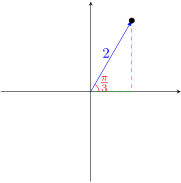
Suppose a point has polar coordinates \((r, \theta) = \left( 2, \frac{\pi}{3} \right)\text{.}\) What are its Cartesian coordinates?

Solution

Graphically, the point is located here, 2 units from the origin:

From the right triangle we've drawn in, the point's \(x\)-value is \(2 \cos \frac{\pi}{3} = 1\text{,}\) and its \(y\)-value is \(2 \sin \frac{\pi}{3} = \sqrt{3}\text{.}\) Therefore, in Cartesian coordinates, the point is \((1, \sqrt{3})\text{.}\)

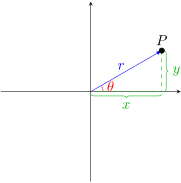
We see that, in general, polar coordinates \(r\) and \(\theta\) are related to Cartesian coordinates \(x\) and \(y\) by \(\boxed{x = r \cos \theta}\) and \(\boxed{y = r \sin \theta}\text{:}\)

In addition, by the Pythagorean Theorem, \(\boxed{r = \sqrt{x^2 + y^2}}\text{.}\)

Note: A point can be expressed in polar coordinates in more than one way. For example, the point \((r, \theta) = \left( 2, \frac{\pi}{3} \right)\) can also be expressed as \((r, \theta) = \left( 2, \frac{7 \pi}{3} \right)\text{.}\) As another example, the origin can be expressed in polar coordinates as \((r, \theta) = (0, \text{anything})\text{.}\)

Subsection 2.1 Basic equations in polar coordinates

We are familiar with describing curves in \(\R^2\) using equations like \(y = \sin x\text{.}\) We will often want to do the same thing with polar coordinates.

Example 2.2

What do the following equations describe?

  1. \(r = 2\)

  2. \(\theta = - \frac{\pi}{3}\)

Solution

Let's look at each separately.

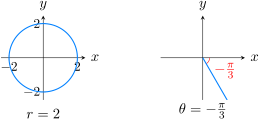
  1. Since \(r\) represents distance to the origin, the equation \(r = 2\) describes all points that are 2 units from the origin. This is the circle of radius 2 centered at the origin.

  2. The set of all points with \(\theta = -\frac{\pi}{3}\) forms half of a line, starting at the origin and extending forever in only one direction. (A “half-line” is called a ray.)

Subsection 2.2 More interesting equations in polar coordinates (optional)

As the above example suggests, polar coordinates will be especially useful to us when we deal with circles. But let's also take a look at some more interesting shapes that have simple descriptions in polar coordinates.

Example 2.3

What does the equation \(r = 2 + \sin(3 \theta)\) in polar coordinates describe?

Solution

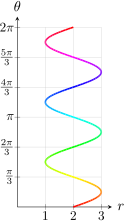
Here's one way to picture such an equation in polar coordinates. First, graph the equation in the \(r \theta\)-plane:

(Although we restrict \(r\) to be \(\geq 0\text{,}\) \(\theta\) can have any value, so we could extend this graph to \(\theta < 0\) and \(\theta > 2 \pi \text{;}\) it simply repeats.) Now, to picture the equation in the regular \(xy\)-plane, picture wrapping the above graph circularly around the origin, so that \(\theta = 0\) stays where it is (along the positive part of the horizontal axis), the lines where \(r\) is a constant become circles, and \(\theta = 2 \pi\) wraps to be on the positive \(x\)-axis; play the video below to see that in action:

What you see at the end of the video is \(r = 2 + \sin(3 \theta)\text{.}\)

As you can imagine, it is quite difficult to write an equation for this shape in Cartesian coordinates.

Example 2.4

Can you figure out what the equation \(r = \theta\) looks like?

Solution

We can use the same strategy as in the previous example; here's a video that shows that. The final result is \(r = \theta\text{:}\)

Example 2.5

What does \(r = 6 \sin \theta\) look like?

Solution

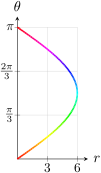
We can try the same strategy as in the previous example. Since \(r\) must be non-negative, when we graph \(r = 6 \sin \theta\) in the \(r \theta\)-plane, we only care about \(\theta\) between \(0\) and \(\pi\text{:}\)

If you picture wrapping this around circularly as in the previous two examples, you should see that we get an oval-ish shape. But, unlike in the previous examples, it's actually easy to convert \(r = 6 \sin \theta\) to Cartesian coordinates, and that will give us a more precise picture of the curve.

Recall that polar and Cartesian coordinates are related by \(x = r \cos \theta\) and \(y = r \sin \theta\text{.}\) Although our equation \(r = 6 \sin \theta\) doesn't involve either, we can multiply both sides by \(r\text{:}\)

\begin{align*} r^2 \amp = 6 r \sin \theta \\ \end{align*}

Now, this is easy to rewrite in polar coordinates:

\begin{align*} x^2 + y^2 \amp = 6y \\ x^2 + y^2 - 6y \amp = 0 \\ \end{align*}

The key to figuring out what this looks like is to complete the square by adding 9 to both sides:

\begin{align*} x^2 + y^2 - 6y + 9 \amp = 9 \\ x^2 + (y - 3)^2 \amp = 9 \end{align*}

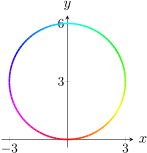
Now, we can see that this describes the circle centered at \((0, 3)\) with radius \(3\text{:}\)