
A curve (whether it's in \(\R^2\) or \(\R^3\)) is 1-dimensional.
A surface in \(\R^3\) is 2-dimensional.
A solid in \(\R^3\) is 3-dimensional.
Points are 0-dimensional.
Section 3 Dimension
¶We're familiar with picturing sets of points in \(\R^2\text{.}\) For example, the set of points \((x, y)\) in \(\R^2\) satisfying \(x^2 + y^2 = 1\) is a circle, while the set of points in \(\R^2\) satisfying \(x^2 + y^2 < 1\) is a disk.

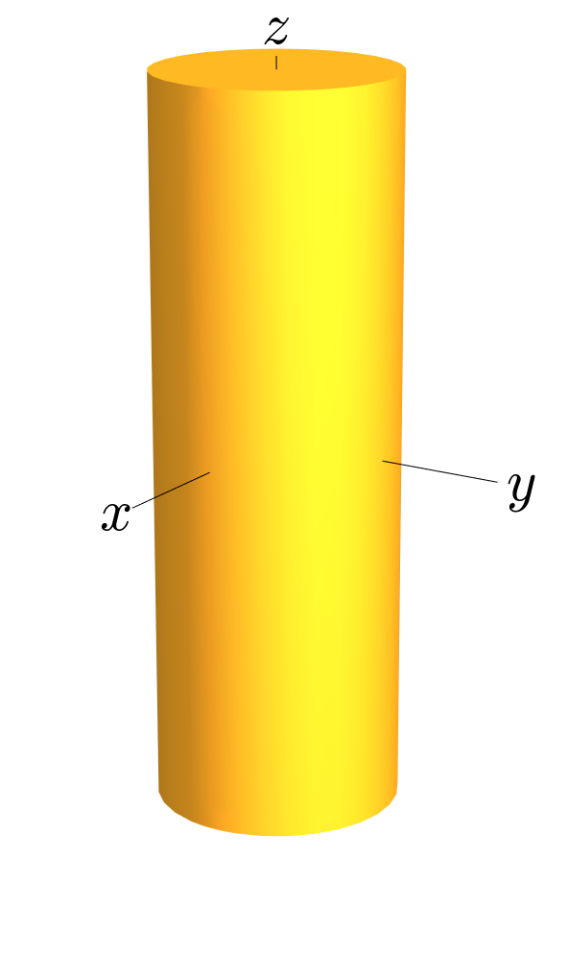
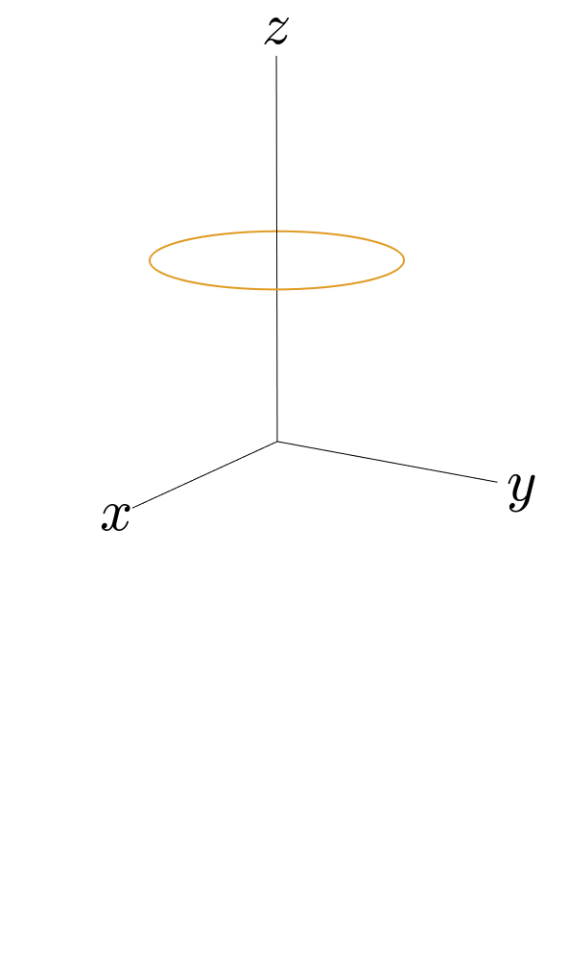
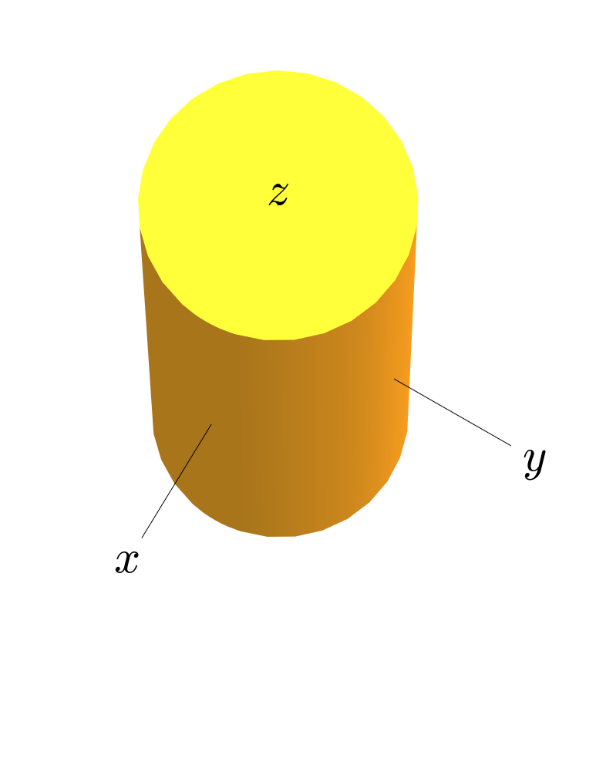
What about in \(\R^3\text{?}\) Now, the equation \(x^2 + y^2 = 1\) describes a cylinder (since \(z\) can be anything). And \(x^2 + y^2 < 1\) describes the interior of that cylinder, which is a solid. The pair of equations \(x^2 + y^2 = 1\text{,}\) \(z = 3\) describes a circle, which is a curve. These objects are shown below from two viewpoints. (Note that both \(x^2 + y^2 = 1\) and \(x^2 + y^2 < 1\) extend forever up and down, but we have no hope of drawing that!)
| \(x^2 + y^2 = 1\) (surface) | \(x^2 + y^2 < 1\) (solid) | \(x^2 + y^2 = 1, z = 3\) (curve) | ||
 |
 |
 |
||
 |
 |
 |
When we study objects like these, it's helpful to talk about their dimensions. You might think that objects in \(\R^2\) are 2-dimensional and objects in \(\R^3\) are 3-dimensional, but that's not what mathematicians mean when they talk about dimension. (We sometimes call that ambient dimension, so saying that an object has ambient dimension 2 is just another way of saying the object lives in \(\R^2\text{.}\))
Intuitively, the dimension of an object tells us how many independent directions somebody living in the object could move forward/back in. For example, think about a plane in \(\R^3\) like the one shown below:

An ant living on the plane could go in the red direction (let's call that “north/south”) or in the blue direction (let's call that “east/west”). Any other direction the ant could go, like southeast, is a combination of north/south and east/west. So, there are really just 2 independent directions the ant can move in, which is why we say that the plane is 2-dimensional (even though the plane has ambient dimension 3 because it sits in \(\R^3\)).
With this idea of dimension:
Here's another way to think about why we say a surface in \(\R^3\) is 2-dimensional. Imagine that you zoomed in a lot on the surface, or that you're something incredibly tiny living on the surface. At a typical point on the surface, the surface looks flat to you (just think of how we live on the surface of the Earth, which is roughly a sphere, but when we look at the ground, it appears flat). In other words, if you're somebody tiny living on the surface, the surface looks an awful lot like \(\R^2\) to you; therefore, it's reasonable to say that the surface is 2-dimensional.
A rigorous mathematical definition of dimension is actually pretty difficult to state, so we won't do that here; if you're interested, you should take a course like Math 132 to learn more!
Subsection 3.1 Rules of thumb
Let's look at several more examples to get a better idea of how an object's mathematical description is related to its dimension.
Example 3.1
Let's start with a few examples in \(\R^2\text{.}\) Consider the following five objects in \(\R^2\text{:}\)
\(xy = 6\)
\(x^2 + y^2 = 16\)
\(x^2 + y^2 > 16\)
\(xy = 6\) and \(x^2 + y^2 > 16\)
\(xy = 6\) and \(x^2 + y^2 = 16\)
Can you figure out what each one looks like and what its dimension is? Give it a try before reading the answers below.
Solution


Here are the first three:
The first two are curves, so they're 1-dimensional (a bug on the curve can walk forward/backward along the curve but not in any other independent direction). The third is 2-dimensional (a bug in the middle of this region could walk in 2 independent directions, the \(x\)-direction and the \(y\)-direction). Here are the last two (in blue), shown with \(xy = 6\) and \(x^2 + y^2 = 16\) in gray:
It makes sense to say the last example is 0-dimensional because a bug on one of the points can't move at all; there are 0 directions it could go!
These examples illustrate a few rules of thumb.
Adding an equation typically decreases the dimension by 1. For example, \(\R^2\) is 2-dimensional but adding one equation like \(xy = 6\) results in something 1-dimensional. Adding another equation like \(x^2 + y^2 = 16\) (so that we're looking at points with both \(xy = 6\) and \(x^2 + y^2 = 16)\) results in something 0-dimensional.
-
Adding an inequality typically doesn't change the dimension. For example, \(\R^2\) is 2-dimensional, and adding one inequality like \(x^2 + y^2 > 16\) results in something that's still 2-dimensional.
As another example, \(xy = 6\) is 1-dimensional, and adding the inequality \(x^2 + y^2 > 16\) (so that we're looking at points with both \(xy = 6\) and \(x^2 + y^2 > 16\)) results in something that's still 1-dimensional.
Example 3.2
If you go back to the examples at the beginning of this handout, you should see that they also fit these rules of thumb. For example, the inequality \(x^2 + y^2 < 1\) in \(\R^3\) describes a solid cylinder, which has dimension 3 (the same as \(\R^3\) itself).
On the other hand, the equation \(x^2 + y^2 = 1\) has dimension 2 (1 less than the dimension of \(\R^3\)). Adding an inequality to this\,—\,for example, by looking at the points with \(x^2 + y^2 = 1\) and \(z > 0\)\,—\,still gives us something 2-dimensional.
Having two equations, like \(x^2 + y^2 = 1\) and \(z = 3\text{,}\) gives us something 1-dimensional; each equation reduces the dimension by 1.
Example 3.3
You might wonder why we call these “rules of thumb” rather than simply “rules”. The reason is that, although these rules of thumb generally hold true, there are exceptions. For instance, the equation \(x^2 + y^2 + z^2 = 0\) in \(\R^3\) describes a single point (the origin), so it's 0-dimensional even though our rule of thumb says a single equation in \(\R^3\) should describe something 2-dimensional.
Of course, if we looked at \(x^2 + y^2 + z^2 = a\) for any positive value \(a\text{,}\) our rule of thumb would work; it's only when \(a = 0\) that we have an issue. Mathematicians call exceptions like this degenerate cases. You should be aware that these exist, but they are atypical.
Subsection 3.2 Why is dimension important?
There are a few reasons the idea of dimension will be important in Math 21a. First, knowing the dimension of an object is often the first step toward figuring out how to describe the object mathematically. For example, in \(\R^3\text{,}\) a plane is 2-dimensional, and we expect 2-dimensional objects in \(\R^3\) to be described by a single equation. So, it's reasonable to think we can describe a plane using a single equation, and we'll do this in a few weeks. On the other hand, a line is 1-dimensional, so we don't expect to be able to describe a line using a single equation; we'll need to figure out some other way of describing lines.
We'll also see that the dimension of an object is very important when we study integration. It turns out that the way you integrate over a 1-dimensional object in \(\R^3\) is different from the way you integrate over a 2-dimensional object in \(\R^3\text{,}\) which is different from the way you integrate over a 2-dimensional object in \(\R^2\text{!}\) The idea of dimension will help us figure out what types of integrals are appropriate in different contexts.
In 21a, you should make it a habit to think about the dimension and ambient dimension of every object you encounter; it's the first step to making sense of any multivariable situation!