Math E-320: Spring 2012
Teaching Math with a Historical Perspective
Mathematics E-320: The floppy
Instructor: Oliver Knill
Office: SciCtr 432
Email: knill@math.harvard.edu
|
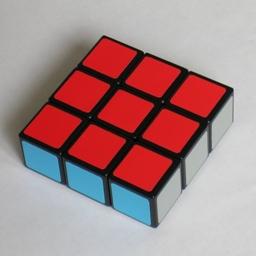
The floppy puzzle consists of one third of the Rubic cube.
It is a wonderful example to show the concept of groups since
it does not have the complexity of the Rubik cube (*)
On the other hand, we can teach and learn the solution to the floppy in 10 minutes.
The group has 192 = 4! * 23 elements and is so
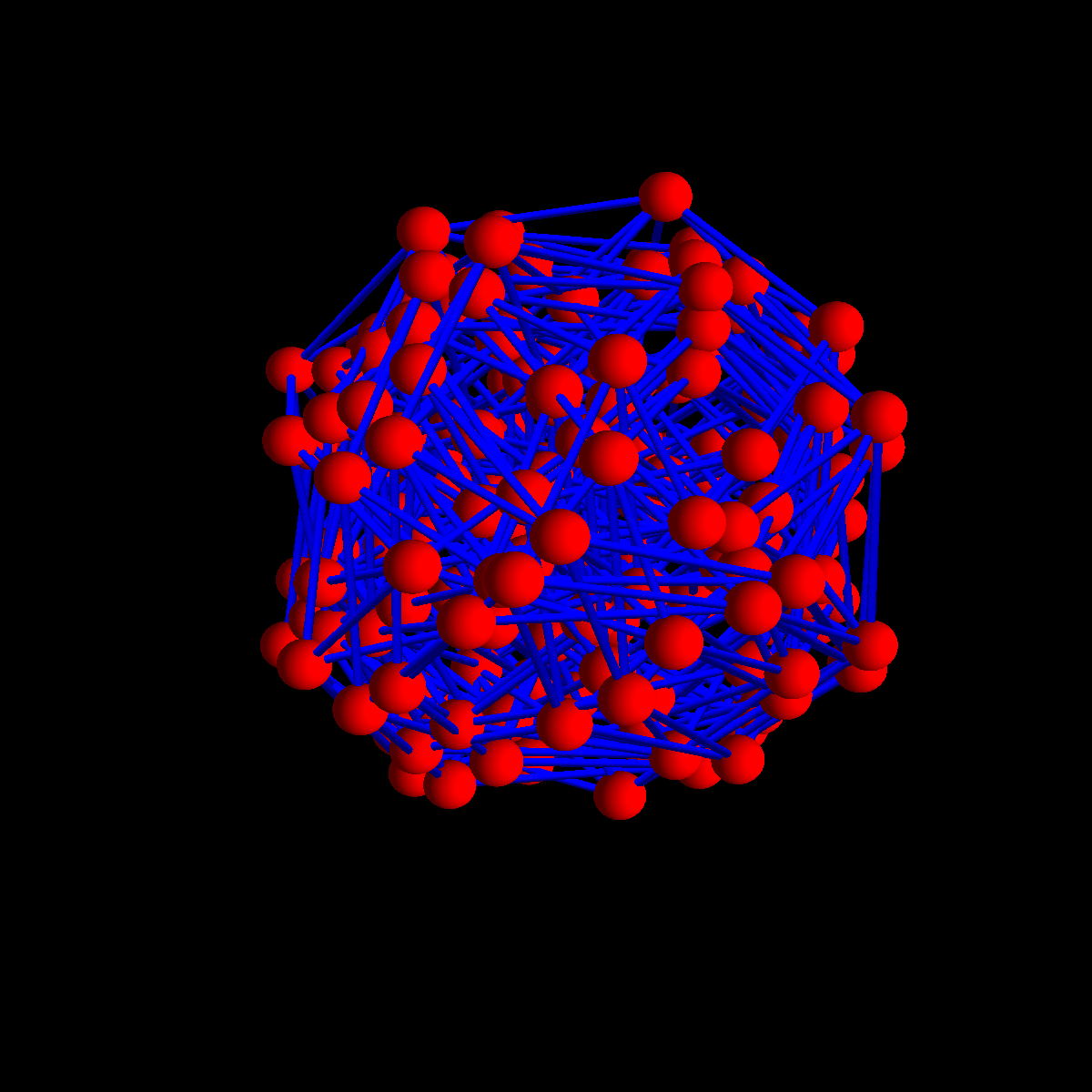
small enough that we can also visualize the Cayley graph
which is the graph showing all configurations as nodes.
Two nodes are connected if there is a move which maps a
configuration to the other, where a move is an flip.
Below you see the a visualization of the Cayley graph of the floppy
computed in Mathematica. Because the group is so small, it can be kept as a whole in the computer. We can measure things out like the diameter. The diameter of the floppy is 6. You can with 6 moves reach from any position to any other position. This is the "God's number for the floppy". The corresponding question for the Rubik cube was solved only in 2010. The Rubik cube has 43'252'003'274'489'856'000 positions. A computer can not hold all of them in memory. Still it is today known that the diameter is 20. It is known to be the God number. |