The projects tickle in. The program being pretty free, students have
traditionally been able to chose from a variety of formats, from prose to picture book,
worksheet, presentation. This year, one student (Luke Hatfield) wrote a
website where some of the
concepts are illustrated.
More about the projects to come here.
To the computing lecture
David writes about the Aiken Mark I at the Harvard Science center:
"It used to be on the ground floor of Aiken labs
(which was torn down to build the new computer science
department) and when it was there we were allowed to play with it. I
used to turn it on sometimes and watch it whirr."
David also clearly realized the reason for the rather strange statistical
behavior of the first significant digit of the prime numbers: they grow too slowly
so that one has long intervals, where one single digit dominates. The statistics
depends on the number of primes considered and does not converge.
Was Ada Lovelace
really a programmer since her programs were never ran. Some do like
this page.
On the slide rule, David recall a joke:
The engineer's answer to "how much is 2x2" -- he pulls out a slide rule
and says, "2 times 2 is 3.99 -- oh heck, let's just call it 4".
If you want to play Music with Mathematica. Here is the function which gives
you the frequency of the key x on the piano. Then play all 88 keys of the piano
in 5 seconds.
f[x_] := N[440 2^((Floor[x] - 49)/12)];
L = 5; Play[Sin[2 Pi f[88 x/L] x], {x, 0, L}]
And here is a piano where we have 19 steps in one octave:
f[x_] := N[440 2^((Floor[x] - 49)/12)];
L = 5; Play[Sin[2 Pi f[88 x/L] x], {x, 0, L}]
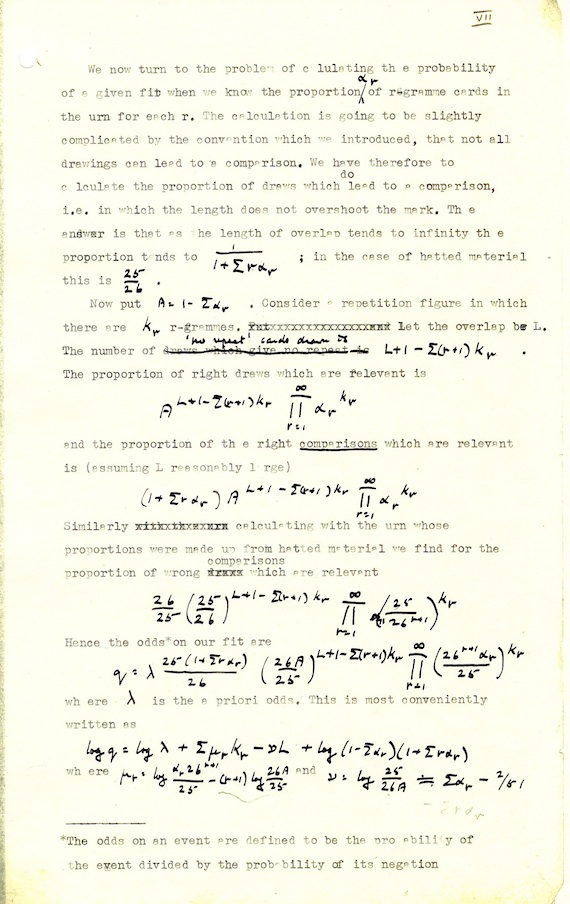
David writes on microtonal music:
On micro-tonal music -- I took a music theory course at the
University of Chicago from Easley Blackwood. Although our course was
on basic music theory in the classical tradition, he made his own
mark in micro-tonal music and I have a record of his in which he
plays an etude in each micro-tonal tuning from 13 through 24
equally-spaced notes per octave. Most of them are not all that
interesting but some were very nice; I wonder if his 19-note one was
particularly good and will have to go find it. He also developed a
notation on the 5-line musical staff that worked fairly well for
these notes.Here
is a link to his CD on Amazon.
Sarah pointed out a Scientific american article about roots of polynomials which produce fractal type pictures. See also here. From the article:
What Christensen and Derbyshire did was plot the roots of entire families of single-variable polynomials, imposing constraints on the polynomials' degrees and coefficients. For esxample polynomials whose degree 6 polynomials with coefficients taking integer values between -4 and 4.
This is an interesting story. It does not seem to be related to dynamical systems (yet?).
A couple of pages of
Pincocks book
are on the exhibit page.
There are quite a few Caesar Cypher online tools like
Briangle.
We mentioned the
Kasiski examination
in class since the example on the white board just gave an example how repeated
patterns allowed to reveal the length of the code word.
Here are a few slides from a CS course.
We have seen that RSA relies on the difficulty to factor large integers.
Here are The RSA Challenges.
Can you factor those integers?
As mentioned in the class, the difficulty of this dimension lecture
was the log. Below are the rules of the logarithm we have used to understand
the formula
dim(X) = -log(n)/log(r)
if n pieces are needed to cover the object X with boxes of length r.
Some have wondered how to derive this. The intuition is that one needs
n = (1/r)^dim(X)
boxes of size r to cover the space. Now solve this for dim(X) and you get the above
formula.
Here are the rules of log:
log(exp(x)) = exp(log(x)) = x log is inverse of the exp, this defines the log.
log(x y ) = log(x) + log(y) Multiplication becomes addition. Secret of the slide rule.
log(1) = 0 Multiplicative unit 1 goes into the additive unit 0.
log(x^y) = y log(x) Logs allow to define general exponentials xy
log(1/x) = -log(x) Reciprocals change sign in log coordinates
Sarah, David and Caroline wondered independently
how to get fractals of other dimensions than the ones seen.
Fractals of arbitrary dimension between 0 and 1 can be obtained by
modifying the Cantor set construction. Start with the unit interval
Cut out a piece of side length 1-2a so that two intervals of length a
remain. Since we need in step m a number of n=2m intervals
of length r=an to cover the set, the dimension is
dim(X) = -log(n)/log(r) = -log(2)/log(a)
For a=1/3, this is the dimension log(2)/log(3) of the usual Cantor set.
If a goes to 0, then the dimension goes to zero. If a goes to 1/2, then
the dimension goes to 1.
It is natural to conjecture that all fractals have irrational dimension, but
one can design fractals with rational dimension too.
Caroline wondered what is the dimension of the Mandelbrot set. It is interesting
that the boundary of the Mandelbrot set has dimension 2.
The posterchild of a fractal is technically speaking not a fractal. Caroline also
wanted to see examples of higher dimensional fractals. It would be an
interesting project to find fractals say in 4 dimension and visualize them in
space.
Andrew noted during class that the dimension of the Koch snowflake is
twice the dimension of the Cantor set. This is because in the Cantor set
one interval gets replaced by 2 and in the Koch curve, one interval gets
replaced by 4.
David tried out what happens if the Koch curve starts with a square
etc. If one replaces each side with 4 in each step, the dimension still
stays log(4)/log(3). We could adjust the length and cut each side into
pieces of length a, 1-2a,a then replace the middle one with a
equilateral triangle of length 1-2a.
David wondered wither one could get curves of ANY dimension
between 1 and 2 using other rules?
Sarah had asked this also in the break and yes, the answer is that
you can get any dimension. For the Cantor set, we just have to scale
differently. Also in the Koch curve case, we can make the lines longer
and get different fractals with different dimension.
David you mentioned that the coastline of a state has
been determined to have a specific dimension. I'm not sure how you
could possibly determine the actual dimension of a natural object
like a coastline, when it is not nearly as regular as our
mathematically-defined objects where we know for sure which pieces we
are taking out, but let's accept that as a given. But if you can do
it for a short distance, aren't there different dimensions in
different parts of the coastline? Can you add dimensions (if you
have a curve of dimension 0.7 and another half of the curve has
dimension 0.9, what is the dimension of the whole curve?).
This is an experimental thing. Collect data for different r and measure
how long the coast is. The growth rate interpolation is the dimension.
It is a statistical measure. The dimension in general depends from point to
point. One can imagine parts, where the dimension is close to one, and other,
rough parts, where the dimension is close to 2.
David also wondered, that the dimension of the Cantor set or Koch curve
is one at every step of the construction but in the limit jumps to the fractional
dimension. Indeed, it is only in the limit that these fractals appear. However,
if we finish after say 20 steps and go about to measure the dimension, we
would measure the dimension of the limiting object as long as we do not
take boxes smaller than 1/3^20. But thats about the size of an atom.
About the length of the Koch curve: In step k, the length of the curve
3 (4/3)^m. The length goes to infinity. It is surprising that the length of
the curve goes to infinity even so the region stays in the same place.
Our lungs can be approximated by a fractal too. The Lung is located in a relatively
small volume of our chest, still, the total surface area is the size of a tennis court
and 1500 miles of airways. (Notter, Lung surfactants).
Karen pointed out connections to Fractal music. Indeed, musicians have used inspiration
from Fractal geometry to generate music.
here here is a link to a page dealing with this.
To the topology lecture
David asks:
For basic topological shapes, are we assuming solid shapes or hollow
shapes? Assuming solid, I wasn't sure how a hollow sphere works (I'm
thinking a hollow sphere with a real thickness -- not just an
infinitesimal shell) -- is that zero holes? Or one hole, even though
from the outside it looks like a sphere? Is it like a donut? I
don't see how to transform a hollow sphere into either a solid
sphere, or a donut. I guess the first question is what is its Euler
characteristic, but then how do you transform it into something else
with the same characteristic?
Actually, it seems to me that a hollow sphere WITH a hole in it, is
just like a sphere, because then you can stretch it into a single
solid shape....
Everything works also with three dimensional shapes. There however
one has also to look at three dimensional "spaces". The Euler characteristic
is then V-E+F-S. Interestingly this is always zero for three dimensional
surfaces without boundary. For three dimensional spaces, the Euler characteristic
is not enough to distinguish spaces. What matters also is for example the
number of holes as you mention. But this is not all. Even that does not
suffice to tell when two three dimensional manifolds are topologically
equivalent. The Poincare conjecture, quite recently proven just established
that every space in which every closed loop can be contracted to a point
must be a sphere.
The Klein bottle you showed -- can you fully represent it in 4D
space? A Moebius strip is really a 2D shape but you need 3D to
fully represent it, right?
Yes, one can. One possibility is to use color as the forth dimension
and if at the intersection points the colors are different then this
shows that there is an embedding in four dimensional space.
I read a Lewis Carroll story excerpt (from Sylvie and Bruno
Concluded,1893, a lesser-known novel for good reason since it isn't
all that good on the whole) about a Klein bottle. He called it
"Fortunata's purse" because everything that is outside it is also
inside it, so whoever owns it has the whole world in their purse.
The text is online here: http://sakredchao.tripod.com/fortunatus.htm
A character thinks she understands how to construct one, but ends
by saying, "I'll sew it up after tea."
Although I've known about the 5 platonic solids, I had never seen the
duality between Cube/Octahedron, 12/20, and the self-duality. That
was neat, and also neat how it fits into Euler's formula. I started
reading Euler's Gem yesterday so perhaps that will answer some of my
questions.
Thats a very nice book.
For the non-convex polyhedra, I wasn't sure WHY you don't count all
the edges and vertices but instead consider lines to be
self-intersecting. Also, if you DO decide to count all the edges and
vertices that you can see on the outside, and not consider it to be
self-intersecting, then wouldn't it obey the V+E-F=2, since it has no
holes?
Regular polytopes are assumed to be made of identical polygons so
that every vertex looks the same. These Kepler-Poinsot polytopes
can not be realized in space without selfintersections.
Good pictures and more information is on the
Wikipedia page.
To the probability lecture
The riddle: "Dave has two kids. One is a boy who was born at night. What is
the probability that the other is a boy" gave a lot of discussion. Amazingly
some of the class (like Charles) have intuition about this. I have a lot of
problem to see why the fact that "born at night" makes a difference. Here is
the case analysis we have done in class
BB
BG
GB
GG
NN
X
X
X
ND
X
X
DN
X
X
DD
You see that there are 7 cases and among these 7 cases, there are 3
cases, where both are boys. The probability is 3/7 which is between
1/3 and 1/2.
Sarah made a detailed analysis and generalized the situation where
one knows that the boy is born in some time interval. If the day is
divided into n pieces, she found that the probability goes to 1/2.
In some sense, by narrowing the time interval in which we know one boy
was born, we make the event that this applies to both boys less and
less likely and we get to a situation where the chance that the second
child is a boy becomes 1/2. The information that one boy is born at 7:45:23
for example makes this boy pretty unique. The chance that the second boy
also qualifies is practically zero. So, the second child probability of
being a boy is close to 1/2.
I had assumed in the combination lock problem that the three numbers
are all different. It seems that there are combination locks, where
numbers can appear several times.
It seems that the masterlock has more structure as Andrew has
found.
David has an interesting variant of the Martingale strategy:
"It seems like with infinite time and
money you are guaranteed a win even at terrible odds. You could
imagine playing at much worse odds (bet on the number 17 instead
of red, and keep doubling your bet if you lose). Eventually you will
not only win, but win REALLY BIG -- you'll make MUCH more than you
lost , at the 36-to-one payoff for a single number. And that is
guaranteed."
Here are more comments of David:
You mentioned the people who went in with cameras and a computer in
their shoe. I read their book -- The Eudaemonic Pie by Thomas Bass
-- and it was quite fascinating. As I recall, they couldn't be sure
exactly where the ball would land, but they were able to narrow it
down to 1/4 of the board, and so by placing bets on those 9 or so
numbers, at a payoff on each one of 36-to-1, they could make a
killing very quickly. I don't think they were arrested, but I'm also
not sure they actually dared play enough to win big -- after all,
getting people angry who run gambling joints is not always a good
idea :). The book suggests that they COULD have won, but didn't.
Then again, maybe they didn't tell us the whole story.
The Monty Hall problem: this is one that is SO HARD to explain to
people. Here is how I have explained it to people who refuse to
accept the answer with 3 doors: suppose you have 1,000 doors -- one
car and 999 goats. You pick a door, and Monty Hall then shows you
goats behind 998 of the other doors, leaving just the one you picked,
and one more. More people (still not all) now believe that it is
better to switch.
One problem people have is that in real life, the actual game was not
quite as simple as the probability puzzle version. The real Monty
Hall, for instance, did not always ask if you wanted to switch doors,
and we have to wonder if he tended to ask "do you want to switch"
more often if you had chosen the car than if you had chosen a goat.
He knew where the car was, after all.
The other way to convince people, if they really don't believe you,
is to offer them to play the game for , as long as they're
willing to play at least 100 rounds. When they've lost a lot of
money maybe they'll believe you. They think they're making an
average of per round, really they're losing .67 (on average).
I'd heard the "one child is a boy" problem before from Martin
Gardner, but never the "boy born at night" part. That is beautiful
-- I followed along on paper and got the same result (3/7 = 42%) as
you got. But as you said, it seems truly impossible. Now I wonder:
how much more information do we need before we get to 50% ? Is it
infinite? Suppose we tell you also that he once had chicken pox, and
that he has red hair and dimples. Does that bring us closer to 50%?
Further away? I am curious. Will need to do some larger tables.
Also Sarah has pondered this question and we convinced ourselves
afterwards that we can creep like this more and more to 50 percent.
Its fascinating and actually an interesting question how much
additional information changes the outcome.
I also loved the question asked in class (not sure by whom) that if
you know the boy was born during the day, then you also get to 3/7.
So this is truly a paradox. Either the kid was born at night or
during the day, after all. Either way, the probability of two boys
is 3/7, but if you DON'T ask the question, then the odds are 1/3.
Not possible! But how can there be paradoxes in simple
probability? There must be something we're missing. Now that I see
this, I think maybe Martin Gardner did raise this issue but I can't
put my hands on it.
Conditional probability can be counter intuitive. The events are not
completely seperate since one boy can be born at night, the other born
during the day. So there are experiments in both.
On the line-through-a circle paradox, I don't agree with the 1/3
answer because I think the odds of the angle being any particular
angle (the second version of 1/3) are necessarily uniformly
distributed. But I'm not sure how to explain the difference between
the 1/4 and 1/2 answers.
Yes, it is probably the most unintuitive models. Each of the models
has its justification and if you set up the experiment according to those
rules, you get the probability 1/2 or 1/3 or 1/4. What happens "really"?
If you throw the line you place its center, spin and role it at the same
time, you probably get some mixture of the three, maybe something close to
1/3. It really depends on how the experiment is setup.
On June 22, 2013, a reader Jeff wrote:
Google led me to your blog at
http://www.math.harvard.edu/~knill/teaching/mathe320_2011/blog.html .
Unfortunately, your answers to the two-child problem ("Dave has two
children. One child is a boy. What is the probability that the other child
is a girl?") and Gary Foshee's variant (the boy was born at night) are
wrong. The answer is 1/2 to both. And no, I am not confusing the problem
with "Dave's oldest child is a boy." The 1/2 answer has a firmly established
history that few seem to remember. It goes back to Joseph Bertrand in 1889,
and includes when Martin Gardner himself retracted the answer of 2/3 (well,
of 1/3; he asked the opposite question).
First, let me treat the Monty Hall Problem the same way you treated the Two
Child Problem. First, introduce the probability space of all possible events
S={CGG, GCG, GGC}, indicating the position of the car and the goats, with
P[{CGG}] = P[{GCG}] = P[{GGC}] = 1/3. Let MH={CGG, GCG} be the event where
there is a goat behind the door Monty Hall opened, and W={GCG} be the event
where you will win by switching. The we get:
P[W|MH] = P[W&MH]/P[MH] = (1/3)/(2/3) = 1/2.
Yet we know this is wrong. The reason it is wrong, is because it addresses
the wrong question. It answers the situation where you asked Monty Hall to
open door #3, not the one where he picked it himself. The correct
probability space uses S'={CGG1, CGG2, GCG3, GGC2}, MH={CGG3, GCG3}, and
W={GCG3}; where the number indicates the door Monty Hall opens. Here,
P[{CGG1}] = P[{CGG2}] = 1/6 and P[{GCG3}] = P[{GGC2}] = 1/3. And now we get:
P[W|MH] = P[W&MH]/P[MH] = (1/3)/(1/6+1/3) = 2/3.
Similarly, in the two child problem, you are just as likely to "know," or
"be told,", about either the girl or the boy in a GB family. Or a boy born
during the day in the variant. If you do that, you will find the answer is
always 1/2.
These are all a generalization of Bertrand's Box Paradox, which can be
characterized by
1) A set of N random objects that
2) Each possess at least one of two symmetric properties, but might have
both; and
3) M is smaller than N/2 have just property #1, or just property #2. The rest have both.
When you learn that an object has property #1, the first instinct is to say
that the chances are (N-2M)/(N-M) that it has both. But you would say the
same thing if you had learned that it had property #2. But if both are true,
the law of total probability says the probability it has both is
(N-2M)/(N-M) even if you don't learn anything. Yet we know that probability
is (N-2M)/N.
The paradox is resolved by assigning a probability of 1/2 to learning about
either property when the object has both.
The Two Child Problem is almost identical to Bertrand's original, only
changing N=3 to N=4 and leaving M=1. Monty Hall is identical to the
original, but only after realizing that the properties are "there is a goat
behind Door #2 or #3".Answer:
Gardner has used both variants and got it correct.
The second answer leading to 1/2 applies only when changing the problem.
Here is a paper about it.
Version ii) on page 2 of this article is clearly a different problem.
I don't think anybody would interpret the problem like that.
In the original problem, "Dave has two kids, one of them is a boy.
What is the probability that the other is a boy" the answer is 1/3.
If the problem is phrased "Dave has two kids, the first is a boy.
What is the probability that the other is a boy", the answer is 1/2.
Controversies are always interpretation or language problems which
actually should be avoided. Maybe it is a communication problem. For me,
the Boy-Girl problem asks for the conditional probability
of the event {BB} conditioned to the event
{BB,BG,GB} in the probability space Omega = {BB,BG,GB,GG} with uniform
probability measure {1/4,1/4,1/4,1/4}. If we agree that this is the
mathematical reformulation of the problem then the answer is 1/3. If
we do not agree, then we look at different problems and have a language
clash. One can always change the problem as Gardner discussed in his
second article, but then the problem becomes a different one.
His modification is NOT a "retraction". Here is an
article
which addresses "boy born at night problem".
To the set theory lecture
Not all slides seem have been seen today:
Quicktime of slides (webquality only).
We have seen the Continuum hypothesis stating that there is no
cardinality between the cardinality of the integers and the cardinality
of the reals. David asked whether there is a simple proof that the
integers have the smallest infinite cardinality.
To see this, one has to note that if A is a subset of B then the cardinality
of A is smaller or equal than the cardinality of B. Now, given a set B, we
can start picking elements and so counting the members. If it stops, then
we have a finite set and the cardinality is the number of elements. If it does
not stop, then we have found a subset A of B which has by definition the cardinality
of the integers. Because A is a subset of B also B must have the cardinality
of the integers.
Here is a
Youtube video showing
an other proof that the rational numbers have the same cardinality than the
natural numbers.
Some comments and questions of David could be interesting to everybody
My first question about the lecture is about plus and times in set
theory, or specifically + : why is + defined as the union minus the
intersection, rather than just the union? I would have assumed + is
OR and x is AND. Wouldn't everything work the same if + is defined
as just plain union? Commutativity, association, and distributivity
all work as far as I can tell, and the empty set is still the "0".
It works only with XOR = + , not OR, which is the union. The union
is not good for arithmetic.
Aha -- maybe the problem is that with just plain union, there is no
inverse? Which of course there isn't, since there's no way to get
back to the null set once you have anything at all. So maybe I just
answered my own question.
yes exactly. It is not a group.
Second question: in Cantor's proof of counting the rationals (the
triangular version you used, or Cantor's first diagonal proof) --
there are a lot of duplicates, e.g. 1/1 and 2/2 are both listed, and
1/2 and 2/4 are both listed. Why is that not a problem with the
proof? We're trying to get an exact one-to-one correspondence, but
aren't 1/1 and 2/2 the same fraction? Don't we really want only the
ones that are in lowest terms?
Good point. Yes, one has to jump over the duplicates. Just cross them
out when counting.
The Ulam spiral nicely takes care of the fractions larger than one
and the negatives, but it still doesn't answer the other issue above.
Is it okay to just leave them out as you go, for numbers that are not
in lowest terms? How do we know for sure that that still works?
Maybe you're leaving out an infinite number that has a different
cardinality and therefore there's some problem with the proof.
yes, also with the Ulam spiral which is an alternative to the triangular
picture, one can just jump over each douplicate
Another question: I've always been troubled by the idea that as long
as there IS a way of showing one-to-one matching, then the two sets
are the same size even if there is also a way of matching that leaves
some out. With two finite sets, there is NO way of matching them
that leaves some out. Is that perhaps the difference between finite
numbers and infinite numbers? Is that the DEFINITION of the
difference?
For finite sets, the cardinality is equal if they have the same number
of elements. Before Cantor, it was not clear how to compare
cardinality.
The second diagonal proof (non-countability of reals), however, I do
not have a problem with -- once you can prove that there is NO WAY to
put them in one-to-one correspondence, then clearly they can't be the
same size. However, I do have a question that I haven't figured out:
why can't you use the same argument for the rationals to show that
the rationals aren't the same size as the naturals? Just lay out
all the rationals between 0 and 1 in decimal form instead of as
fractions, and change one digit for each one.... Why does the proof
work for reals but not rationals?
very good question. The proof still works but it will just produce you
an irrational number, a number not in the original list. We know that
already, because sqrt(2) is already irrational.
There is actually a small problem with the proof for reals, although
it's easy enough to get around. What if the digits that you end up
with in the diagonal, after the first digit, are all 8s, so that the
new number you get by adding one to each digit gives you something
like 0.1999999999 which equals 0.2000000 which MIGHT be on the list.
But this we can get around by just saying that if the number is an 8
change it to something other than 9.
Yes, well observed. There is always the ambiguity with the decimal expansion. This is
not a problem for cardinality purposes. Since there are only countably
many of them.
On the countability of the algebraic numbers: I'll need to see this
better. Perhaps we're looking at a collection of diagonals. I see
how you can use a diagonal proof to count all the algebraics of any
GIVEN degree, but not that this necessarily follows when you have to
count an INFINITE number of degrees, even though all the degrees are
finite.
For the algebraic numbers, it is a bit more complicated. Yes we first
count all solutions to linear equations (the rationals) then all quadratic
and then all cubic etc. We can count the linear ones and put them in one line,
the quadratic ones in one line etc and then use again the Ulam spiral trick
to get through all of them. It is a similar challenge like the rationals.
I assume that infinite polynomials are NOT countable, right? That's
why you can write PI or E as an infinite series?
Yes, the set of infinite polynomials (taylor series) are not countable.
Indeed with infinite polynomials we can describe any real number as the
geometric series 1/(1-a) = 1+a+a^2+a^3 + ....
allows to describe any number between 0 and 1.
The continuum hypothesis issue is fascinating. I'd heard that, but I
still don't understand how there could possibly be such an infinity
in between N and R.
Yes, we can not have intuition about it because we can go both ways
and have in each case a valid mathematical building.
Is R (number of reals) the same size as the number called Aleph-one?
And is that the same as the number of sets of naturals? Or is that
equality part of the question about the continuum hypothesis?
Yes, aleph 0 is the usual name given to the cardinality of the integers,
and aleph 1 the cardinality of the reals. The set of all subsets of the
reals is even larger and has the cardinality alpha 2
If there were an infinity in between N and R, what would it look like
exactly? If we're allowed to decide that it exists, how do we define
it?
I don't know. I don't think anybody knows. It would be a strange construct
because there is a mathematics build on top of ZFC in which this is not possible.
Maybe I need to find a book that answers all these questions in
easy-to-read form. I learned the 2nd diagonal proof in 9th grade,
but I can't remember if we discussed all these ramifications, and
then in college we never looked at any of this. If you know a good
book please let me know. This is all fascinating. Poor Cantor....
Goedel Escher Bach does a goo job about paradoxa.
Also the Book by Eli Maor called "To infinity and Beyond".
Your comment about the theorems that make mathematicians go crazy
reminded me of a story "The Devil and Simon
Flagg" and actually appears in Clifton Fadiman's other collection of
mathematical stories, entitled "Fantasia Mathematica". The story is
available online at numerous sources, including
here.
Its interesting that before something is proven
there is a remote possibilty that the statement is true but that it is not provable.
That could be the case for Goldbach. This is part of the story in the novel of
"Uncle Pedros and the Goldbach conjecture".
The Epimenides paradox is not in fact a paradox as originally stated.
If he'd said "I always lie" that would be a paradox, but by saying
"The Cretans are always liars", all we need to solve this logically
is to conclude that there is at least one Cretan who is NOT a liar,
but that Epimenides IS.
I agree this is more precicely done with "I always lie"
On the Russell paradox: I understand it, but I've been troubled by
this idea of a set that contains itself. Can you give me an example
of a set that contains itself? How would you write it down? Here's
the empty set: {}. And here's the set of even numbers: {2, 4, 6
...} and here's the set containing 1, 3, and 12: {1, 3, 12}, and
here's the set containing those three sets: { {} {2, 4, 6, ...}, {1,
3, 12} }. And here's the set containing the above set-of-three-sets:
{ { {} {2, 4, 6, ...}, {1, 3, 12} } } But none of those sets contain
themselves. Can you write down a set that contains itself?
This is exactly the problem. But the point is that set theory should
be able to describe all sets. You could imagine define A={A} without
specifying what A is. We can talk about such an object. The problem
with the Russell set is that we can not even talk about this because
if it exists, then it does not exist and if it does not exist, then
it exists. The set A={A} might just not exist. That would be fine for
mathematics.
On the "no surprise exam" paradox -- isn't it the case that once I've
convinced myself, using the induction proof, that there cannot be a
surprise exam, you could still give a surprise exam ANYTIME (even on
May 3rd, the last day) and it would be a surprise, since I'd already
decided it couldn't happen!
The fact that there are two reasonings makes it a paradox. One gives
a surprise exam, the other does not. Does the paradox mean that we can
not do surprise exams ? ...
To the Calculus lecture
During the lecture, the question came up, when the concept of function was introduced.
Caroline reminded me about that and sent the
link
which tells that it was Johann Bernoulli in a letter to Leibniz in 1694
who gave a first definition and Leonard Euler who clarified.
Galileo already had a good understanding of the concept but it needed Descartes to
link the geometric and algebraic picture.
Several of you have asked about the "Calculus in 20 Minutes" source. Here is
a Youtube version
I did forget to bring up the example of the function f(x) = 2x in class.
It has the property that
D f (x) = f(x+1)-f(x) = 2x+1 - 2x = 2x
It is the exponential function if the Planck constant h is 1. For general h,
the exponential function is (1+h)x/h which has the property that
D f = f for
D f (x) = [f(x+h)-f(x)]/h
For h going to zero, we get to the classical exponential function ex which
has the property that d/dx ex = ex.
What we did in class is calculus with Planck constant 1. This is calculus which could
have been developed by the Greeks or even by the Egyptians if somebody would have come up
with the concept of function. This calculus is not unfamiliar to us. We all the time work
with this, for example, when balancing our checkbooks. In economics, one deals with
total cost F and marginal cost f functions which are functions of a quantity q
which is of course an integer. The marginal cost f(q) is the derivative of the total cost F(q) and the
total cost F(q) is the anti derivative of marginal cost f(q). Nobody cares so much about the fact that
one can not buy 4.2323 shoes. The quantity q is always an integer and f(q) = F(q+1)-F(q) as
a derivative does very well.
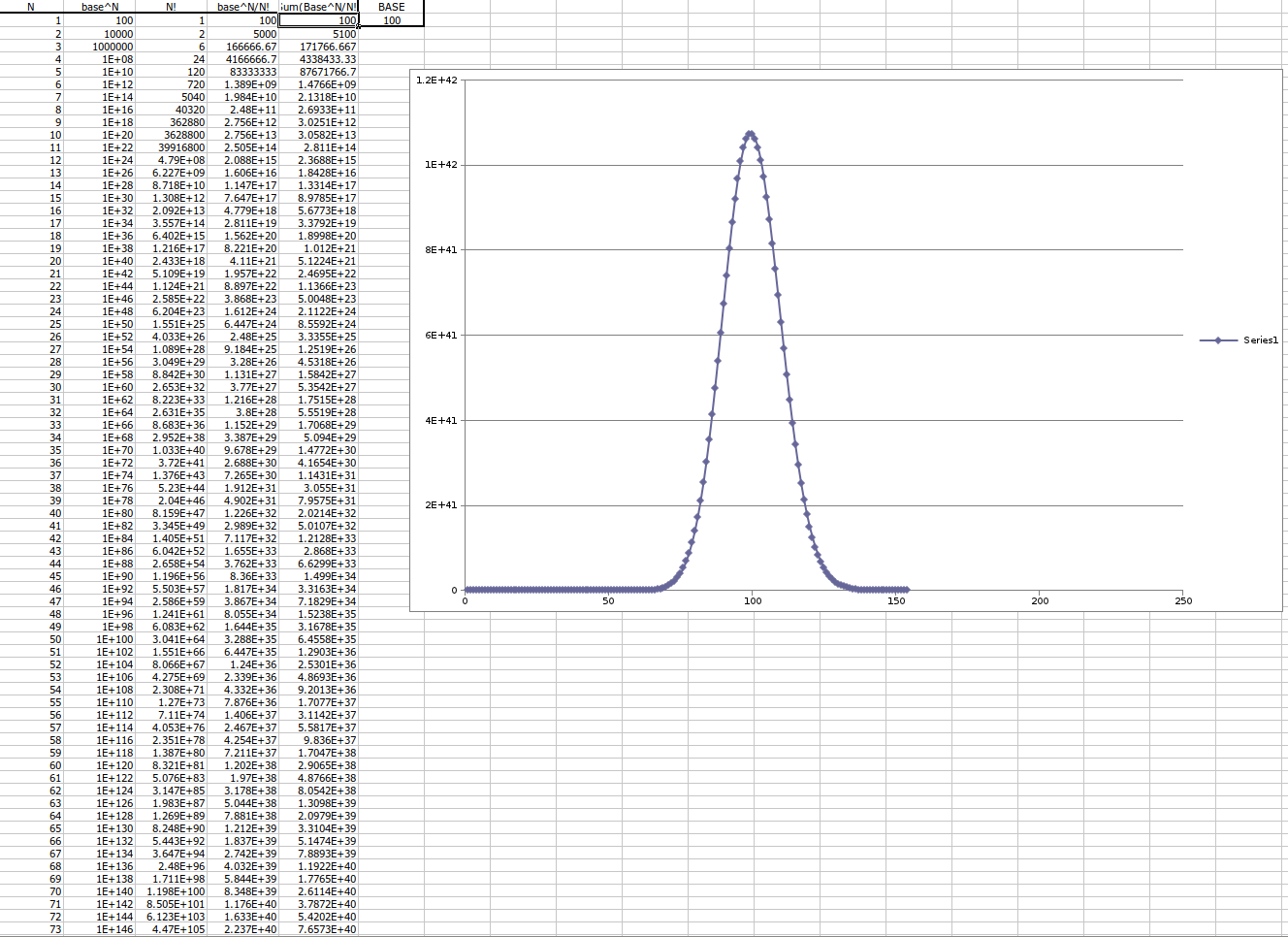
At the end of the lecture, I mentioned the Poincare sums which run against
intuition. David ran these sums in Excel
Screenshot. It shows how overflows occur first
for base 1000 before the convergence is noticed.
With computer algebra systems, this happens also. The point of Poincare is
that an experimenter dealing with such data would judge the sum to diverge
evenso it does converge and that mathematical statements are therefore often
difficult to find experimentally.
David also looked at the dominos. How many dominos do you need to get
"1 full domino length off the table with 4 dominoes, 2 lengths with 11,
and 3 lengths with 31. Is there any sort of pattern to these numbers? We've got 4, 11, 31,
83, and then I found 227 and 616. They do get very big, as you said,
very quickly. I couldn't find a pattern other than "vaguely
exponential".
a search on the Integer sequence encylopedia tells about it.
Isaac wondered about how one can define 0/0 or infinity/infinity. This is the
core question of calculus. I bypassed such questions by looking at calculus without
limits. Classically, the derivative for example is defined as (f(x+h)-f(x))/h
which is "0/0" for h going to zero. Calculus is all about making sense about this.
Isaac also wondered about how to extend algebraic operations to a larger set so that
we can for example compute with infinity.
This is often done, like in measure theory. One can not define 0*infinity
but one can define infinity * infinity = infinity
infinity * (-infinity) = - infinity, infinity + infinity = infinity
or -infinity - infinity = -infinity. But both infinity/infinity
or 0/0 or infinity - infinity can not be defined.
Mathematicians can deal with this using the concept of compactification.
In complex analysis also one adds a point at infinity to get the Riemann sphere
and one can do geometry with this very well.
One adds some additional point at infinity. This works topologically
but algebraically one has problems to exend the structure to this larger
structure. It can be done using nonstandard analysis, where one also
computes with infinitely large or infinitely small numbers. But there, one
does not add one point infinity but extends things to a larger framework.
To the Algebra lecture
The main goal of the algebra lecture is to learn about the problem of
solving polynomial equations like the quadratic, cubic or quartic
which will lead us to groups. Groups are algebraic objects which can
come to live as symmetry groups or in puzzles like the Rubic puzzle or
the 15 puzzle.
Here is something about the floppy
David suggested: to make a triangle with six different colors to
help with visualizing the rotations and reflections: draw the three
angle bisectors to get six regions and color each a different color.
Some students (not all) might find that easier to visualize than just
having the letters at the corner. And of course I wouldn't start out
with the terminology "group" -- I'd just let them experiment with
combining operations and seeing the great patterns in the product
table.
David also mentioned:
Sam Loyd published a great book of puzzles in 1928 called "Sam Loyd
and His Puzzles: An Autobiographical Review", which I have in my
library. The 15 puzzle (which he calls the 14-15 puzzle after the
challenge of reversing those two squares) is the first chapter, and
he has a great essay on a variety of people's attempted solutions
that, of course, don't work -- ending with the reason why he stopped
agreeing to listen to people's solutions (someone threatened to punch
him in the nose if Loyd didn't believe that the fellow had solved it)
Yes, the "god number" had had been in the news several times. Each time people would bring down
the upper bound or bring up the lower bound. I have a link to the article
on the exhibits page.
An important class of groups are permutations. Lets take the group of permutations of three elements. We write the result
of the permutation starting with (1,2,3) as
(1,2,3) (1,3,2) (2,1,3) (2,3,1) (3,1,2) (3,2,1)
The permutation (1,2,3) is the identity. If we (1,3,2) and compose with (2,1,3), then 1 -> 1 -> 2
and 2-> 3 -> 3 and 3 -> 2 -> 1 resulting in (2,3,1).
David notices " that this looks
like another way of writing the symmetry group for
equilateral triangles, with the corners labeled 1,2,3 instead of
A,B,C. We have the same operations, so (1,3,2) is a reflection
around the 2-3 line, for instance, and (2,3,1) is a rotation of 120
or 240 degrees depending on our definition of direction..
Sarah mentioned a puzzle which involves the group of permutations. Lets call it the "swapper problem". I formulate it in my own words:
20 boxes are alligned in a closed room. Each box has a number 1 to 20 inside visible only when opening the box.
The boxes are randomly permuted and arranged on a line so that we can say box number 1,
box number two etc. Now, 20 people, numbered 1 to 20 and a "swapper" have the task to find a strategy to solve
the following problem: after arranging a common strategy,
the swapper goes first into the room, looks at all the numbers and is allowed to swaps two boxes of choice,
then leaves, not be seen and heared of again. After that, each of the 20 people enters the room, each
to look into 10 boxes of his choice. This has to happen in such a way that every person finds its number among
the 10 opened boxes. This happens so that each person will close the 10 opened boxes again and not leave any traces before
exiting and allowing the next person to enter. Like this every of the 20 people has so the same information available
when entering the room. No information exchange between any of the parties is allowed to happen from the moment
on that the swapper starts going into the room to look into all boxes to possibly swap two boxes.
Mathematically, the problem asks whether one can change a permutation with 2m elements with one transposition so that
2m people numbered 1,...,2m can independently pick each m elements from the 2m and be sure that person k choses the number k.
It looks impossible but can be solved. The solution is here.
Caroline noticed that the number of solutions 3 was not addressed:
- When you solve the cubic equation using Tartaglia and Cardano's formula,
you'll get two solutions for the quadratic in u^3. Substituting back, you
can then get two solutions for the cubic. Is there a formula to get exact
value of the third solution?
The formula should get all the solutions. The substitution for u gives you also a choice.
So there are two places, where roots appear. There are 3 solutions in general.
One could think that the solution formula gives 4 since twice a solution of a
quadratic are involved.
Can you explain how you get the 192 = 4!*8 for the Floppy puzzle?
and for the Rubik cube?
You can permute all the 4 corners arbitrarily. this is 4!. Then you can turn the
edges in two way. This would give 2^4 possibilities. But there is a parity thing
happening. The signature of the permutation plus the number of flips is even.
This stays true during every move. Therefore, we get only half of 2^4*4!
The Rubik cube is similar. Look at all the possible positions of the corners and
edges. There are parity issues also here which shows that not all possible
permutation/orientations are possible. You can not turn a single corner by 120 degrees
for example (this is a "quark" state). You need 3 quarks (a Baryon) to be seen.
Similarly, one can not turn a single edge by 180 degrees. This is also a quark state.
One needs to quarks (a "meson") to get a state which can be realized.
A few interesting questions by Karen:
In Pascal's triangle. I didn't understand when you made =
a smaller triangle inside of all the 1's. What does that do?
If you look at the p'th row of the triangle and you look at all the entries
different from the first and last then they are all divisible by p if p is prime
You see for example that 7,21,35 are all divisible by 7. Thats what we prove
When doing induction for Fermat's theorem we need exactly this property.
When you are doing prime triplets, how do you prove one of n, n+2, n+4 =
is a multiple of 3? How do you do it mathematically in detail?
If you look at the reminder of n when dividing by 3, there are three possibilities
the reminder can be 0, 1 or 2. In each of the cases we can show that one of the
three is divisible by 3: We write n = 3k+1 for example if the reminder is 1:
n n+2 n+4
---------------------------------------------
n = 3k + 0 n+2 = 3k + 2 n+4 = 3k + 4 n is divisible by 3
n = 3k + 1 n+2 = 3k + 3 n+6 = 3k + 5 n+2 is divisible by 3
n = 3k + 2 n+2 = 3k + 4 n+6 = 3k + 6 n+4 is divisible by 3
Why did people find perfect numbers? What do we do with perfect numbers?
Perfect numbers are a way to find large primes. It is a drive for prime records.
Every time a new largest prime is found, these are headlines. Like
here
Originally they were thought to have magic properties. It was more a spiritual
quest at first, but once a mathematical problem is established, it becomes a
quest, like a holy grail. The quest for odd perfect numbers is especially appealing
because it is the oldest theorem.
There are so many theorems... to me, people were playing around with the numbers
like primes, perfect numbers, etc. Like Wilson's or Fermat's, etc., what do we do with them?
Many mathematical quests are first just trying to understand things. It is not that
any applications were in mind. If you have a beautiful problem like whether every
even number can be written as a sum of two primes, you wonder whether you can prove this.
There is no a priory application in mind. Wilson's theorem is beautiful because it allows
to define primes in a single formula n divides (n-1)! + 1 if and only if n is prime
The original definition was only telling what a prime is not. It is not divisible by any number
between 2 and n-1. These are lots of conditions. The Wilson formula is a single formula.
When do you use them?
It turns out however that many of these questions have applications. Fermat's theorem is
essential today for example for secure communications. We will see this. One can use it
for example to exchange secrete keys over a public channel so that both parties have a
secure key but even if somebody was listening to our conversations, they could not figure
out the key.
I am wondering if there might be much simpler way to represent all numbers
There might be ways to understand numbers better than we do and one can ask whether
numbers could be decomposed differently/ One has indeed done that. There are other kind
of numbers which also can be decomposed like integers. Examples are Gaussian integers n+i m.
With these numbers we can factor 3 for example because 3 = (2+i) (2-i). There are now new
prime numbers in the complex plane but they are also not so easy to understand. The structure
of primes will occupy mathematicians for a long time to come. It is not impossible that your
question will have a surprising answer and that new structures will be implemented which allow
to understand primes better. Huge machineries in analysis and geometry were built exactly for
that. Many of these theories have applications way beyond where they were originally designed
for. They are used to study quantum mechanics or differential equations which help us to
predict weather. Prime numbers are used also directly, like for designing music halls in
which the sound reaches every seat well.
Fermat's theorem and Wilson's theorem which we proved in class are both
a bit tough. Take this week and try to dig through the details.
To appreciate it, look at some examples, like (5-1)! + 1 = 25 which has
5 as a factor. The theorem assures that 5 is prime.
The numbers get pretty quickly fast. For p=13, already
12! + 1 = 479001601 and this is indeed divisible by 13.
For the prime p=101, we have (p-1)! + 1 =
93326215443944152681699238856266700490715968264381621468592963895217599993229915608941463976156518286253697920827223758251185210916864000000000000000000000001
and this 155 digit number is divisible by 101.
Wilson needs a bit of modular arithmetic. This means that one
can compute with numbers 0,1,...,p-1 for some prime p and keep the numbers always
between 0 and p-1. To compute modulo 5 for example, you only use the numbers
0,1,2,3,4 and get 4*3 = 2 because 12 leaves remainder 2 modulo 5. We can of course
also add numbers like 4+4 and get 4+4=3 because 8 leaves remainder 3 modulo 5.
Wilson's theorem uses the fact that if p is a prime, then any
number different from 0 modulo p has a multiplicative inverse. For example, for
p=7 then the inverse of 3 is 5 because 3*5 = 15 leaves rest 1 modulo 7.
Sarah has written down a proof of Wilson's theorem which does not need modular arithmetic.
The proof essentially introduces modular arithmetic.
Sarah also noticed that to show that if n is not prime, then to show that (n-1)! + 1
is not divisible by n requires that one looks also at the case when n=p*p is a square of a
prime. In that case (n-1)! is not divisible by n. An example is n=4, where 3!=6 is not divisible
by 4. But it is divisible by p and (n-1)! + 1 is then not divisible by p.
Andy H. mailed me an other interesting example:
I have a number theory question for you. I have a colleague with a math =
tee shirt that says "(pi^4+pi^5)^(1/6)=e. Evaluated this on the
calculator and it came out to be true.
which shows how calculators can deceive. Calculators are rather poor in handling
math. A computer algebra system can compute things with arbitrary precision. Here
is the result when computed with Mathematica to 100 digits:
N[(Pi^4 + Pi^5)^(1/6) - E, 100]
1.98471299777560852129322426652
20179954506028251710117327842
58163490452575964421920645037
621054740491*10^-8
The T-shirt identity draws on an other open problem in mathematics. Are the numbers
Pi and E independent or is there a relation like Pi^7 E + Pi^6 E^4 + 4 Pi^2 E^9 = 0
which relates Pi and E in a nontrivial manner. Nobody knows.
Is the above almost identity an accident? Probably not.
Sometimes there is more behind it. The number E^Sqrt[163] for
example is close to an integer and there is a deeper explanation.
David investigated a bit more (with Excel), how frequent the cases are when the product of the
first n primes is prime. Such primes are called primordial primes and the product
of the first n prime numbers + 1 is called an Euclidean number.
The following Mathematica line fills the primordial soup with such primes:
Here are all the cases up to 1000. The number is the n such that one plus the product of the
first n primes is prime. For n=11 for example, the corresponding primordial prime is 200560490131.
About the Pythagorean Triples, Sarah H has found a geometric derivation
of the formulas that x=2t m,y=(m2-t2, z=(m2+t2)
produces all Pythagorean triples. For example 8^2+15^2=17^2 is interpreted
as adding (2*15+1) + (2*16+1) pebbles outside as square of 15^2 pebbles to get
a square of 17^2 pebbles. This could be the path, the Babylonians took to get the
formula.
To the geometry lecture
As several of you have asked for the source,
the Mathematica manipulation files are now on the
lab page. I will post later a Mathematica Demonstration
version which can be used without having Mathematica installed.
But note that you can download mathematica and use it as a student of this course.
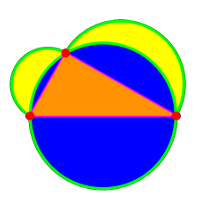
David writes: Since you used Thales and Pythagoras to prove Hippocrates, I am
now thinking of it as the formula "Thales + Pythagoras = Hippocrates"
I realize that is a silly idea mathematically, but it might help me
remember it all.
It would be interesting to know whether Hippocrates statement taken as
an assumption would imply both Pythagoras or Thales.
David I can see why Morley's result is called a miracle. I have trouble
believing it. Why would an equilateral come out of the chaos of ANY
possible triangle? Neat. I will look that one up later. I'm also
wondering if you get any similarly interesting results by trisecting
the angles of a quadrilateral or pentagon or n-gon.
No other similar result seems to be known for quadrilaterals. One could wonder
whether there is a version for tetrahedra. The theorem is nice and so it
is not surprising that it can also fascinate some of the best contemporary mathematicians
today. The most elegant proof is by John Conway (the one who invented among other
things surreal numbers). Alain Connes, who works on fancy noncommutative geometry and who has the
fields medal in mathematics, has given a new proof in 1998.
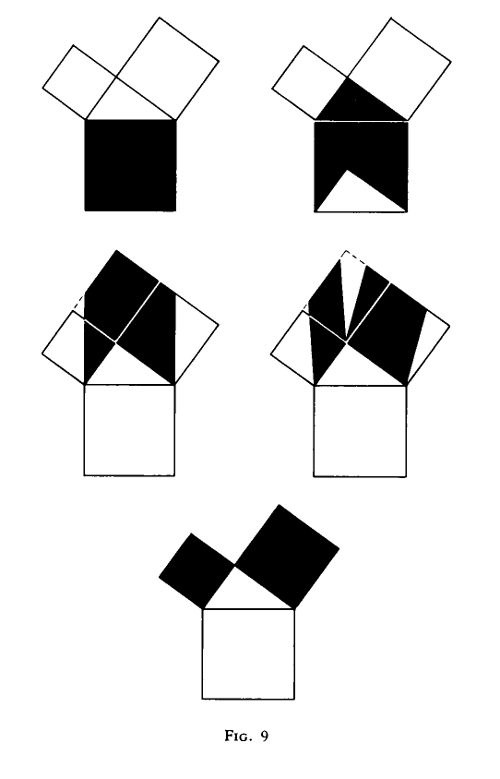
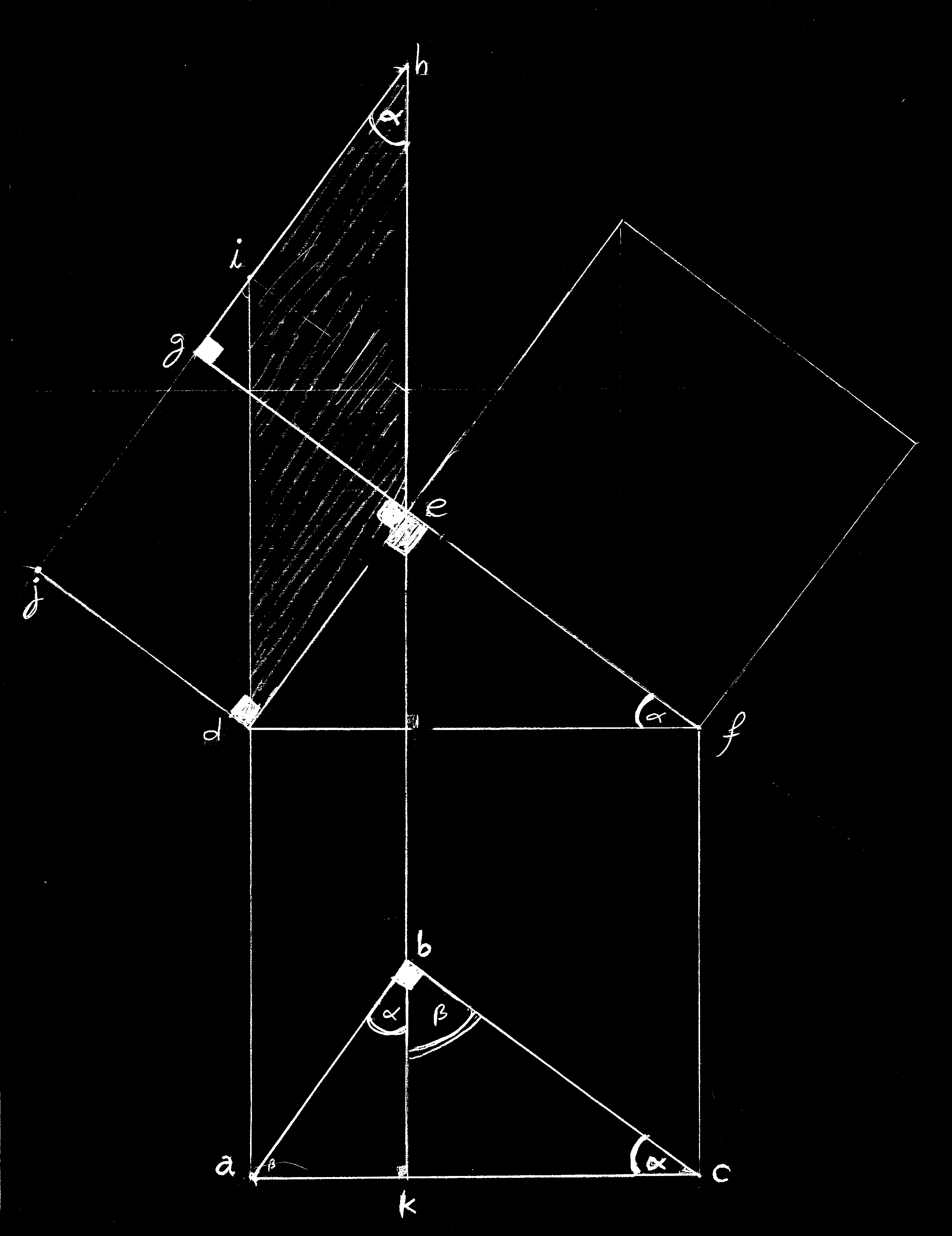
During class, we wondered about Eves proof of the Pythagorean theorem. It had
not been quite clear why the parallel. Right after class, Sarah has drawn the
crucial picture on the white board Omar has sent me a similar
picture. Here is the page of Eves book:
To the arithmetic lecture
Caroline I agree that some of the hardest concepts to teach in math are the
simplest ones. I teach an arithmetic class to college students and they
still have a hard time understanding negative numbers and fractions. Many
of them memorize the rules to perform the operations but lack a deeper
understanding of the real number system and its properties.
Yes, even the brightest college students and even mathematicians
can be at war with fractions.
In many of the proofs that sqrt(2) is not rational, we assume that
sqrt(2) = p/q and p are q are relatively prime. In class, you did not make
this assumption that p and q are relatively prime but the proof still works
by looking at the exponent of 2 (odd/even) on both sides of the equation. I
think the proof you showed in class is a lot simpler and can be easily
understood by students.
I did not make that assumption that p,q are relatively prime. It is not
needed. We just have to look whether we have an even or odd number of factors
2. Yes Traditionally, the proof is done by first factoring out common
factors. I feel the proof is simpler without.
Can you give an example of a system where the prime factorization of a
number is not unique? I have been thinking of this since the lecture and
seems to be an interesting topic.
The simplest example are the numbers x+sqrt(5) y where
x,y are integers. These numbers can be multiplied and added and have again
this form. The number 6 now has two different factorizations
4 = 2 * 2 and 4 = (sqrt(5) -1) (sqrt(5) + 1)
The geometric proof of sqrt(2) was great!
Yes it is beautiful and does not need the factorization. It has
probably been known to the Greeks. Could have been deadly to know this proof.
About 1.99999...=2 . I know that many students will hesitate to say this
is true. However, when you ask them if .33333...= 1/3, they will immediately say yes!
Thats interesting. Because this might be a bridge to convince somebody.
The identity 0.33333 = 1/3 can be multiplied by 3 to get 0.9999999 = 1.
If the first is accepted, the second should be accepted too.
David:
How can you tell, in the clay tablet number system, where one
digit ends and the next one begins.
How would one represent 60? It needs a zero as a place holder.
The Egyptian system doesn't have this same problem because they don't
really have place value.
I'm not sure about that. Spacing must be crucial. Maybe its also
context. I also do not see other marks. Sumerian math does not have zero yet.
Spacing, context or some other hints must have been enough.
I thought I had read in the Britannica History that Egyptians had,
as well as all the unit fractions, also a fraction for 2/3. Unless
that was a different civilization.
No, you are right. There were other abbreviations used.
See also the Wikipedia page
My source is Boyer. I have posted some pages from this book
here.
I didn't know the Mayans had a zero. Neat! Did they use it the
same way the Arabic zero was used, as a placeholder anywhere in the
place value system? Or was it used in a much more limited fashion?
Could it be used as a number all by itself? I know that some systems
that used a zero didn't recognize it as an actual number, but ONLY as
a placeholder.
It think it is only as a place holder in order to be able to represent dates. From
This article:
"Maya zero is predominantly used in stone inscriptions and screenfold
paper manuscripts as a coefficient of Long Count quantities and in
counts of the phases, movements, and cycles of celestial bodies including
the moon, sun, and Venus, and their various numerical relationships
to one another."I used those extensively and still have my
set somewhere in the basement. I didn't know anyone else had ever
heard of them, though.
Yes, Cuisenaire is no more so popular. But I saw it in Montessori schools.
I myself went to a public school, had excellent math teachers from primary to high school
and am very grateful. I think my first grade teacher introduced the Cuisenaire material
on his own initiative. I used Cuisenaire material in high school to explore problems in
additive number theory and was even able to discover the
pentagonal number theorem
with them and was of course disappointed to learn that Euler "did it already".
You stated that 3 + 2, if you add them together, you get 5, and
that there is no mystery about 3 + 2 = 2+ 3, the way there is with
3x5=5x3. I'm not sure I agree that the first one is any less
mysterious than the second one. It is certainly not obvious to
children that the order of addition is immaterial.
Indeed, as you talked about how px is not necessarily equal to xp in
physics, I was able to think of various real-life situations in which
addition would not be the same in both orders either.
Transformations like rotations are other examples which do not not commute.
In arithmetic, one can also question the commutativity of addition. Its possible
to start building up arithmetic on a addition system, where we have no commutativity
in addition, but its rather strange and its difficult to bring in multiplication.
An important structure with addition and multiplication a "ring" like the integers
or polynomials. Even non-associative rings (where a*(b*c) is not equal (a*b)*c
like octonions have commutativity in addition.
One could for example explore sets X with two noncommutative operations (+,*)
such that (X,+,0) and (X,*,1) are noncommutative groups and a*(b+c) = a*b + a*c
(b+c)*a = b*a+c*a. Finding such objects is a combinatorial problem if X is a finite set.
I don't see any example and do not know whether this combinatorial problem has
been studied. We have barely scratched the surface in exploring mathematical structures.
I've always loved the arithmetic proof that sqrt(2) is irrational,
which I've seen before, but I had never seen the geometrical proof --
thanks! That is also really beautiful. Also I had never seen (or
even considered) the proof that the logarithms are irrational, until
I saw it in the Britannica book. The proof is so simple!
After reading the section in the Britannica I had figured out how to
generalize the arithmetic proof to other square-root irrationals.
I'm not sure if the geometric proof can be generalized quite as
cleanly, though. I'll have to think about that. Also hadn't thought
about how to expand it to cube roots but now I see that it really is
basically the same, and also explains clearly why the proof of
irrationality fails for sqrt(4) or cube-root(27).
The geometric proof about the irrationality is from on of Eves book.
I do not know a proof for other square roots but it looks reasonable.
Would be a nice project on its own. I have never seen it.
You say that "little kids" will say that 1.99999... is smaller
than 2.0000.... . I wonder if you may be overestimating the average
mathematical understanding of older kids and adults. I have asked
older kids, adults, my parents.... Many of them are not at all clear
on why 1.999... should be equal to 2. Some of them I can convince,
but others are never convinced.
Would be nice to quantify and make a test like Piaget did and see. The concept
of limit is not easy to grasp indeed.
You said that algebraic numbers are a "small set" of numbers. Are
they countable, equal in size to the rationals? Maybe I should ask
you not to tell me yet. I studied sizes of infinity at some point in
high school algebra and we looked at Cantor's first and second
diagonal proofs to show that rationals are countable and reals are
not, but we never looked at the algebraic numbers separately from the
reals in general.
We will look at this. Yes, algebraic numbers are countable and so a much smaller
set than real numbers. This is one of the triumphs of the set theory of Cantor.
It is not so easy to show that a particular number like pi is transcendental
(not a solution to any polynomial with integer coefficients.)
To the first lecture
Some interesting thoughts were mentioned during class and it turned out
that the garden theorem should be clarified a bit more. What is a "flower"?
Also interest sparked the "Zeno's paradox", "Euler's formula"
V-E+F=2 and "Grandi's series" 1-1+1-1+1-1+.....
We will some of it later in the course.
Sarah: In class last night we briefly discussed one of Zeno's paradoxes of motion
(Achilles and the tortoise). When we looked at the paradox you mentioned
that the modern concept of the limit has allowed us to solve the paradox.
This happens to be a subject that I have read a bit about, and I am under
the impression that modern thinkers do not believe that the concept of the
limit solves the paradox. As I understand it, the concept of the limit is
supposed to solve the paradox by showing (formally) that the sum of an
infinite number of terms can be finite, and that the infinite number of
distances (or times) in the paradox is just such a sum. If the Zeno's
argument were that any sum of infinite terms must itself be infinite, then
the formal concept of the limit would indeed solve the two of Zeno's four
paradoxes of motion (the dichotomy and the Achilles-tortoise). However, it
seems that that was not quite the thrust of Zeno's argument. One can
formulate the problem as one of completing an infinite number of tasks. In
this interpretation, the issue is that there is no way to complete an
infinite number of tasks because there is no final task (i.e. there is no
move that Achilles makes that has him reach the tortoise). Thus, on this
interpretation, the discussion of limits is beside the point. Reasons for
reading Zeno's paradox in this alternative way come from Aristotle's
discussion of the paradoxes in his book *Physics *(which has the only
surviving account of the paradoxes from ancient Greece).
Anyway, I think Zeno's paradoxes are fascinating by themselves, and all the
more so because many consider them to remain unsolved.
This is a very good analysis.
The notion of limit is still difficult today. We see the difficulty in the classroom
today and I wanted to make the point that the difficulty of the pioneers in mathematics
developing a formalism had a difficult time too. Limits are difficult because it
involves the "infinite". And infinity is a concept difficult to grasp.
Today we know that if we add up
1 + 1/2 + 1/4 + 1/8 + 1/16 + .... ,
we get a limit which is a definite number, namely 2. Similarly, we know that
1.9999999999999999999....
is the same number like 2. There is no gap between the decimal expansion with infinitely many 9's
and 2.00000000000. Piaget type experiments
with young kids even up to middle school show however that many would say that 1.999999.... is
smaller than 2.00000000...
In some sense this is like Archilles and the Tortois. We can argue that 1.999999.... never reaches
2.00000000.... because there are infinitely many steps needed to reach it.
Like Zenos paradox with Archilles and the Tortois is a rhetorical" paradox.
It appeals to the intuition that we can never can count up to infinity. Zeno would argue that
1.9999999... never reaches 2.0000000... Therefore, there are no numbers larger than 2.
But 2.3 for example is larger than 2 and the number 2.3
does not care whether infinitely many steps have been used to get to 2.0000 from approximations
1.9, 1.99, 1.999, 1.9999, ....
We will discuss later the problem of the Pythagoreans with real numbers which are not rational numbers
like the square root of 2. Because this number can not be written down completely, (the decimal expansion
1.414213562373095048801688724209698078569671875376948073176679737.... never ends), the Pythagoreans would
not accept it and (according to legend) even killed "heretics" who would argue otherwise.
An other question came up in the break: How do we make sense of the identity 1-1+1-1+1 ... = 1/2? .
The answer is to look at geometric series like 1+1/2+1/4+... and add it up. In this case it is 2.
There is a formula for the geometric series 1+a+a2+a3 + ... = 1/(1-a) which can be proven
by multiplying both sides with 1-a and noticing that on the left hand side everything except 1 cancels.
While the left hand side is only defined for |a| smaller than 1,
the right hand side makes sense for all a different from 1. We can now postulate the identity to hold for other values of
a also and apply this for a=-1 where the right hand side has the value 1/2. On the left hand side, we have the nonsensical
Grandi's series 1 - 1 + 1 - 1 + ..... .
What we have seen is quite an important principle: functions defined in one way can be extended
and make sense in much larger domains. Mathematicians call this "analytic continuation".
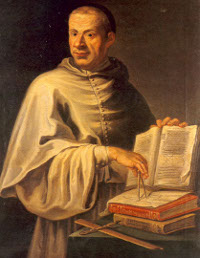
Of course this was not yet known to Luigi Grandi
who was contemplating probably more about the puzzling fact that different arrangements of the sum lead to different
values: (1-1) + (1-1) + (1-1) .... = 0 and 1 + (-1+1) + (-1+1) + (-1+1) .... = 1.
I mentioned this example during lecture as one of the "strangest results" I know in Mathematics.
Isaac: What is the meaning of "base trunc" and "leaves" in trees?
This is not an official terminology in graph theory. There are vertices in a tree which
have only one neighbor. To match the picture of a real tree, we single one out and call it
the base trunc. The others are then the "leaves". The curvature of such vertices is 1/2.
Vertices with two neighbors are "branches" and have zero curvature. Vertices with more than
two neighbors are "crotches" and have negative curvature. We generalized the concept of tree
and allowed the addition of "flowers", closed loops. The tree becomes then a "plant". Like
several trees form a forest, several plants form a "garden. We have seen that in this case
the total curvature of a garden is the number of plants minus the number of flowers.
David:
Are we going to go further with the Euler function V-E+F=2 in a future week?
Yes, we will look at this again. There is a more general formula which says that for
a surface, we have V-E+F=2-2g where g is the "number of holes" in the surface.
For a sphere, which has no holes, the answer is V-E+F=2, for a doughnut with one hole
we have V-E+F=0 and for a brezel with 2 holes, we have V-E+F=-2.
This Euler Poincare formula V-E+F=2-2g is very closely related to our formula
"number of plants" minus the "number of flowers". The flowers play the role of the holes.
But there is more to it, this number V-F+F is called Euler characteristic. A theorem
in differential geometry tells that if we integrate a quantity called "curvature" over the
surface, we get this number. We have not discussed this in the first lecture but for
a tree, this number can also be expressed as V-E where V is the number of vertices, E
is the number of edges.
Andrew: "I have a question about yesterday's lesson. I understood everything
about the forests and how to find curvature. My question is what is the
measure of curvature, or rather what do we learn about a plant, tree or
forest using it's curvature? Was it just made up by us so that we could
talk about the idea of a theorem, or does it have an actual application?"
It actually has applications. It turns out that for large graphs, it can be
tedious to compute the number directly and that summing up
the curvatures is faster. The number we were computing is called the
Euler characteristic.
It is defined for any graph. In geometric setups, the Euler characteristic contains topological information.
What we have seen in the forest or plant theorems that the sum gives information about the number of
components as well as the number of "holes". This number is also important when studying
surfaces. The same theorem appears there too if we define curvature of a surface nicely.
Last year, we played with the same theorem but in the context of
towns.
You find in that handout remarks on the connection with surfaces.
The theorem we have seen is a prototype of an important class of results in mathematics
called Gauss-Bonnet theorems.
We can add up local quantitities called curvature to get a global result which does
not change if we deform the object. This is a central theme of mathematics.
Unfortunately, learning about the classical Gauss Bonnet needs quite a bit of calculus and differential geometry
and is usually the culmination of a semester long course. What we did in class with graphs is much easier to grasp.
It turns out that it is pretty close to the actual geometric theorem [I work on a proof of
the classical result in any dimensions, which uses graph theory and hopefully will be shorter than
any known classical proof]. The main ideas in the graph theoretical setup are
the same, but we have no technicalities to deal with. We can play and have fun with it in a classroom,
where absolutely no calculus, no algebra and no geometry background is required. It just involves adding up numbers.
The class was successful in designing a proof of the theorem using induction. I imagine however
that the proof can only be found by gifted high school students. It could be a good theme also to introduce
the concept of "induction". As we have seen, the induction "seed" is the "seed" of the tree: a graph with only one vertex.
We grow a tree and see that adding a branch does not change the total curvature. We can then even allow flowers to grow
and still have a result.
In the first lecture, we also saw connections between Math and Art. Here is a movie from an exhibit at Boston