Math 22b Spring 2022
22b Vector Analysis and Linear Algebra

There is a one line PhD Thesis
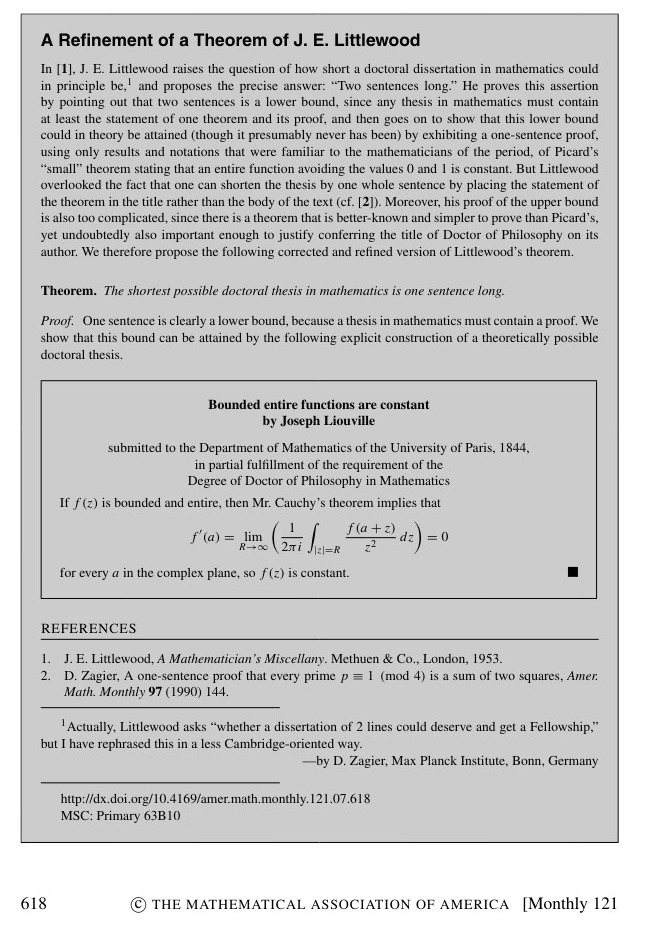
Simplicity, Clarity and Generality is a famous paradigm in computer science but one can adapt this also in mathematics. When doing a proof, one wants it to be as elegant and short as possible. Paul Erdoes often mused about ``the book", a document kept by God in which the shortest proofs to every theorem is written down. He would call a perfect proof a ``proof from the book". here is a nice article about Ziegler and Aigner, the authors of the book ``Proofs from the book" A great example of a perfect proof has been written down Don Zagier who used it to prove the following meta theorem of Littlewood: (a meta theorem in mathematics is a theorem about mathematics)(* Remark for 22b students) In this course we have not looked at calculus in the complex, but you must know that a complex valued function in the complex plane is called entire if it has a convergent Taylor expansion near every point. You must also know that integrals in the complex plane are essentially line integrals and that the Green's theorem counter example you have looked at in a homework is essentially Cauchy's theorem which tells that ∫|z|=R f(a+z)/z = 2 π i f(a). Greens theorem itself implies the Cauchy formula &int_{|z|=R} f(z) dz = 0 as writing down a differentiable function f(x+iy)=u(x+iy) + i v(x+iy) defines a vector field F(x,y) = [P(x,y),Q(x,y)] = [u(x+iy),v(x+iy)] that is conservative! The Clairaut condition is equivalent to (d/dx - i d/dy) f(x+iy) = 0. From Cauchy's theorem one obtains by differentiation the formula for the derivative of the function. Since the circle of radius R has length 2π R and |z|2 = R2 and by assumption f(z) is bounded, the line integral on the right hand side of the one line proof is bounded above by M/R, where M is a constant. Now M/R goes to zero for R to infinity
Here is Zagier's one paragraph paper citing the one line meta theorem of Littlewood which in the proof contains a one-line thesis.
 Source