Lucy
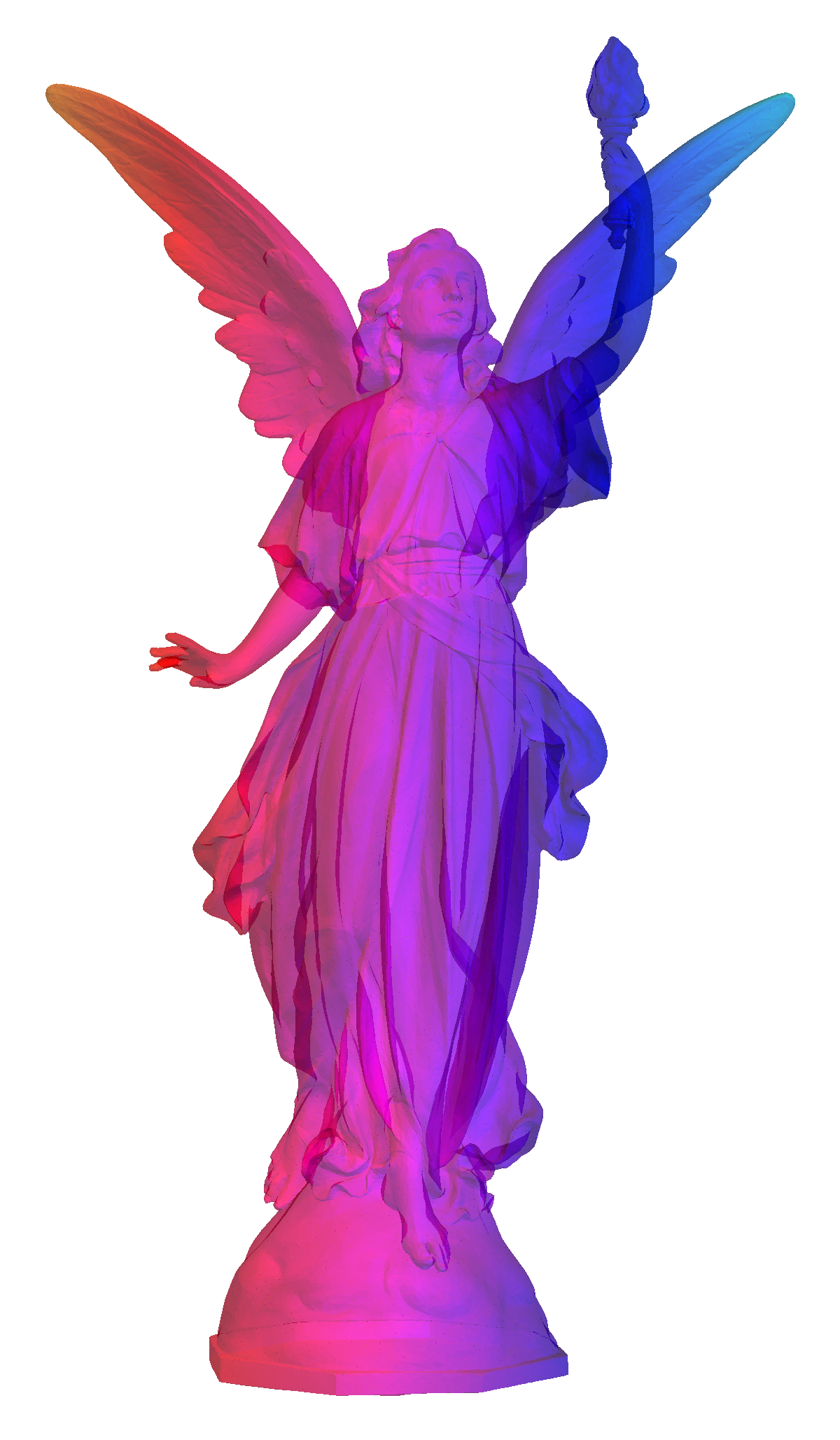
Update March 23: here is a from Mathematica to Povray exported Lucy (click for a large 3200x2700 pixel picture).
Mathematica just wrote the povray file triangle by triangle but now, Lucy is now right handed.

The
Stanford 3D scanning repository
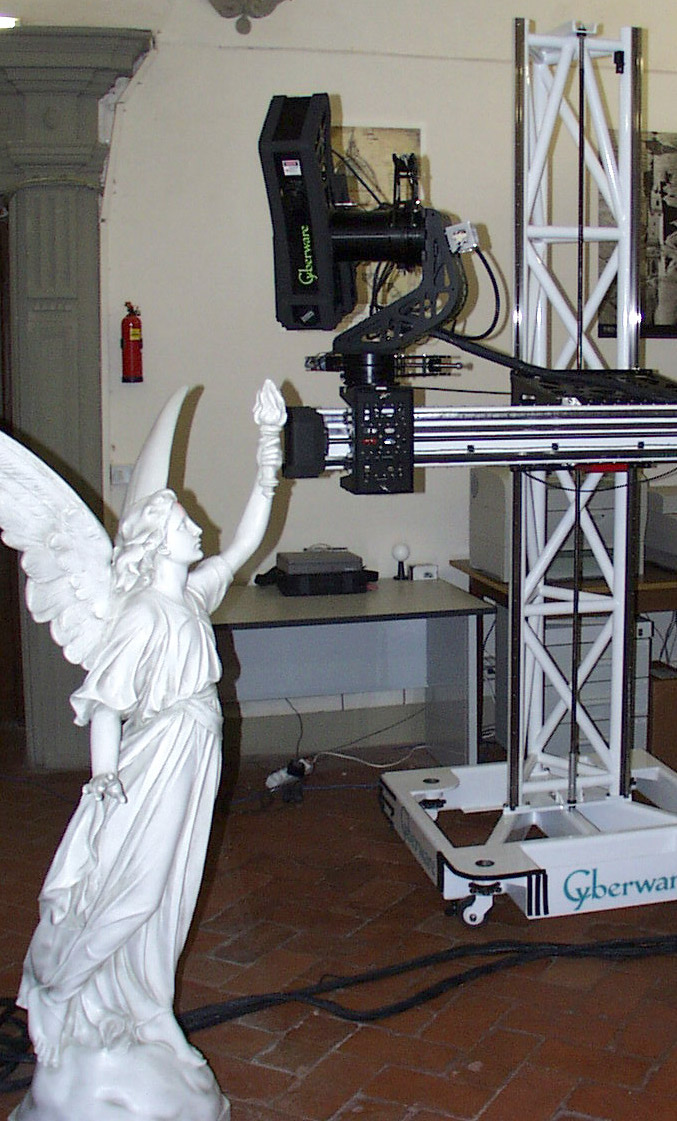
has a copy of Lucy with 116 million triangles. Stanford scanned it in 1998.
There were 47 scans producing 325 MBytes of uncompressed data. The polyhedron
has the f-vector (v,e,f) = (14027870, 42083635, 28055724) which means that there are
14027870 vertices, 42083635 edges and 28055724 faces. The Euler characteristic is v-e+f=-41
which means that there are 39 missing faces. Algebraic topology writes this number as
b
0 - b
1 + b
2,
where genus = b
1 is the number of holes in the surface. By the way, you have computed
these numbers in Math 22a, as they are the dimensions of the kernels of the form Laplacians.
Remember L=d d* + d* d ? The number b
0 is the kernel of the Kirchhoff Laplacian L
0
which is 1 as the surface is connected. The number b
2 is also 1 by Poincaré duality.
The number b
1 is the kernel of L
1
is the only interesting one for oriented connected two dimensional surfaces. It tells about the number of holes
in the surface. For this surface, due to defects in scanning, there were
39 missing faces. Software like meshlab can fix that.
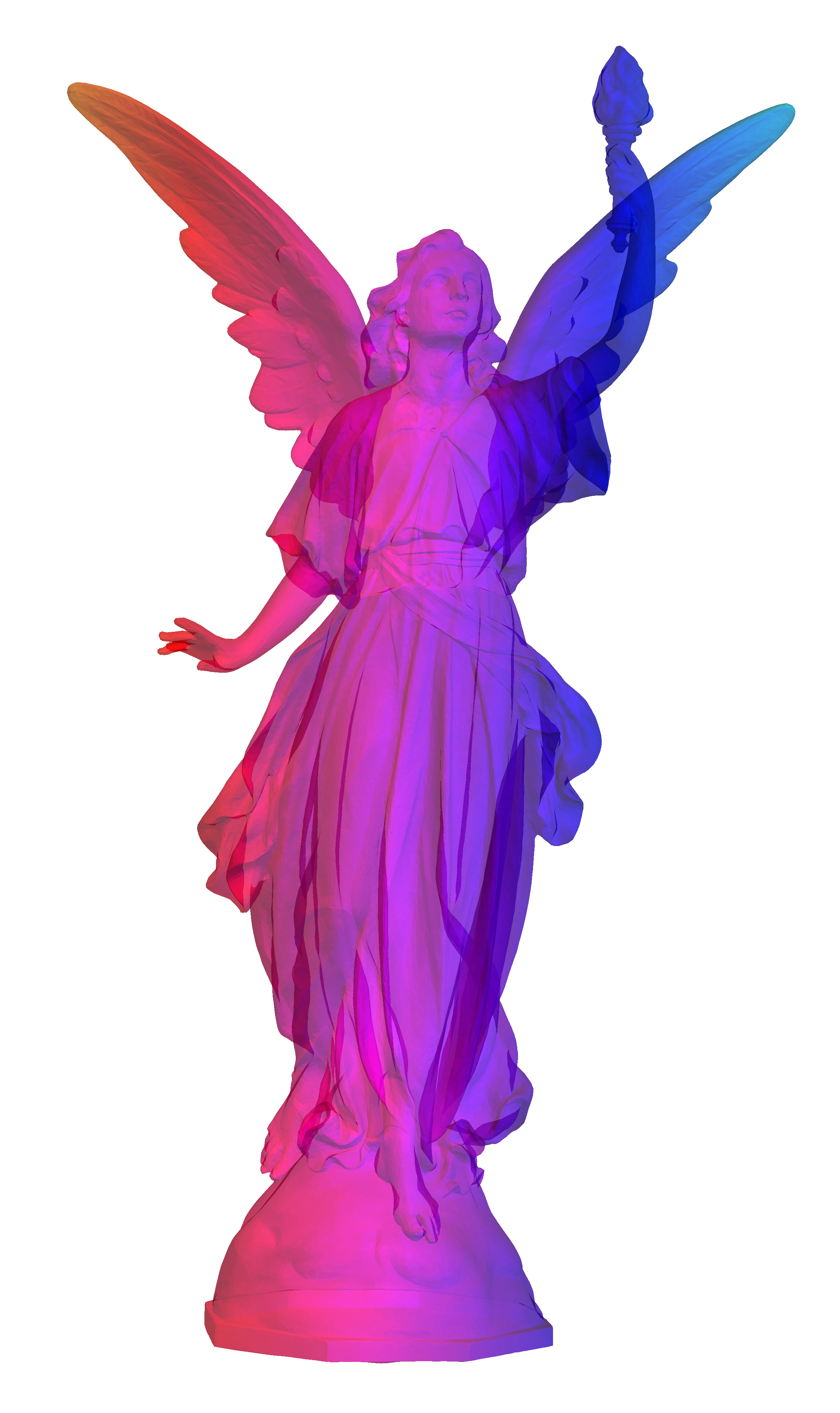
In the following picture the mesh got reduced with ``meshlab" to f=100'000 triangles so that it can
comfortably be processed with Mathematica. This reduction also closed the defects. Lucy is a now a large
sphere polyhedron. It contains f=100000 triangles, and e=150000 edges and v=50002 points. We check that
the Euler polyhedron formula v-e+f = 2 holds.
Click for a 2400 x 4000 pixel version.
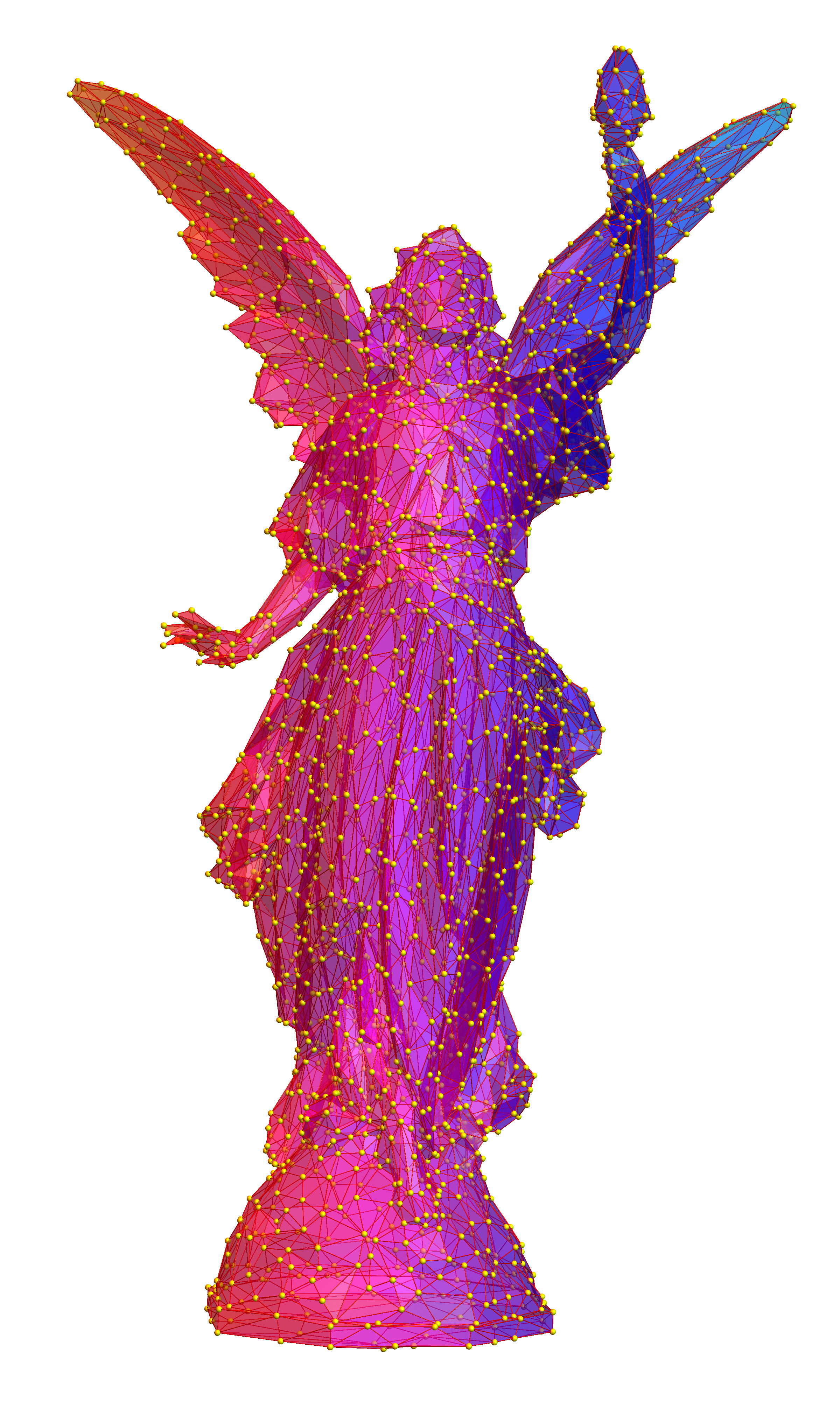
And here is a reduction to f=5000 faces, with 7500 edges and 2502 vertices.
Also shown are the vertices and edges.
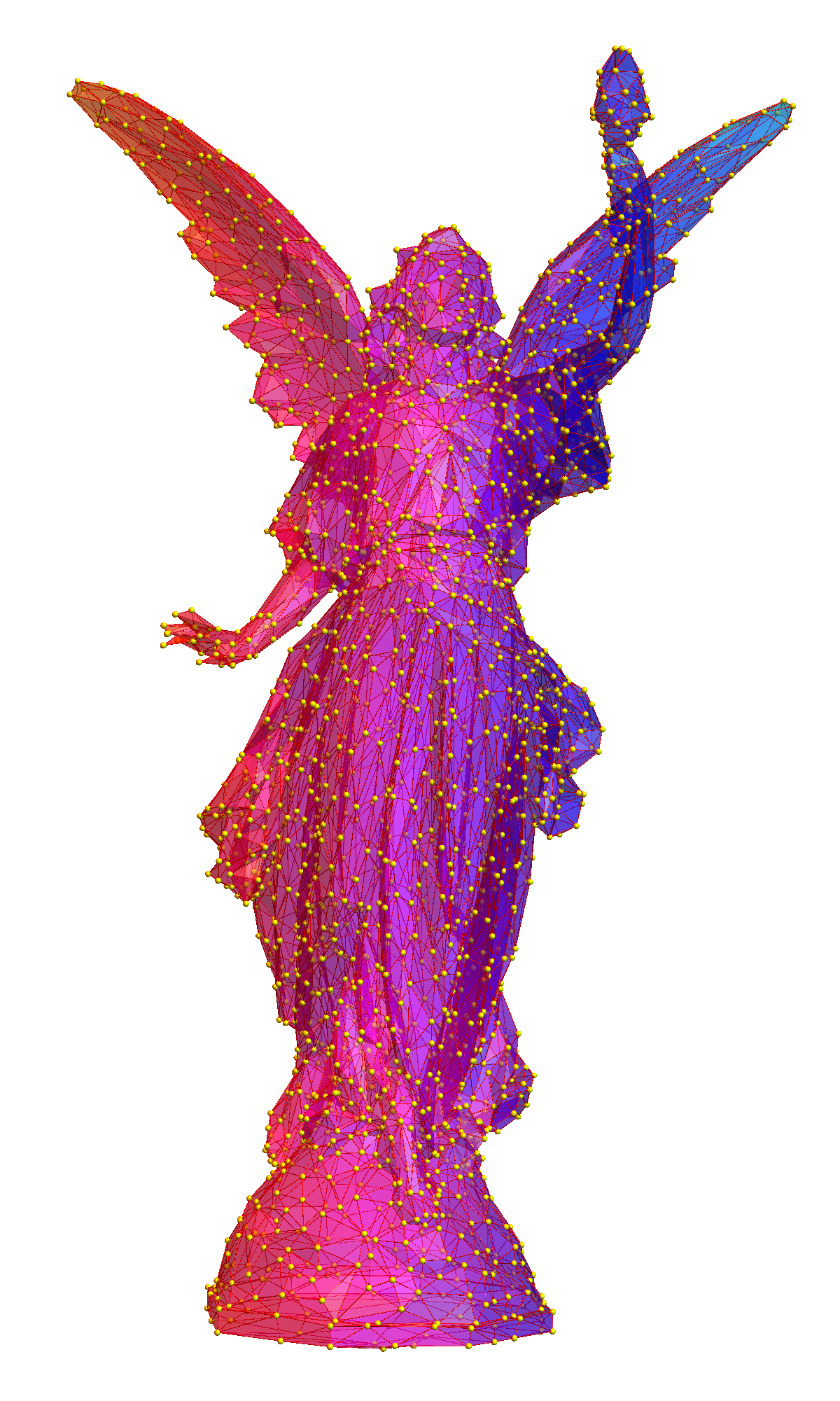
Click for a 2400 x 4000 pixel version.
This stanford page
from 1998 has some more information about the Large Statue Scanner.