The Mathematics
Definition
A finite set of maps T
1, ... T
d from a finite set V onto itself defines
a finite simple graph G=(V,E), where E={ (x,y) | x ≠ y, exists k such that T
k x=y }.
Why look at them?
- These dynamical graphs show interesting structures and bring arithmetic structures to live.
- Their statistical properties of path length, global cluster and vertex degree are interesting.
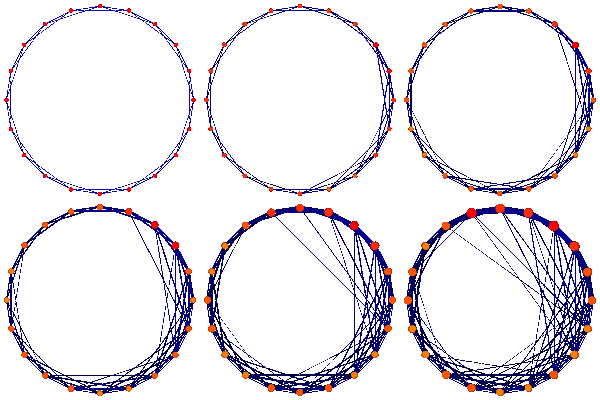
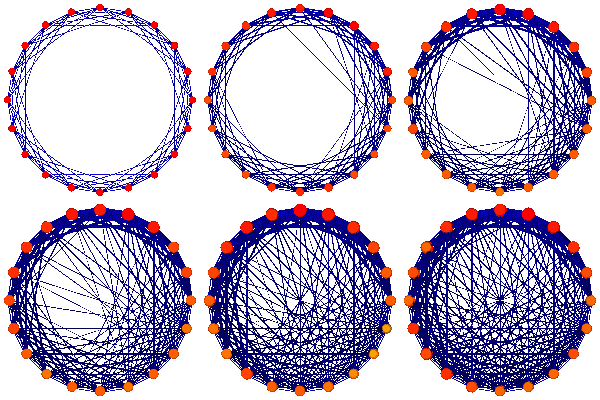
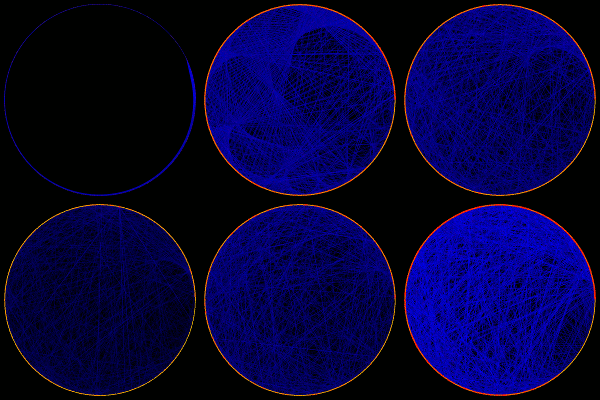
- Some examples lead to deterministic small world examples with small diameter and large cluster.
- The graphs display rich-club phenomena, where high degree nodes are more interconnected.
- They feature garden of eden states, unreachable configurations like transient trees.
- They can feature attractors like cycle sub graphs but also more complex structures.
- By definition, these graphs are factors of Cayley graphs on the permutation group of V.
- While arithmetic graphs are the focus they are universal: any finite simple graph is obtained.
Examples:
- V is a ring and Tk are polynomials.
For example, if T1(x) = x2 + a and
T2(x) = x2 + b.
- If V is a group and Ti x = ai x, then G is the Cayley
graph of the finite presentation of V.
- if V is the group Zn
T1x=x2 and T2 x = x3 then
the graph G is connected if and only if n is a Pierpont prime, a prime
of the form 2t 3u+1.
Deterministic Small world
Deterministic rewiring:
 |
 |
 |
| n=20, k=2 |
n=20, k=4 |
n=200, k=4 |


