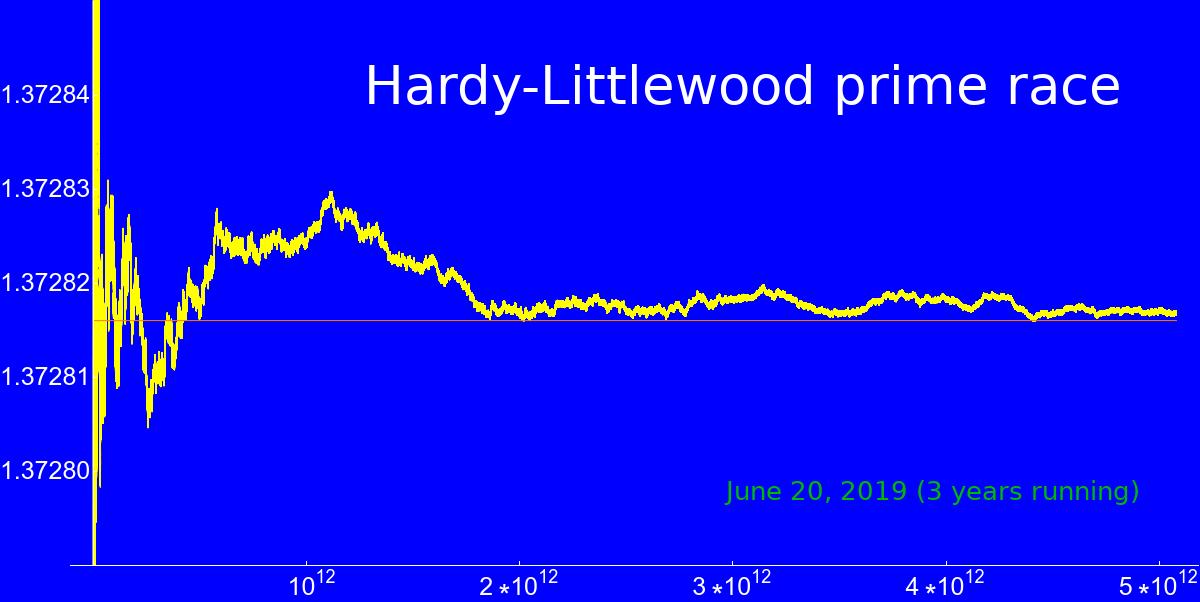
June 20, 2019: It is now 3 years, that the prime race is running. We are now at p=5*1012.
In the Paper about Gaussian primes (of June 19, 2016) we had
gone up to 1.25 1011 only (running for a few days then only). The Hardy-Littlewood
prediction is getting better. Again, be reminded that we don't even know whether the constant C
is not actually zero (Landau's famous problem about the infinitude of primes of the form n2+1).
March 8, 2017. We have now run it more than 10 times longer than in the
ArXiv version, where we went up to 1.2*1011.
Now we deal with integers 1.2*1012 meaning that we check primes of the order 1.4*1024.
The prime race average is still quite high up, but it decreased a bit again in the last month.
I will definitely keep the process running an other few months to see whether the data come down again
closer to the conjectured limit.
January 29, 2017. Again a month has past and an other surprising development
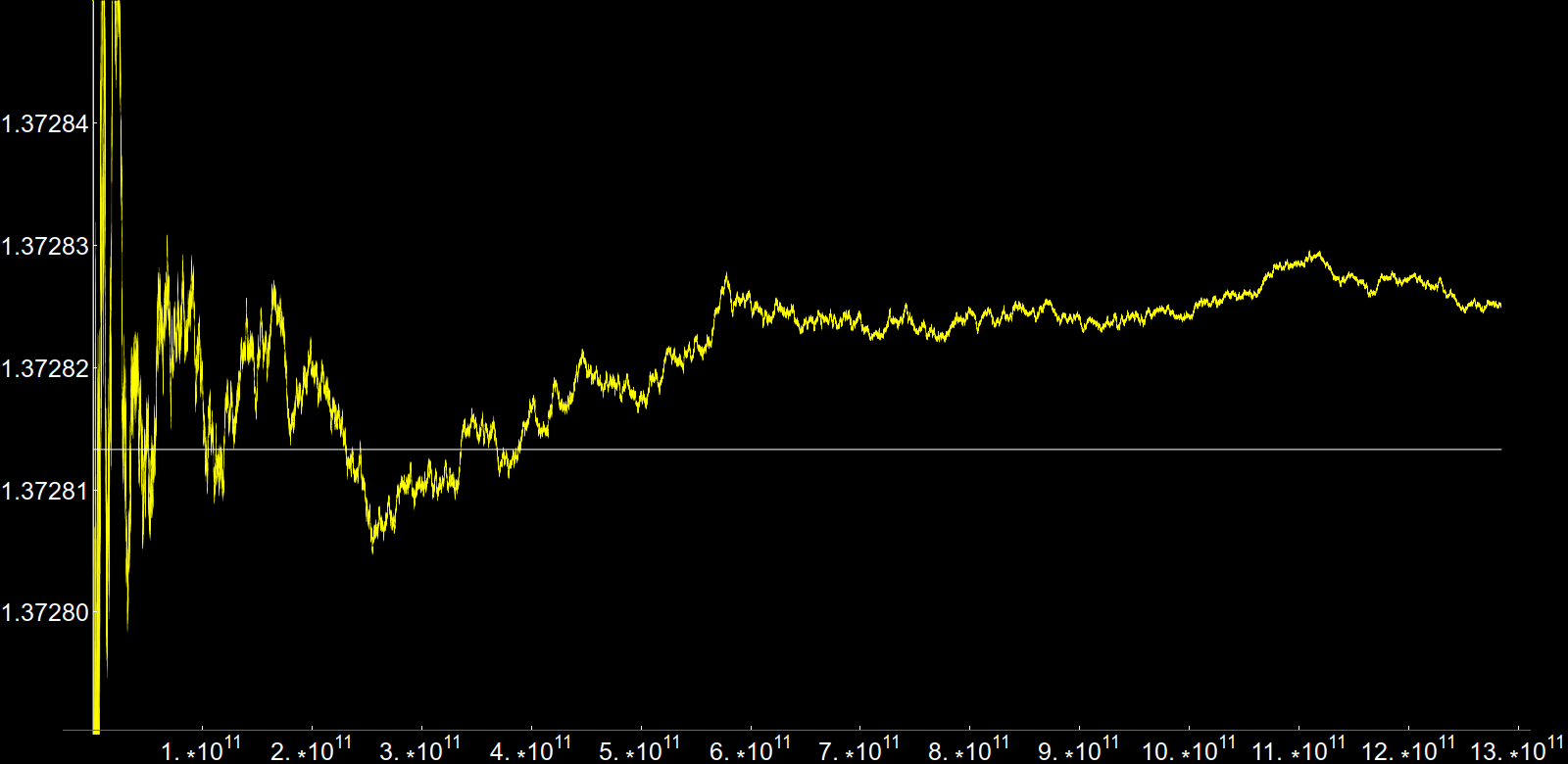
takes place. While in July 2016, a smaller drama happened with a sharper drop (around 2.5*1011,
the there is now a steady upwards trend visible. We have now 10 times more data than when
we wrote the preprint (1.3*1011). Now 1.2*1012. This means the
program now works with primes of the size 1.4 1024.
December 18, 2016. The last two months, the prime race has become even more strange.
While there had been a phase of rapid decay around 2-2.6 * 1011 and
a relatively steady increase afterwards until 6 * 1011, the
distribution is since then pretty flat bit. It is a bit off from the predicted limit.
October 30, 2016. Since early October, the prime race has again changed. The average value has increased
again substantially but remained pretty stable in the last few weeks. Changes seem to get slower but still,
there is no convergence in sight. In case of a function sin(log(x)) one would never
detect experimentally what is going on. Still, one has to remind that one does not know anything about the
value. Not even if it is positive and that the experiments are still theoretically compatible both with
a convergence and not convergence (even heuristically). I still would like to see this race going on for
longer, certainly to 1012.
October 5, 2016: In the last couple of months, the from 3*1011 to 6*1011,
the average has increased again. A change of almost 2*10-5. If we would look at this unbiased,
it would appear that there is no convergence but that the fluctuations just get wider and wider like with
sin(log(t)) a case, where an experimental verification of non-convergence is pointless. We are terribly bad
if things are logarithmic.
When looking at this race, I would not be surprised if in the next century, somebody will actually prove that the limit does not
exist and so disprove the Hardy-Littlewood conjecture.
July 27, 2016: a calmer period in the race
from 2.5*1011 to 3*1011. Are there more turbulences
July 15, 2016: there is a small drama going on. The prime race goes
through a serious "recession" (see the picture to the left). While at n=1.75 1011, the
prime ratio was still almost 1.37283, it is now at 2.5 1011 down
to 1.37281. Initially, when starting this computation, my first reaction beginning
June was that this is not going to converge and that the existence of a
Hardy-Littlewood limit is an illusion. But as the convergence is expected to be slow,
there is still no reason for alarm. It would be nice to know what the ratio is say at
10100 but of course, reaching this is completely out of question. Theoretically
it should be possible for me to reach 1012 at the end of 2016 but even this
is questionable, as checking for primality gets harder (we need to check primes of the
order 1023). I have an other
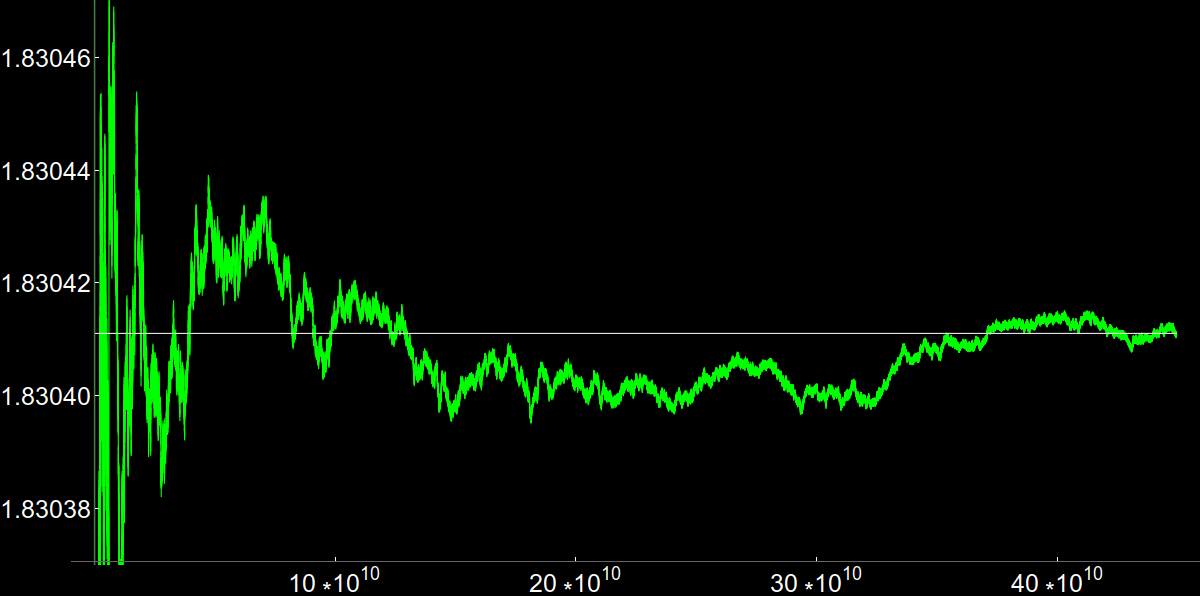
process running: one looks for the ratio of primes on im(z)=5 compared to the Gaussian primes
on the real axes, a row where the
prime density among Gaussian primes is particularly high (even so one has no idea
whether at all there are infinitely many). On that row, primality testing for
n2 + 25 seems harder as progress there is slower.
June 26, 2016: I decided to keep a job running, computing primes on the
first imaginary row im(z)=1 and continuing the prime number race
(a term introduced by Granville and Martin).
And this is what it is, a race between primes on the first row of
complex plane and the ones on the real axes, the zero'th row.
Of course, the real primes are given an advantage (as they grow slower)
and that is what the Hardy-Littlewood constant C is
about as described in our preprint too. The latest picture is always kept here,
(as well as the corresponding case on Im(z)=5, where the density is higher).
We soon reach n=1.7 * 1011 which requires testing primes of the order 2*1022.
I did not parallelize the job, nor do anything fancy, just count up. Could have easily been sped up.
Currently it is a one line program (See the code).
Just to get an idea how far people have gone:
This page announces a prime counting
up to 1026 for the usual primes. This needs sophisticated techniques and combinatorial algorithms.
June 25, 2016: While searching further about Takayoshi Mitsui, I found
a paper of Otto Koerner appearing about at the same time. This led to
work of Hans Rademacher from 1924-1928 on Goldbach. Rademacher seems have
been the first to consider Goldbach in Number fields and apply there the
Hardy-Littlewood method (or rather a version of it motivated by Work of Landau).
All these papers (Rademacher, Koerner and Mitsui) use total positivity, which
in the Eisenstein and Gaussian case is no condition. So, these papers look at the
number of primes which are needed to write a totally positive algebraic integer
as a sum of totally positive algebraic primes in that field.
What is different both in the paper of C.A. Holben and James Jordan of 1968, as well
as in our quest is that we want to write the numbers as a sum of two primes, like
in Goldbach. Holben and Jordan do that in the Gaussian case by giving an angle condition.
We use the positive quadrant there and in the Eisenstein case the sector spanned by
1 and (1+sqrt(-3))/2 = (-1)1/3. So, currently it appears that it is the
first time that it is conjectured that every Eisenstein integer is a sum of two
Eisenstein primes and even that every Gaussian integer is the sum of three Gaussian
primes (both without any further conditions on evenness, or angle).
Rademacher, who looks at the problem analytically, tells about the problem in the
imaginary quadratic case like Gauss or Eisenstein: the entries which tell in how
many ways one can write a number as a sum of primes, can become infinite:
June 22, 2016. Thanks to Marek Wolf,
who sent some references which helped to beef up a bit the bibliography.
Marek has formulated some interesting conjectures and constants. Interesting in the
context of the Gaussian Goldbach is his constant
Sum{p=n2+1 is prime) 1/p
which is mysterious still. But even proving that it is irrational is out of reach because
we don't know whether it is a finite sum! Marek pointed out also some links to prime tables:


 prime ratio was still almost 1.37283, it is now at 2.5 1011 down
to 1.37281. Initially, when starting this computation, my first reaction beginning
June was that this is not going to converge and that the existence of a
Hardy-Littlewood limit is an illusion. But as the convergence is expected to be slow,
there is still no reason for alarm. It would be nice to know what the ratio is say at
10100 but of course, reaching this is completely out of question. Theoretically
it should be possible for me to reach 1012 at the end of 2016 but even this
is questionable, as checking for primality gets harder (we need to check primes of the
order 1023). I have an other
process running: one looks for the ratio of primes on im(z)=5 compared to the Gaussian primes
on the real axes, a row where the
prime density among Gaussian primes is particularly high (even so one has no idea
whether at all there are infinitely many). On that row, primality testing for
n2 + 25 seems harder as progress there is slower.
prime ratio was still almost 1.37283, it is now at 2.5 1011 down
to 1.37281. Initially, when starting this computation, my first reaction beginning
June was that this is not going to converge and that the existence of a
Hardy-Littlewood limit is an illusion. But as the convergence is expected to be slow,
there is still no reason for alarm. It would be nice to know what the ratio is say at
10100 but of course, reaching this is completely out of question. Theoretically
it should be possible for me to reach 1012 at the end of 2016 but even this
is questionable, as checking for primality gets harder (we need to check primes of the
order 1023). I have an other
process running: one looks for the ratio of primes on im(z)=5 compared to the Gaussian primes
on the real axes, a row where the
prime density among Gaussian primes is particularly high (even so one has no idea
whether at all there are infinitely many). On that row, primality testing for
n2 + 25 seems harder as progress there is slower.