The hourglass conundrum

Oliver Knill, 4/19/26

Related:
I just saw today a delightful physics conundrum:
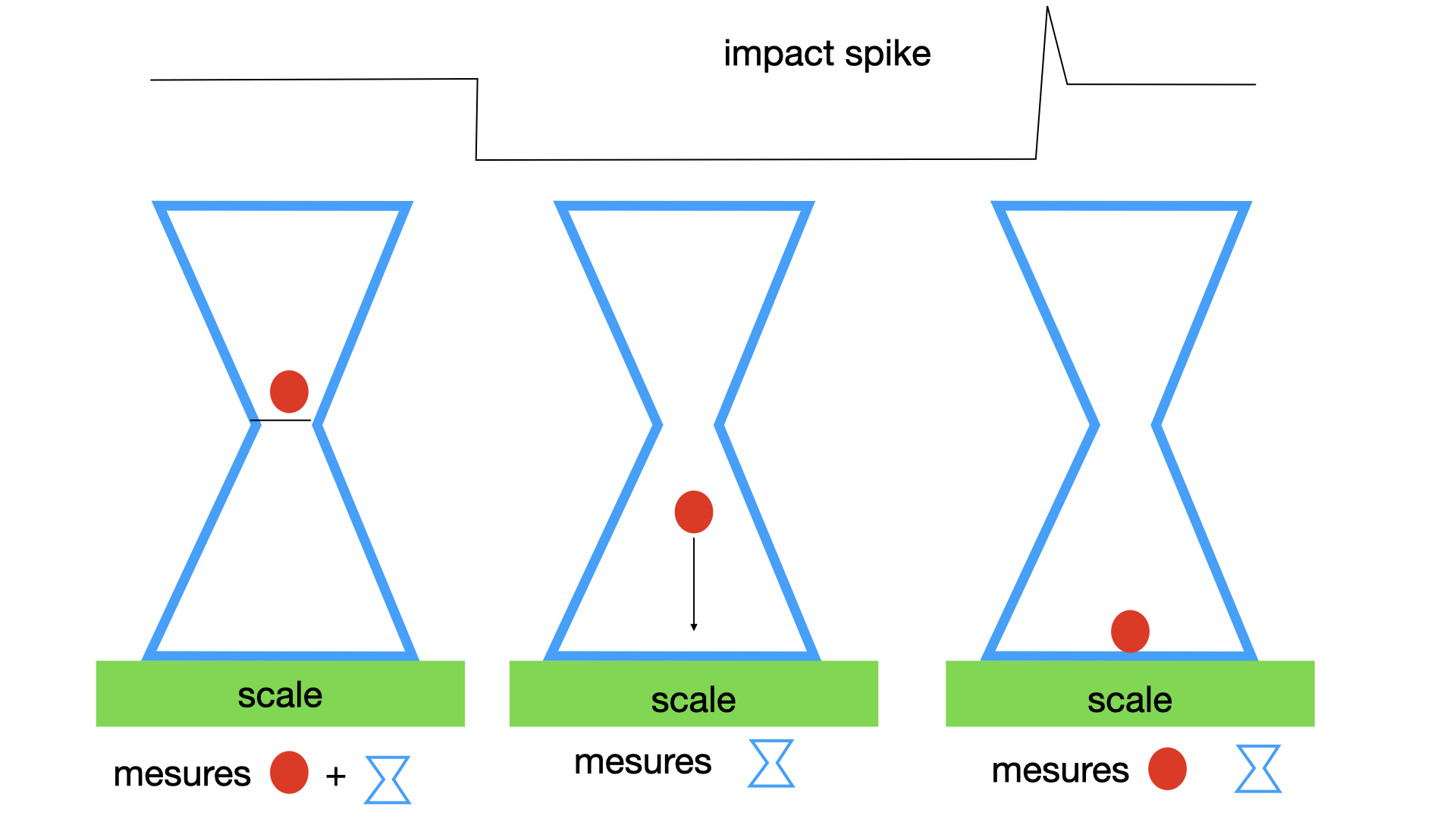
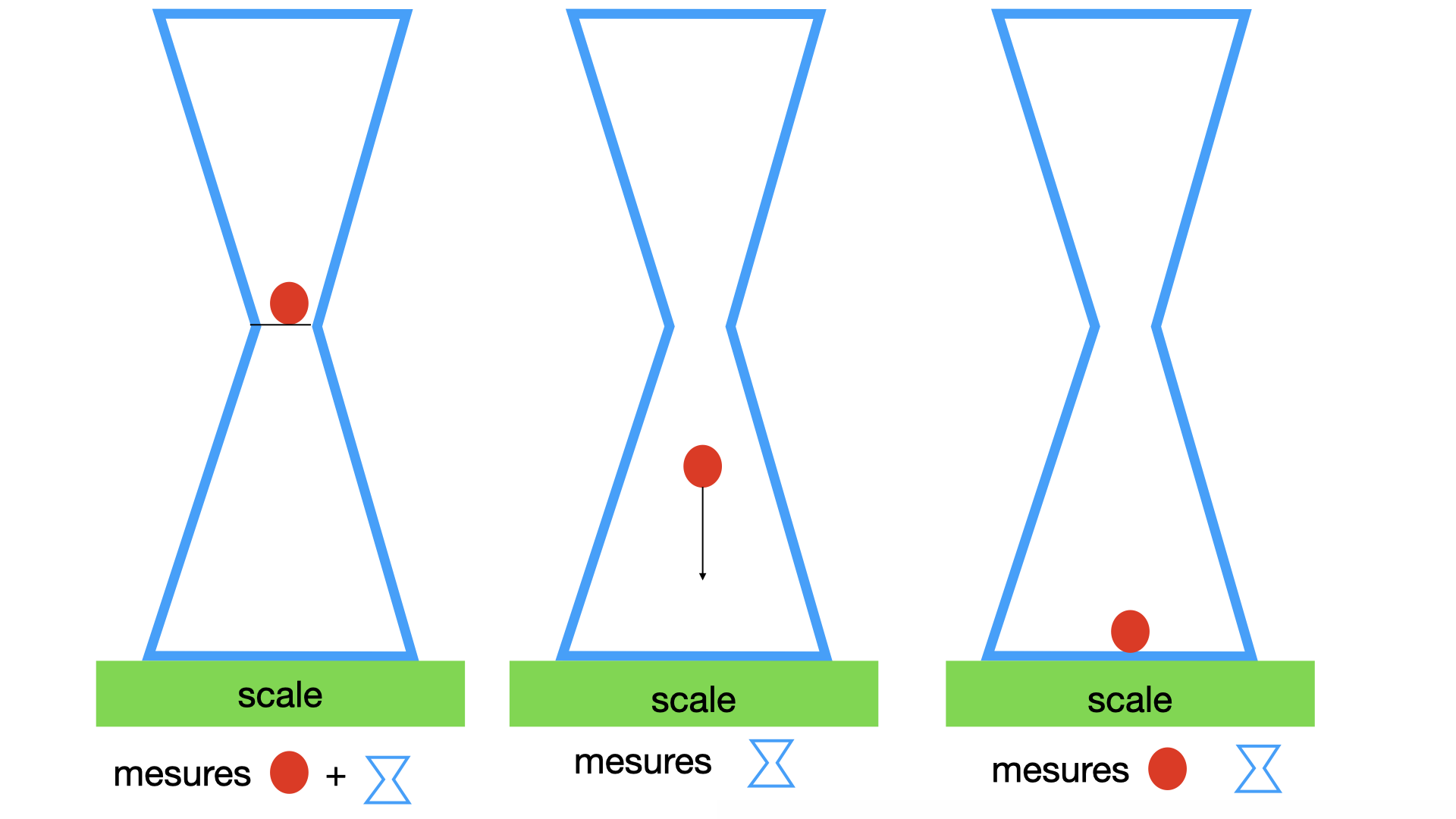
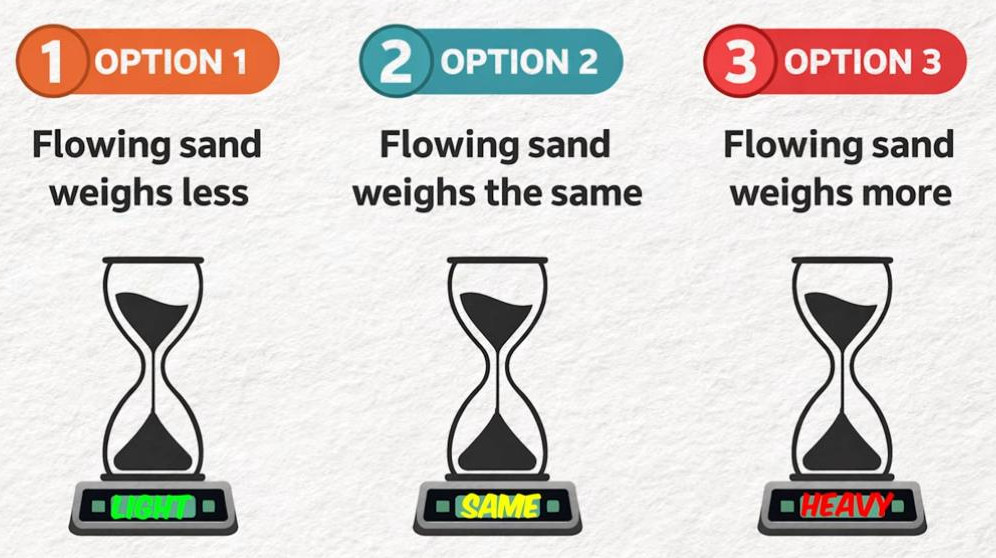
What is heavier? A sand hourglass in which the sand is flowing or an hourglass, where the sand has fallen.
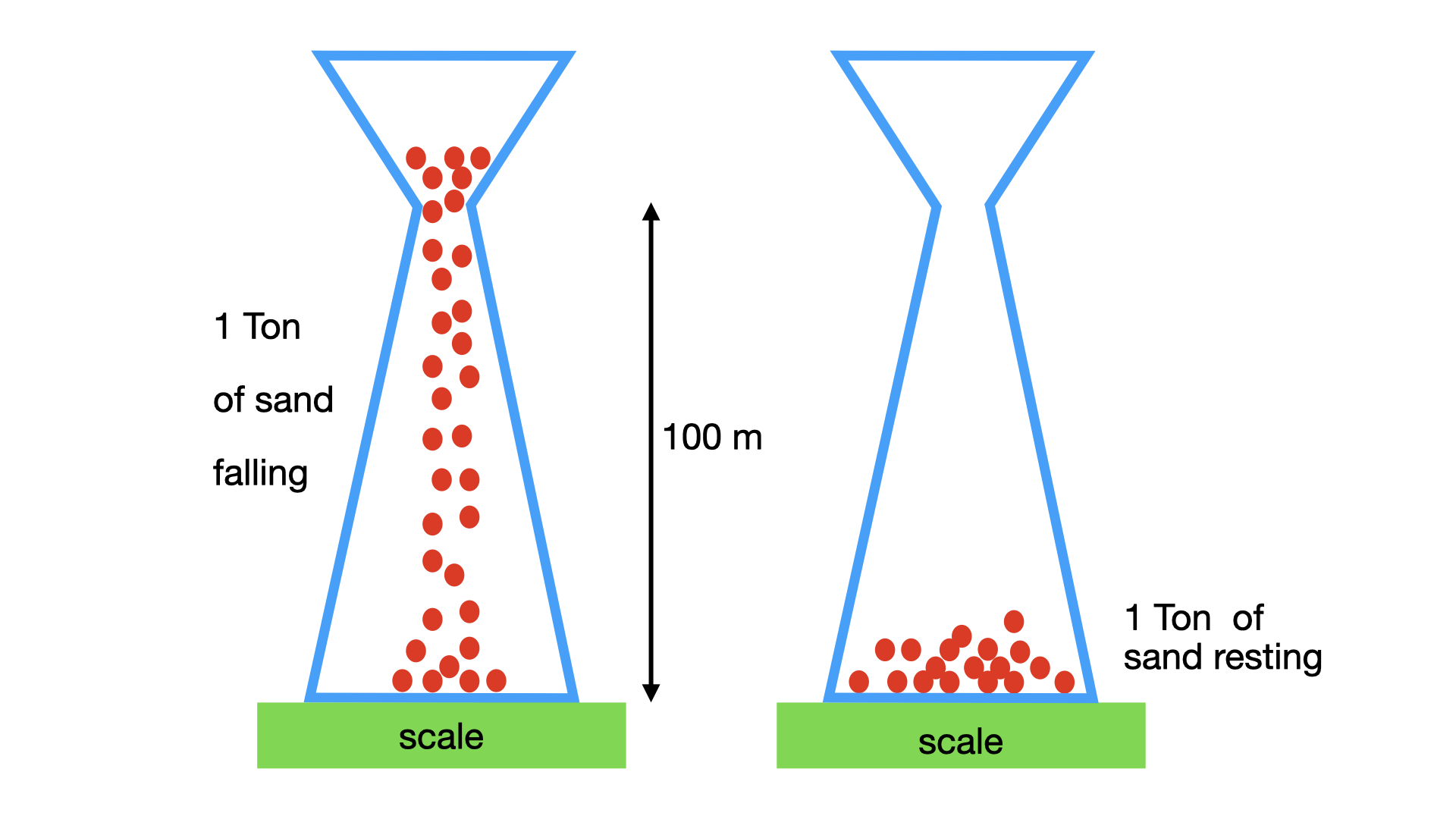
There are two effects: the falling sand F does not count on the scale, making it lighter. Then there is pressure contribution from the momentum change d/dt B of the sand when reaching the floor. The scale shows
H + S - F + v d/dt B
where H is the weight of the hourglass, S is the total weight of the sand F is the weight of the falling sand and B is the weight of the sand at the bottom and v is the velocity of the sand reaching the bottom. The dynamic is larger if the hourglass has reached almost the end and the last grains reach the ground. It is smaller if the stream of sand has not yet reached the bottom. In the general case, the result depends on the size of the gravitational constant.


My immediate reaction was that the flowing sand should have lower weight because the missing sand that is falling. The pressure of the sand when reaching the bottom is smaller.
  • Look at the situation with one heavy sand grain. In the falling case, its weight does not count. After having reached the bottom, the weight of rock counts. The falling case was less.
  • For a very long hour glass that most of the sand can be in a free falling situation.
What is known?
  • This youtube video from the action lab measures larger weight when flowing.
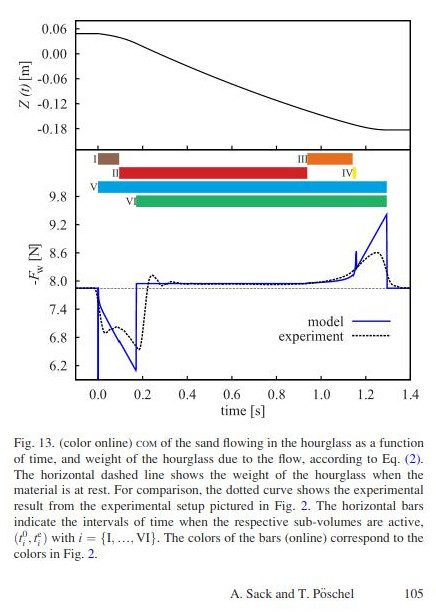
  • A web-search finds a paper "Weight of an hourglass" Theory and experiment in quantitative comparison by Achim Sack and Thorsten Poeschel, Am. J. Phys. 85, 98-107, 2017. In the abstract they mention that since the hourglass changes weight due to accelerated motion of the center of mass. Here is the paper [PDF]. This is an interesting argument. If you take a closed body and internally make an accelerated change of center of mass, it changes the weight. But it is only one effect.

More thinking

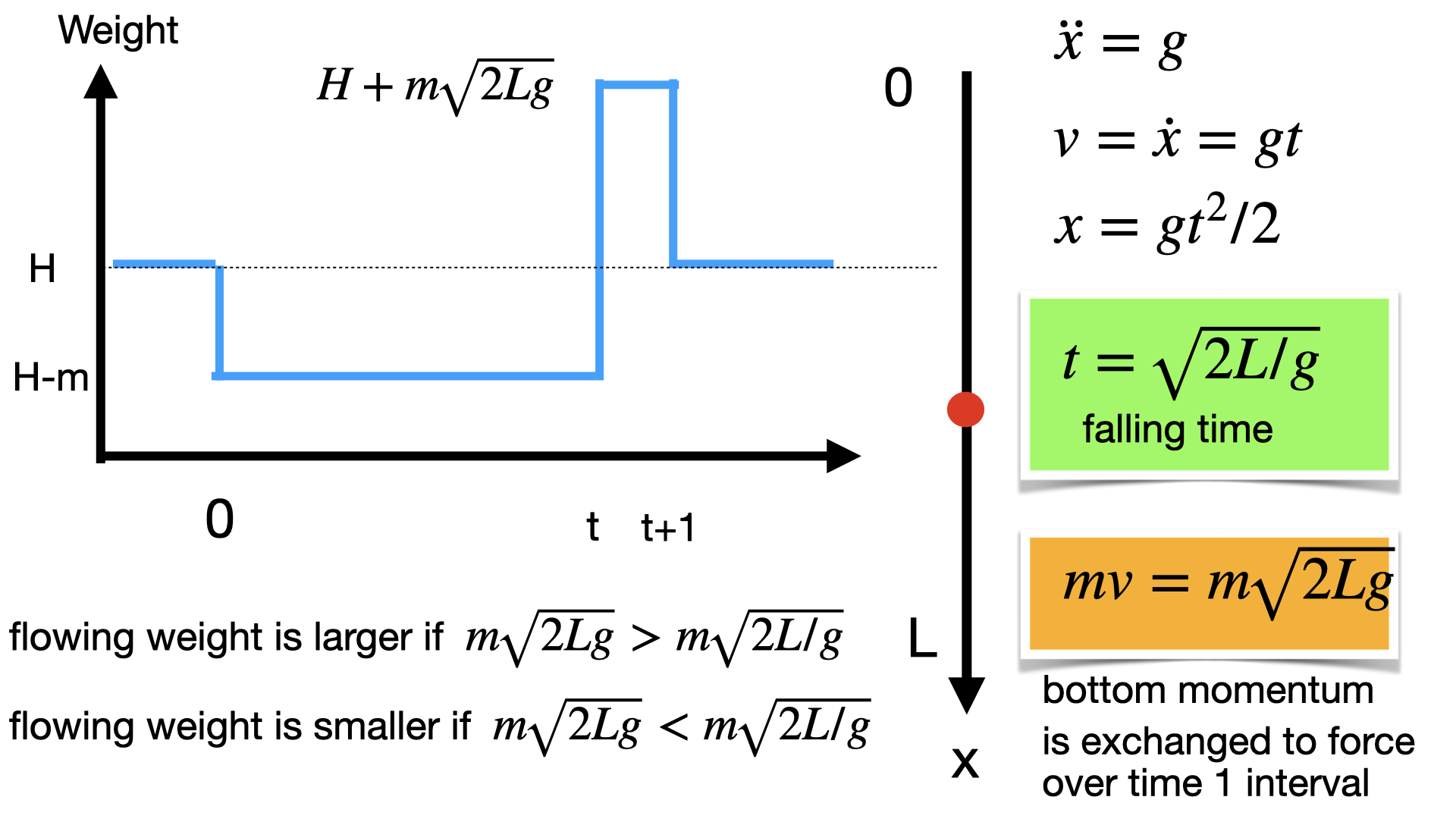
At the moment, I believe the situation depends on the situation and parameters. Lets look a bit more closely at a single grain falling. Assume the fall length is L. Before the fall, the scale shows the weight H (hourglass plus grain weight). During the fall, of time t = sqrt(2 L/g) scale will show H-m. At arrival the grain has velocity v=g t = sqrt(2 L g) and momentum M sqrt(2 L g). Assume this momentum gets changed to zero during 1 unit of time. During this time, the scale shows H + m sqrt(2 L g). Afterwards, the grain is again at rest and the scale shows again H.

When taking many grains, we see that we have to compare m sqrt(2 L/g) and m sqrt(2 L g). This means that the flowing case is heavier if g is larger than 1 and lighter if g is smaller than 1.


Last update: April 19, 2026