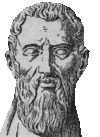
 The Greek philosopher Zeno, who lived in the fifth century B.C., decades before Socrates,
dedicated his life's work to showing the logical paradoxes inherent to the idea of indefinite
divisibility in space and time -- i.e., that every line is composed of an infinite number of
points. One of these paradoxes is known as the arrow paradox: If the motion of a flying
arrow is divided ad infinitum, then during each of these infinitesimal moments the arrow is at
rest. The sum of an infinity of zeroes remains zero, hence the arrow cannot move. One can
imagine how someone giving a flying arrow quick, repeated glimpses can actually freeze it in
place. Zeno inferred from this that movement cannot happen. Indeed, he was a true follower
of Parmenides, his teacher and mentor, who advocated that any change in nature is but an
illusion.
The Greek philosopher Zeno, who lived in the fifth century B.C., decades before Socrates,
dedicated his life's work to showing the logical paradoxes inherent to the idea of indefinite
divisibility in space and time -- i.e., that every line is composed of an infinite number of
points. One of these paradoxes is known as the arrow paradox: If the motion of a flying
arrow is divided ad infinitum, then during each of these infinitesimal moments the arrow is at
rest. The sum of an infinity of zeroes remains zero, hence the arrow cannot move. One can
imagine how someone giving a flying arrow quick, repeated glimpses can actually freeze it in
place. Zeno inferred from this that movement cannot happen. Indeed, he was a true follower
of Parmenides, his teacher and mentor, who advocated that any change in nature is but an
illusion.
|