|
The mathematics of the dynamo is tied to the theorem of
Stokes. Experiments show that if one moves a closed wire
through a magnetic field, then a current flows in the wire.
The voltage is proportional to the change of the
magnetic flux through a surface spanned by the wire.
Maxwell derived from such knowledge the equation 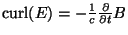 .
To see that this law explains the experiments, we take
a surface .
To see that this law explains the experiments, we take
a surface  which has the wire as a boundary. Compute
the flux integral of both sides of this Maxwell equation
and get which has the wire as a boundary. Compute
the flux integral of both sides of this Maxwell equation
and get
 .
The left hand side is by Stokes theorem the line integral .
The left hand side is by Stokes theorem the line integral
 which is the voltage. The right
hand side is the change of the magnetic flux through the surface. which is the voltage. The right
hand side is the change of the magnetic flux through the surface.
|
 from the center of the moon?
This question can be answered quite nicely using the divergence
theorem.
The law of gravity can be reformulated by saying that the
gravitational field
from the center of the moon?
This question can be answered quite nicely using the divergence
theorem.
The law of gravity can be reformulated by saying that the
gravitational field  satisfies the law
 ,
where
,
where  is the density of the mass distribution. We want to see whether
this is reasonable. Consider the case of the moon, a ball of radius
is the density of the mass distribution. We want to see whether
this is reasonable. Consider the case of the moon, a ball of radius  , then
by rotational symmetry, the gravitational force is rotationally symmetric
and normal to the surface of the moon. Therefore, we can write
, then
by rotational symmetry, the gravitational force is rotationally symmetric
and normal to the surface of the moon. Therefore, we can write
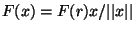 for the force at a point
  . We have
 . By the divergence theorem,
the left hand side is
. By the divergence theorem,
the left hand side is
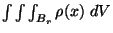 which
is the mass of the material inside the sphere of radius
which
is the mass of the material inside the sphere of radius  for
for  and
and  for
for  . We see
that inside the moon the gravitational force decreases linearly when
we dig in while decreases like
. We see
that inside the moon the gravitational force decreases linearly when
we dig in while decreases like  when going away from the moon.
 which is conservative
away from the origin: a potential function is
which is conservative
away from the origin: a potential function is
 . The potential of a bunch of
vortices located at points
. The potential of a bunch of
vortices located at points  is
the sum
is
the sum
 , where
  .
Assume we move around a closed path on the water surface we experience at every
point a force which is equal to the water velocity at that point.
A fly which fell into the water swims around a closed path
.
Assume we move around a closed path on the water surface we experience at every
point a force which is equal to the water velocity at that point.
A fly which fell into the water swims around a closed path  .
It surrounds two positive vortices and one negative vortex. What is
the work, it did? You have seen in one of the homework problems that
a path around a vortex leads to a line integral value
.
It surrounds two positive vortices and one negative vortex. What is
the work, it did? You have seen in one of the homework problems that
a path around a vortex leads to a line integral value  and that a
path surrounding no vortex produces a zero line integral.
Without doing any calculation, we see that the fly's work is
and that a
path surrounding no vortex produces a zero line integral.
Without doing any calculation, we see that the fly's work is
 . More generally, the work needed to go around
  vortices
with positive vorticity and
vortices
with positive vorticity and  vortices with negative vorticity
is
vortices with negative vorticity
is  .
.
 is the work
done. With a nonconservative field, one would
be able to go around some path such that the line integral (=work)
is positive (if negative, we could reverse the direction).
is the work
done. With a nonconservative field, one would
be able to go around some path such that the line integral (=work)
is positive (if negative, we could reverse the direction).
 and
magnetic field
and
magnetic field  :
:
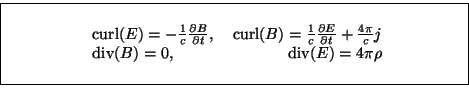
 is the electric current
vector field and
is the electric current
vector field and  is a constant, the speed of light.
 the electric field satisfies
 .
We see for example that
.
We see for example that  satisfies the wave equation
 . Actually, all components
  of the electric field
and all components
of the electric field
and all components  of the magnetic field satisfy the wave equation.
 . This means that there are no places, where the magnetic field
is created. If we take a closed surface
. This means that there are no places, where the magnetic field
is created. If we take a closed surface  .
This means that no magnetic field is created inside
.
This means that no magnetic field is created inside 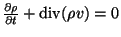 ,
where
,
where  is the velocity of
the fluid. In order to see what it means, we
introduce the current
is the velocity of
the fluid. In order to see what it means, we
introduce the current  which is a vector field.
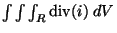 which is by the continuity equation equal to
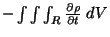 .
This is the negative of the time derivative of the total mass
.
This is the negative of the time derivative of the total mass
 . In other words, the flux through the
surface
. In other words, the flux through the
surface  through the boundary.
(Why? Think it maybe first through at the example of a box
through the boundary.
(Why? Think it maybe first through at the example of a box
 .
The x component of the force at the wall
.
The x component of the force at the wall  is
positive, the force at the wall
is
positive, the force at the wall  is negative and zero at the other
walls. )
is negative and zero at the other
walls. )  .
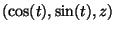
Assume that in a cylindrical wire pointing in the
.
Assume that in a cylindrical wire pointing in the  direction flows
a current
direction flows
a current  where
where  is a still unknown function of
  ,
we get
,
we get  which is what we want to know.
The line integral is by Stokes theorem equal
to the flux of
which is what we want to know.
The line integral is by Stokes theorem equal
to the flux of  through the surface. From
Maxwell equations, we know that this is
through the surface. From
Maxwell equations, we know that this is  times the flux of
 thought the wire. We simply call this
 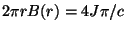 that the magnetic field
strength decays up to a multiplicative constant like
that the magnetic field
strength decays up to a multiplicative constant like  , where