 Let
Let
 be the vector field defined by attaching a unit vector
orthogonal to at the arm be the vector field defined by attaching a unit vector
orthogonal to at the arm  at at  . The weel rotation
measures the line integral . The weel rotation
measures the line integral
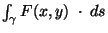 along the piecewise smooth path
  .
We call the vector field .
We call the vector field  the "planimeter Vector field".
Let the "planimeter Vector field".
Let  by the region enclosed by .
By Green's theorem,
this is equal to by the region enclosed by .
By Green's theorem,
this is equal to
 . .
If  is the length of the legs of the planimeter, the
planimeter vector field is explicitely given by is the length of the legs of the planimeter, the
planimeter vector field is explicitely given by
The curl
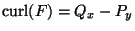 of
is equal to of
is equal to
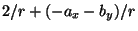 which is which is  plus the curl of
the vector field plus the curl of
the vector field
 . The later has the
curl . The later has the
curl  : :
Proof. This is a calculation. The equations
 give
give
 and from and from
 , ,
 , we get after solving for , we get after solving for 
 where
where  . .
Because
 , the planimeter line integral
is , the planimeter line integral
is  times the area of the enclosed
region. In units where times the area of the enclosed
region. In units where  , the curl is , the curl is  and consequently, we measured
the area of the region. and consequently, we measured
the area of the region.
|
 Planimeters are mechanical instruments which can measure the area of
closed regions in the plane. Planimeters are used in medicine for example to
measure the size of the cross-sections of tumors or organs, in biology to measure
the area of leaves or wing sizes of insects, in agriculture to measure the area
of forests, in ingeneering it is used to measure the size of profiles.
Planimeters are mechanical instruments which can measure the area of
closed regions in the plane. Planimeters are used in medicine for example to
measure the size of the cross-sections of tumors or organs, in biology to measure
the area of leaves or wing sizes of insects, in agriculture to measure the area
of forests, in ingeneering it is used to measure the size of profiles.  The polar planimeter has the shape of a ruler with two legs.
One leg of length
The polar planimeter has the shape of a ruler with two legs.
One leg of length  to
to  . The second leg
of length
. The second leg
of length  , then the
intersection point is uniquely determined and we could write
, then the
intersection point is uniquely determined and we could write
 to emphasis that
  and
and
 . The measurement consists of dragging the end point
 A planimeter can be assembled for classroom demonstration with a few pieces.
We took the bars from a desk folder hanger and joined them with a screw.
At both ends we added a wheel, one which turns at the origin, the other, orthogonal
to the bar at the other end. The device could be used at the blackboard.
We gauged the planimeter using a square of
A planimeter can be assembled for classroom demonstration with a few pieces.
We took the bars from a desk folder hanger and joined them with a screw.
At both ends we added a wheel, one which turns at the origin, the other, orthogonal
to the bar at the other end. The device could be used at the blackboard.
We gauged the planimeter using a square of
 on the blackboard.
A good demonstration is to measure then the area of a disc of radius 10 inches.
on the blackboard.
A good demonstration is to measure then the area of a disc of radius 10 inches.