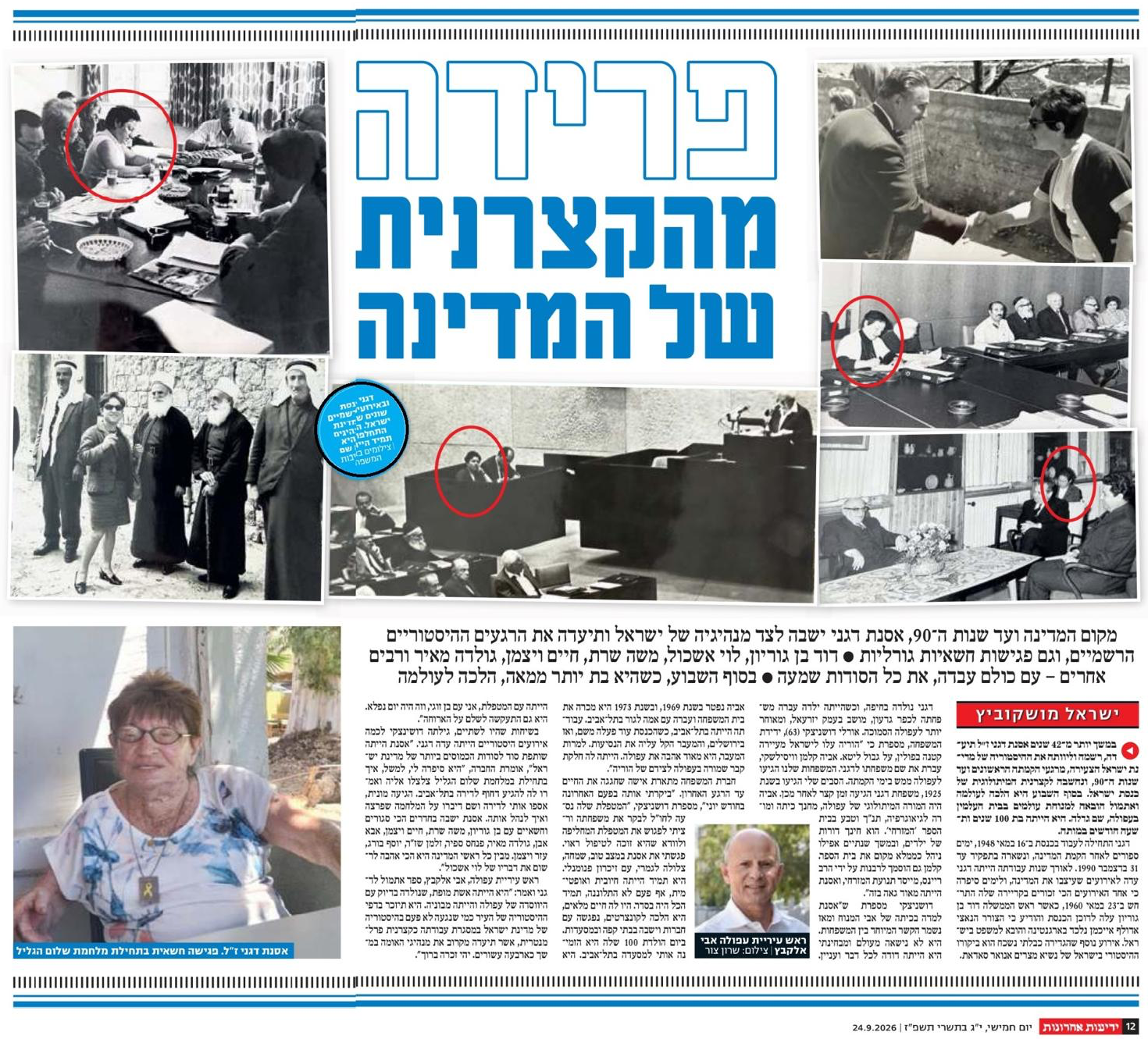
Farewell to the State’s Stenographer
From the establishment of the state until the 1990s, Osnat Dgani sat
alongside Israel’s leaders and documented the historic official
moments - as well as fateful secret meetings. David Ben-Gurion,
Levi Eshkol, Moshe Sharett, Chaim Weizmann, Golda Meir and many others
- she worked with all of them and heard all the secrets. At the
end of the week, at more than 100 years old, she passed away.
By Yisrael Moskovitz
For more than 42 years, the late Osnat Dgani documented, recorded and
accompanied the history of the young State of Israel, from its very
first days until the 1990s, and came to be regarded as the legendary
stenographer of the Knesset of Israel.
At the end of the week she passed away, and yesterday she was laid to
rest in the cemetery in Afula, where she grew up. She was 100 years and
nine months old at the time of her death.
Dgani began working in the Knesset on May 16, 1948, only a few days
after the establishment of the state, and remained in her position until
December 31, 1990.
Over the course of her work, Dgani witnessed events that shaped the
country. She later said that one of the most memorable events of her
career occurred on May 23, 1960, when Prime Minister David Ben-Gurion went
to the Knesset podium and announced that the Nazi criminal Adolf Eichmann
had been captured in Argentina and brought to Israel to stand trial.
Another event she described as unforgettable was the historic visit to
Israel by Egyptian President Anwar Sadat.
Dgani was born in Haifa. When she was a child, her family moved to Kfar
Gideon, a moshav in the Jezreel Valley, and later to nearby Afula.
Orly Dushnitsky, 63, a friend of the family, relates:
"Her parents immigrated to Israel from a small town in Poland,
on the Lithuanian border. Her father, Kalman Wisilsky, Hebraized the
family name to Dgani. Our families arrived in Afula during the period
when the town was first being established. My grandparents arrived in
1925, and the Dgani family arrived shortly afterwards."
Her father became a legendary teacher in Afula - a homeroom
teacher and a teacher of geography, Bible and nature studies at the
Mizrahi school.
He educated generations of children and for two years even served
as acting headmaster of the school. Kalman was also ordained as a rabbi
by Rabbi Reines, the founder of the Mizrahi movement, and Osnat was very
proud of that.
Dushnitsky continues:
Osnat was a pupil in the class of my late father, and from then
on the special relationship between the families was maintained. She
never married, and as far as I was concerned she was an aunt in every
sense of the word.
Her father died in 1969, and in 1973 she sold the family home and moved
with her mother to Tel Aviv.
Her work had originally been in Tel Aviv when the Knesset still
operated there, and later in Jerusalem, and the move made her travelling
easier. Despite moving away, she remained very attached to Afula. She
had reserved a burial plot in Afula beside her parents.
The family friend describes a woman who celebrated life right up to
the end:
I visited her for the last time in June, Dushnitsky
says. Her caregiver had gone abroad to visit her family, and
I wanted to meet the replacement caregiver and make sure Osnat was
receiving proper care.
I found Osnat in good condition, happy, completely lucid, with
a phenomenal memory. She was always positive and optimistic. She never
complained; everything was always all right.
She had a full life. She went to concerts, met friends and sat
in cafes and restaurants. On her 100th birthday she invited me
to a restaurant in Tel Aviv. She was there with her caregiver and I was
there with my partner, and it was a wonderful day. She even insisted on
paying for the meal.
In their conversations, Dushnitsky learned just how many historic events
Dgani had witnessed.
Osnat was entrusted with some of the most closely guarded secrets
of the State of Israel, her friend says.
She told me, for example, how at the beginning of the Peace for
Galilee War [the 1982 Lebanon War], they telephoned her and told her to
come urgently to an apartment in Tel Aviv.
A taxi came and picked me up and took me to the apartment. There
they discussed the war that had broken out and how it should be
conducted.
Osnat sat in the most closed and secret rooms with Ben-Gurion,
Moshe Sharett, Chaim Weizmann, Abba Eban, Golda Meir, Pinhas Sapir,
Zalman Shazar, Yosef Burg and Ezer Weizman.
Of all the country's leaders, the one whose words she most
liked to take down was Levi Eshkol.
Afula mayor Avi Elkabetz eulogized Dgani yesterday:
She was an exemplary woman who was born at practically the same
time as the founding of Afula and was among those who built it. She will
be remembered in the pages of the city's history as someone who
more than once touched the history of the State of Israel.
In the course of her work as a parliamentary stenographer, she
documented the leaders of the nation at close quarters for approximately
four decades. May her memory be blessed.
And of article.
The photograph caption at the bottom says:
The late Osnat Dgani. A secret meeting at the beginning of the
Peace for Galilee War.
The photograph with the wood-panelled room
seems to be from a secret meeting at the beginning of the 1982 Lebanon War.
The other small caption identifies the man pictured separately as Afula
mayor Avi Elkabetz; photo by Sharon Tzur.
The article is dated 24 September 2026. (Translation initiated by family
with the help of GPT 5.6)