Oscar Zariski

O. Knill, Start: December 10, 2022
Oscar Zariski (1899-1986) was one of the most important algebraic geometers. He had been the Dwight Parker Robinson Professor of Mathematics at Harvard. Most remarkable is that he has 2161 descendents among them household names like Robin Hartshorne, Heisuke Hironaka, David Mumford or Michael Artin.

Zariski had a turbulent life: As one can read in the preface of the Parikh biography: "He was an undergraduate in 1917 during the revolution, a graduate student in Rome during Mussolini's rise to power, an assistant professor in Baltimore during the Depression and a visiting professor at the university of Sao Pauolo in 1945 when he learned that his family in Kobrin had been murdered by the Nazis. In the eighty-seven years, he contributed to the radical transformation not only of algebraic geometry, but also of what it meant to be a Jew, a communist and a university professor."

In Cambridge, Zariski lived first on Avon Street and then later at 27 Lancaster Street. [P.S. I read somewhere else but can not recall where that he also lived at Linnaean Street for some time.] In the book, one can also read that in 1975, Zariski moved into a more quiet apartment in Brookline. He and his wive Yole spent his summer holidays for 10 years at the same cottage every August in Madaket on Nantuket, then for 12 summers in Monomoy.
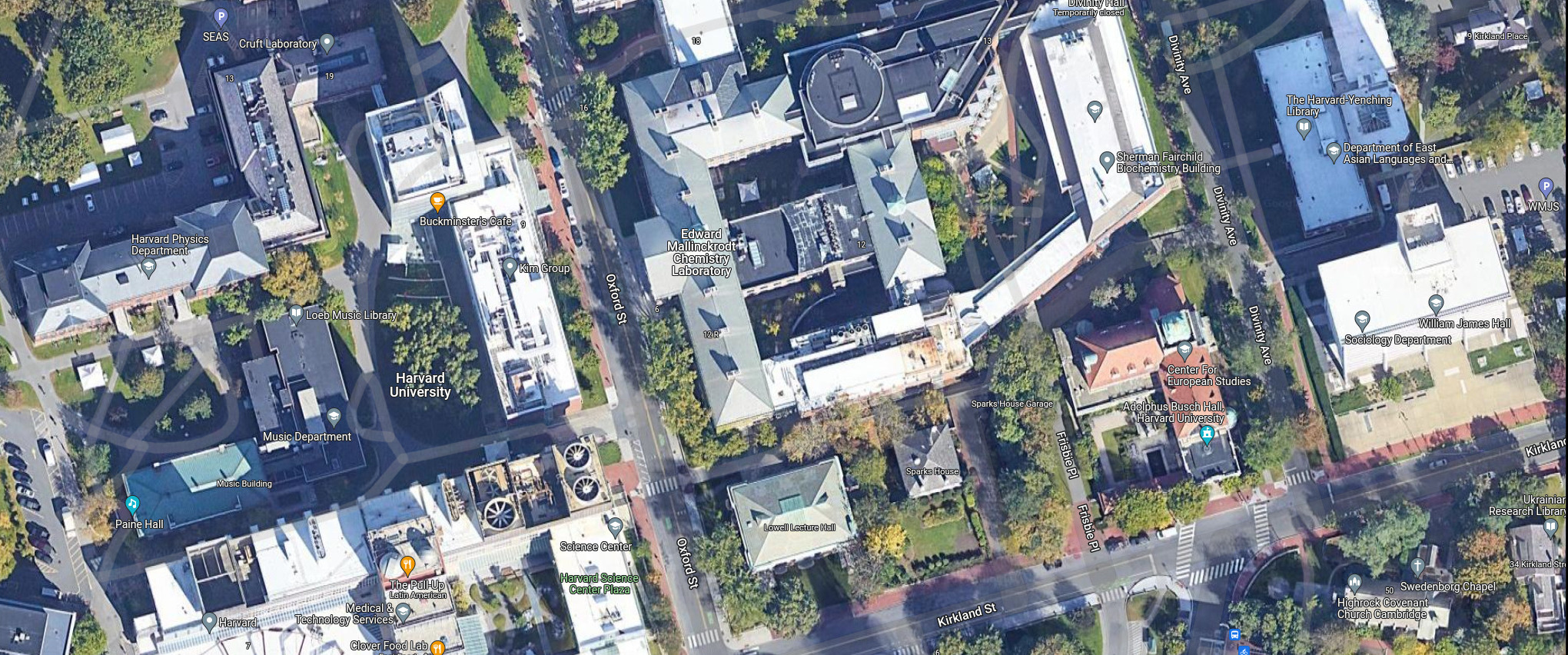
Google map (click for larger picture) showing both the science center and the divinity 2, which is attached to the Harvard Yenching library. The science center was constructed 1970-1972 and became operational 1973. Also the Yenching library was constructed in 1973. (google link)

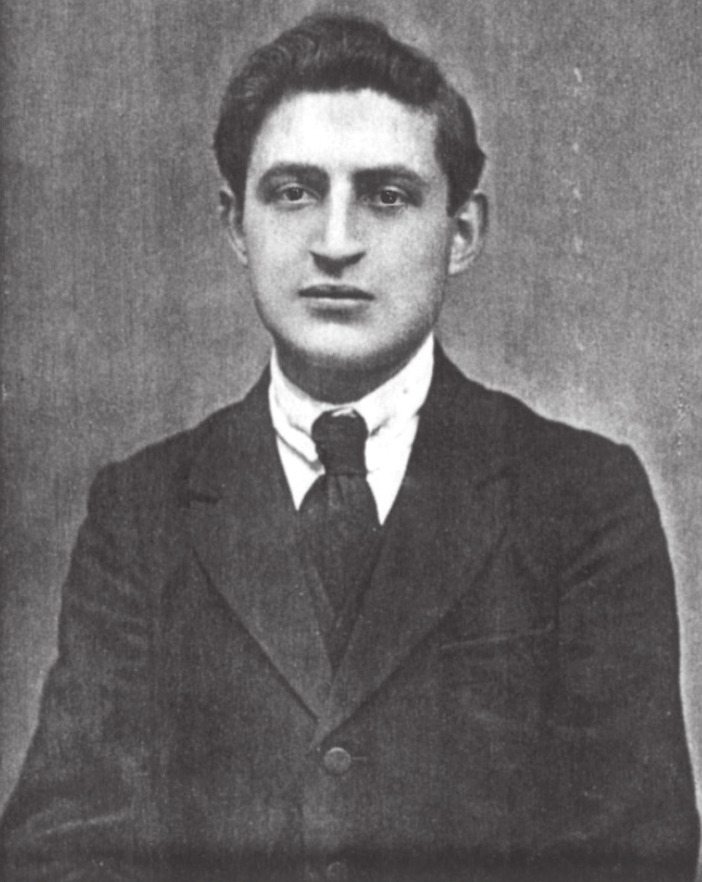
Foto of Zariski 1924, (by Yole Zariski) Source: "The unreal life of Oscar Zariski" by Carol Parikh, Springer 2009

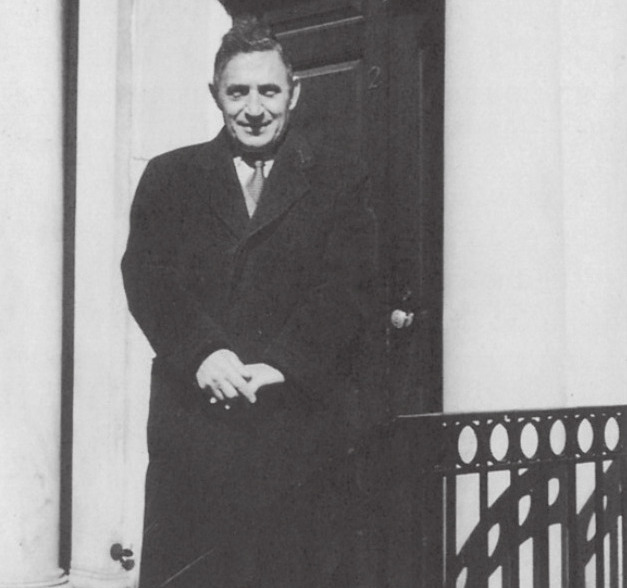
Zariski at the Harvard math department at 2 Divinity Avenue: from "The unreal life of Oscar Zariski" by Carol Parikh, Springer 2009


By the way, the book of Parikh contains a lot of interesting stories. For example "In 1933, a few years before Zariski's arrival, the Harvard Math Department had been scandalized when Professor Osgood ran off with Professor Morse's wife. Coolidge, who was chairman at the time, immediately demanded the resignation of Osgood, who left for China. Morse moved to the Institute for Advanced Study." Or: "When Karin Tate, the daughter of Emil Artin, came to Harvard with her husband, John Tate, in 1956, she was welcomed by a close-knit community of faculty wives. Ilse Brauer taught her where to find the best bargains in Boston, and Elizabeth Walsh, a soft-spoken Southern woman who had been a lieutenant colonel in the W.A.C., introduced her to the Faculty Wives Tea, where women met without their husbands and ate watercress sandwiches. Apparently still intent upon their role as the upholders of convention, many wives regarded Karin's choice to write "Karin Tate" rather than "Mrs. John Tate" across her name tag as "provocative." " or " Very impressed with Raoul Bott's flair and brilliance, Zariski decided that Bott was just the man to liven up what often seemed to him a rather stodgy department, and as with Igusa and Hironaka, his judgment was excellent. As Mumford remembered it, "Raoul would come into parties and clap his hands and say, `Why is everybody whispering? Where am I? At Harvard?' " Bott and John Tate, who were good friends, were being courted by many places, but with the aid of Brauer and Mackey, Zariski succeeded in keeping one and hiring the other. He also helped to recruit Schlomo Sternberg. Or "As chairman, Zariski further strengthened the algebraic geometry group by extending enthusiastic invitations to those who were doing new work. He welcomed Alexander Grothendieck to Harvard three years in a row even though Grothendieck's radical techniques in algebraic geometry threatened to replace his own." Apropos (from an Apocrypha: In the early sixties, Grothendieck visited Harvard while Zariski was still a faculty member. Once, while Zariski was lecturing in a seminar, Grothendieck kept asking him why he didn't prove his result for all schemes, not just varieties, but Zariski simply responded that it didn't work. Eventually, Grothendieck could stand it no longer and went to the blackboard and began writing down a proof for schemes. While he did so, Zariski wrote down a counter-example. When Grothendieck realized he was wrong, Zariski said (in his heavily accented Russo-Italian English) "In my time, I have had to learn many languages." At this, Grothendieck turned bright red from embarrassment. Another time Zariski was lecturing and Grothendieck again asked him why he didn't generalize his work to schemes. This time Zariski merely said "Now now Alexander, we must show some self control."

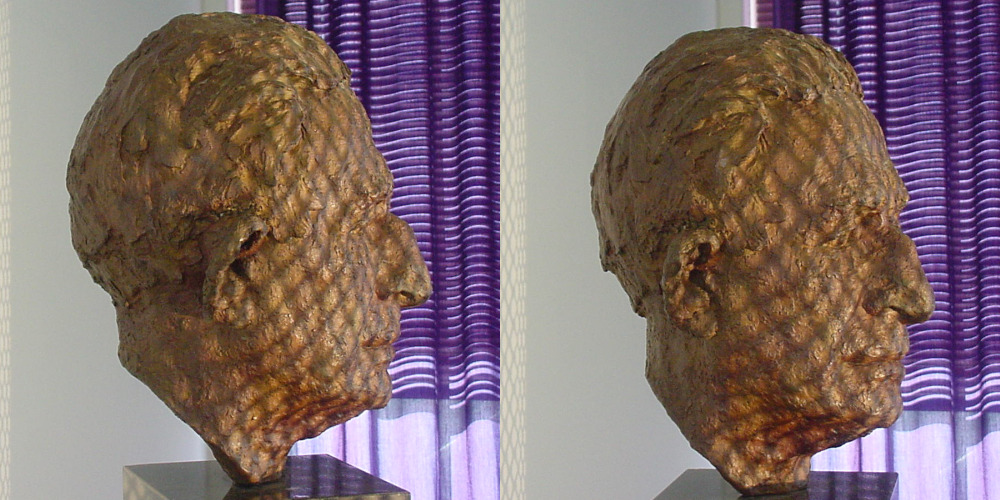
Oscar Zariski statue

On July 31, 2000, I just had arrived at Harvard, I photographed the statue of Oscar Zariski (1899-1986). According to the book, the statue had been unveiled in the Math Commons room at his 75th birthday in 1974. The statue is probably now in some archival storage.
In 2001, in a fall multi-variable calculus course, I made the following stereo picture with my trusted Sony Mavica camera which stored the pictures on Floppy drives! This was November 21, 2001):
We had then experimented in multi-variable calculus with reconstructing a surface from stereo picture. I had even written a C program in xwindows, which allowed to match points by hand, The goal had been to do a structure from motion reconstruction.

Here is a picture of Greg Westin, one of the students in that class who participated in the project of reconstructing a surface from two pictures. this is Greg now