HCRP project 2009
Caustics on edgy gaussian graph
Caustics on edgy gaussian graph
Office: SciCtr 434
Email: knill@math.harvard.edu
 |
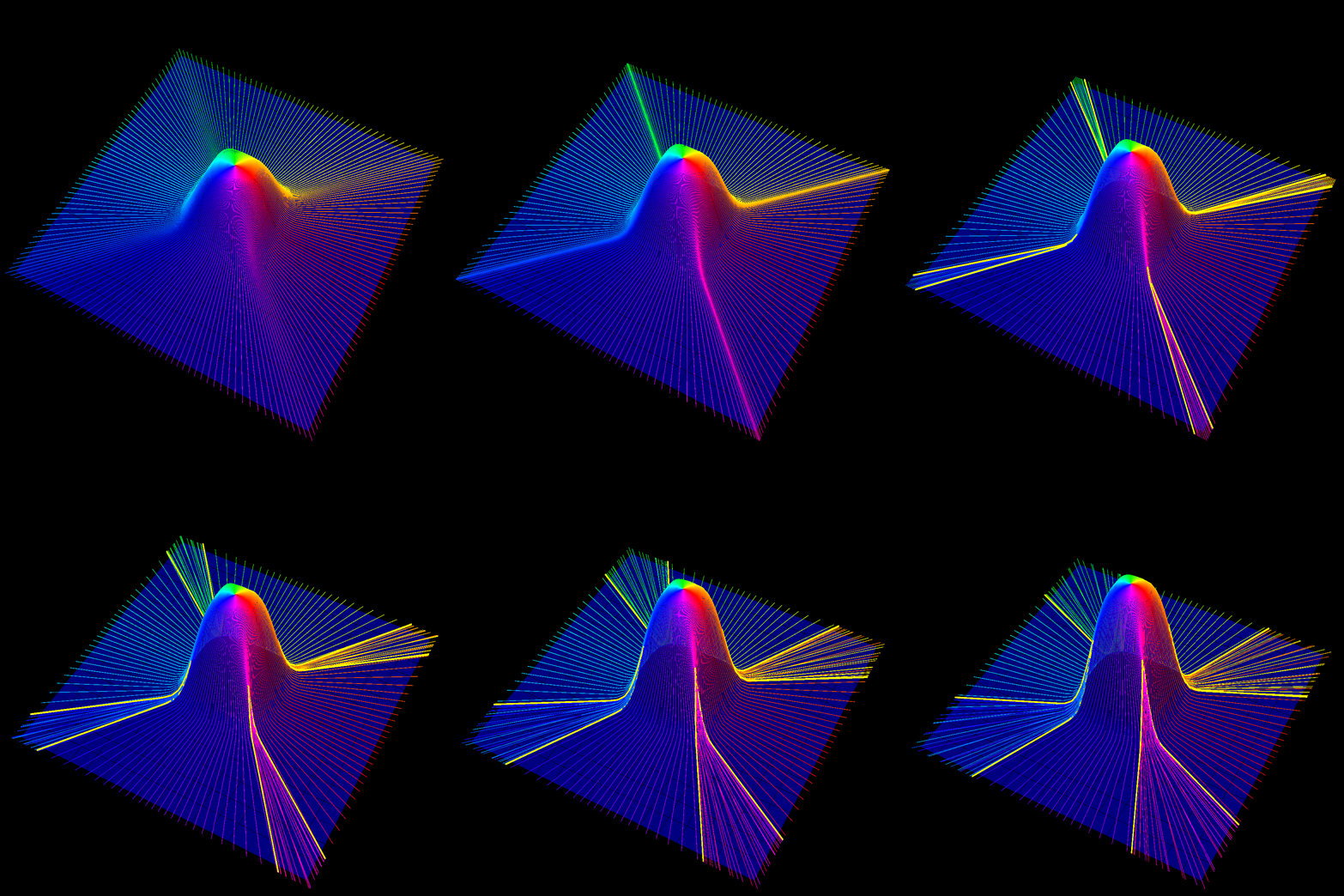 |
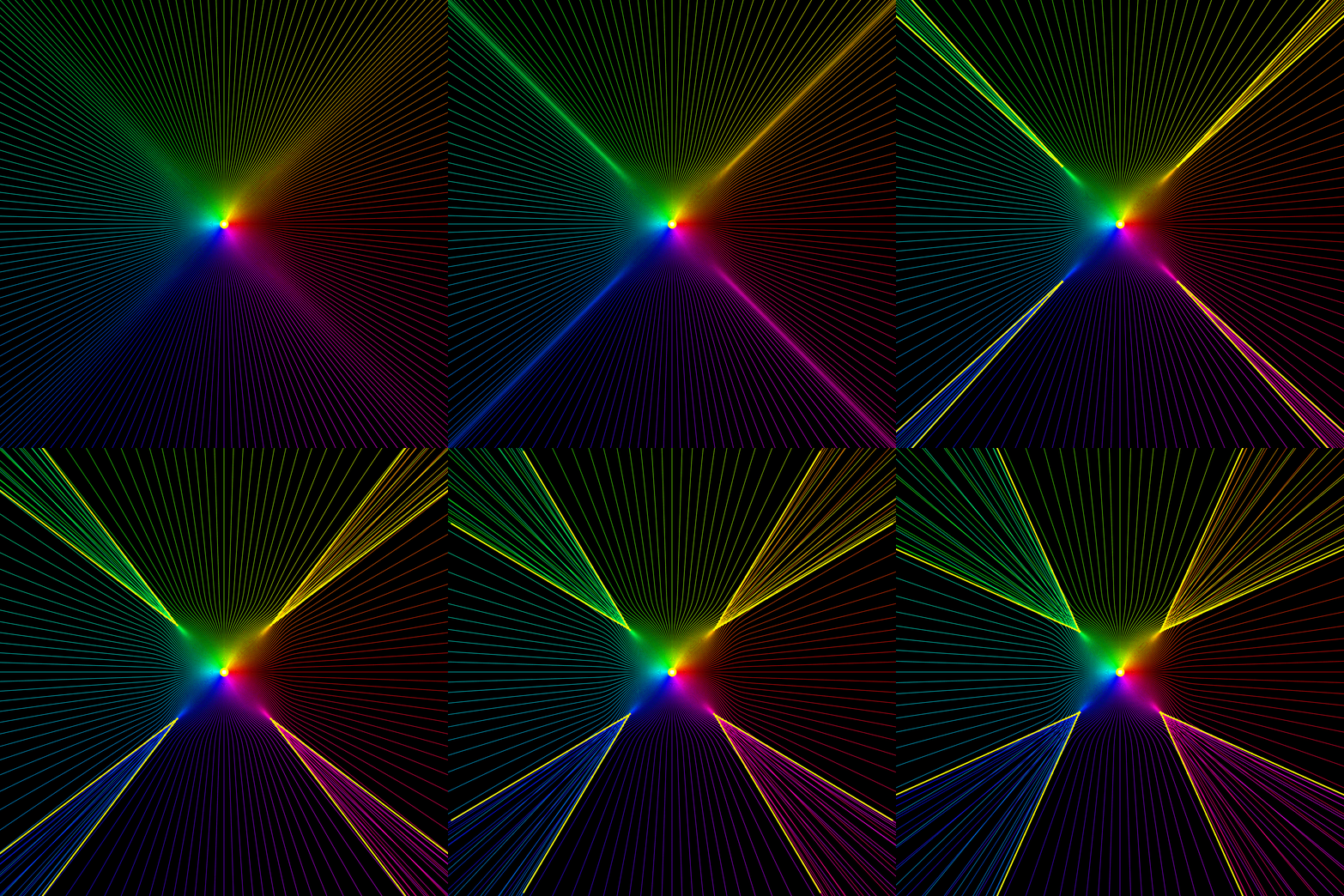
Geodesics start at the origin (0,0) of the graph z = b exp(-x4 - y4) where b
is a parameter varying from 1 to 3. For small b, the exponential map is a diffeomorphism on the plane. There are no caustics.
The metric is not strong enough to bend the wave fronts. However, if b is larger, wave fronts bend over and caustics become visible.
The caustic cusps are born at infinity and come closer and closer to the origin as b increases. It would be nice to know the exact
bifurcation parameter b*, where the caustic catastrophe transiation happens.
The situation can be understood by looking at the Jacobi equation f'' + K f = 0. If b is small, the curvature
              48*e^(2*x^4 + 2 y^4)*b^2*x^2*y^2*(3 - 4*x^4 - 4*y^4)
   K(x,y) = --------------------------------------------------------
                  (e^(2*(x^4 + y^4)) + 16*b^2*(x^6 + y^6))^2
of the surface is small. Since K(g(t)) decays fast, the solution to the Jacobi equation with f(0)=0, f'(0)=1, never reaches zero.
However, if b is large, K becomes large enough near the origin so that the solution of the Jacobi equation can reach a zero. The
rotational asymmetry is necessary. Caustics do not happen for (0,0) for the Gaussian graph
z = b exp(-x2 - y2), where geodesics starting at (0,0) are straight lines. To estimate the
bifurcation parameter, we would need a priori curvature estimates for the geodesics light rays and then analyze the Sturm
Liouville problem. Click onto an animation to see a large version.
| |