Wanted: A print Button for 3D objects
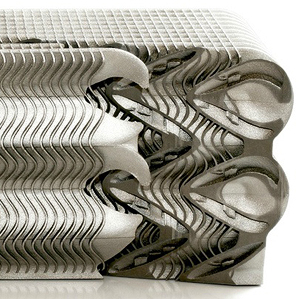 From the article":
Interest in 3-D printing, also known as additive manufacturing, is
exploding due to the falling cost of machines that can lay down finely
targeted layers of plastic to make simple products, like jewelry or
sculptures, much as a traditional printer sprays ink onto paper. The
idea is that 3-D printers could democratize design and eventually
manufacturing by letting anyone make physical things in small
quantities, without the expense of an assembly line.
The technology still has a ways to go-making objects on consumer
printers is slow and expensive. To print a solid plastic apple on
MakerBot's ,000 consumer printer, for instance, takes seven hours and
costs in supplies, so it's no competition for cheap plastic goods
made in China.
But the bigger obstacle to a 3-D printing revolution is that few
consumers or designers can actually operate the software used to render
objects and turn them into files that can be printed. "A lot of people
are 3-D printing other people's designs, but they can't yet model their
own. They are in a holding pattern," says Matthew Griffin, director of
community support at Adafruit Industries, an online marketplace for
high-tech hobbyists. "There is a gap between what they are seeing and
what is inspiring them and what they can make."
The problem is that the design software is too complex, says Igal
Kapstan, a vice president at PTC, a Massachusetts company that sells
computer-aided design software. He spoke this week at Inside 3-D
Printing, a conference in New York. Computer-aided design software
creates shapes, or "geometries," but it often takes expert knowledge to
reliably translate these into files usable by a 3-D printer. Kapstan's
company is working on software that would take a shape on a computer
screen and print it directly. Other companies, including Autodesk and
3-D Systems, said they are developing similar software.
That means software innovation could be more important to 3-D printing
than gradual improvements in the underlying technology for shaping
objects. That technology is already 30 years old and is widely used in
industry to create prototypes, molds, and, in some cases, parts for
airplanes. (...)
|