Kyle numbers
| Kyle Burke wrote the first solutions to the Bretscher book. Maybe to make the solutions a bit more personal or maybe as a joke, he introduced an ``easter egg" and called some numbers "Kyle numbers". Suddenly, students were talking about these mysterious "Kyle numbers" and the instructors (who would of course solve the problems themselves and not look up the solutions) would have no clue! |
 Kyle Burke's website at Plymouth State University. |
Here is how it goes: if you see a matrix like
    1  2  3  4  5
    2  4  6  8 10
    3  6  9 12 15
you can often
immediately write down the kernel of the matrix by placing numbers above
the columns. They tell how to add the columns up to get zero. For example, in the
case of the above matrix, one can see
    3  0 -1  0  0

--------------------
    1  2  3  4  5
    2  4  6  8 10
    3  6  9 12 15
because 3 times the first column minus the third column is zero.
The matrix indeed has the kernel [3,0,-1,0,0]^T.
Similarly, [2,-1,0,0,0]^T,[4,0,0,-1,0]^T,[5,0,0,0,-1] are kernel
vectors. These 4 vectors form a basis of the 4 dimensional kernel. The numbers are now acknowledged in the later editions of the book by Otto Bretscher. In edition 4 for example, it appears on page 131.
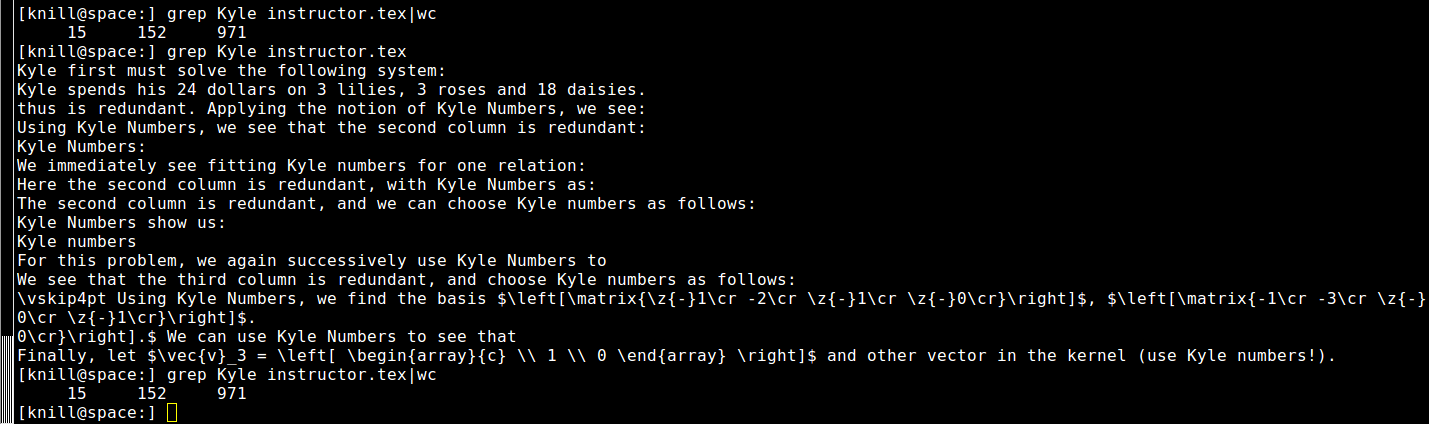
Since Oliver also once worked on the solutions, he can count the number of occurrences of "Kyle". In the source solution file of 2008, it appears 15 times: