|
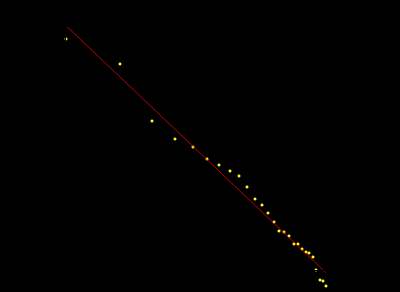
Here is a nice data fitting problem which empirically leads to Zipfs law.
If we read in the data of the population of cities:
A=ReadList["data.txt","Number"]; B=Partition[A,2]; n=Length[B];
B1=Table[{Log[k],Log[B[[k,1]]]},{k,27}]; Fit[B1,{1,x},x]
and do a linear fit, we measure a power law. The linear fit is 17-0.77 k as mentioned in the New York
Times article
New York Times: Math and the city. Note that the law only applies to the
top. If we take all data, we get 17.5-0.95 k:
A=ReadList["data.txt","Number"]; B=Partition[A,2]; n=Length[B];
B1=Table[{Log[k],Log[B[[k,1]]]},{k,100}]; Fit[B1,{1,x},x]
and a quadratic fit is probably better
A=ReadList["data.txt","Number"]; B=Partition[A,2]; n=Length[B];
B1=Table[{Log[k],Log[B[[k,1]]]},{k,n}]; Fit[B1,{1,x,x^2},x]
|