6760, Math 21a, Fall 2009
Exhibits page Math 21a 2009, Multivariable Calculus
Lagrange Multipliers and the Fundamental theorem of algebra
Course head: Oliver Knill
Office: SciCtr 434
Email: knill@math.harvard.edu
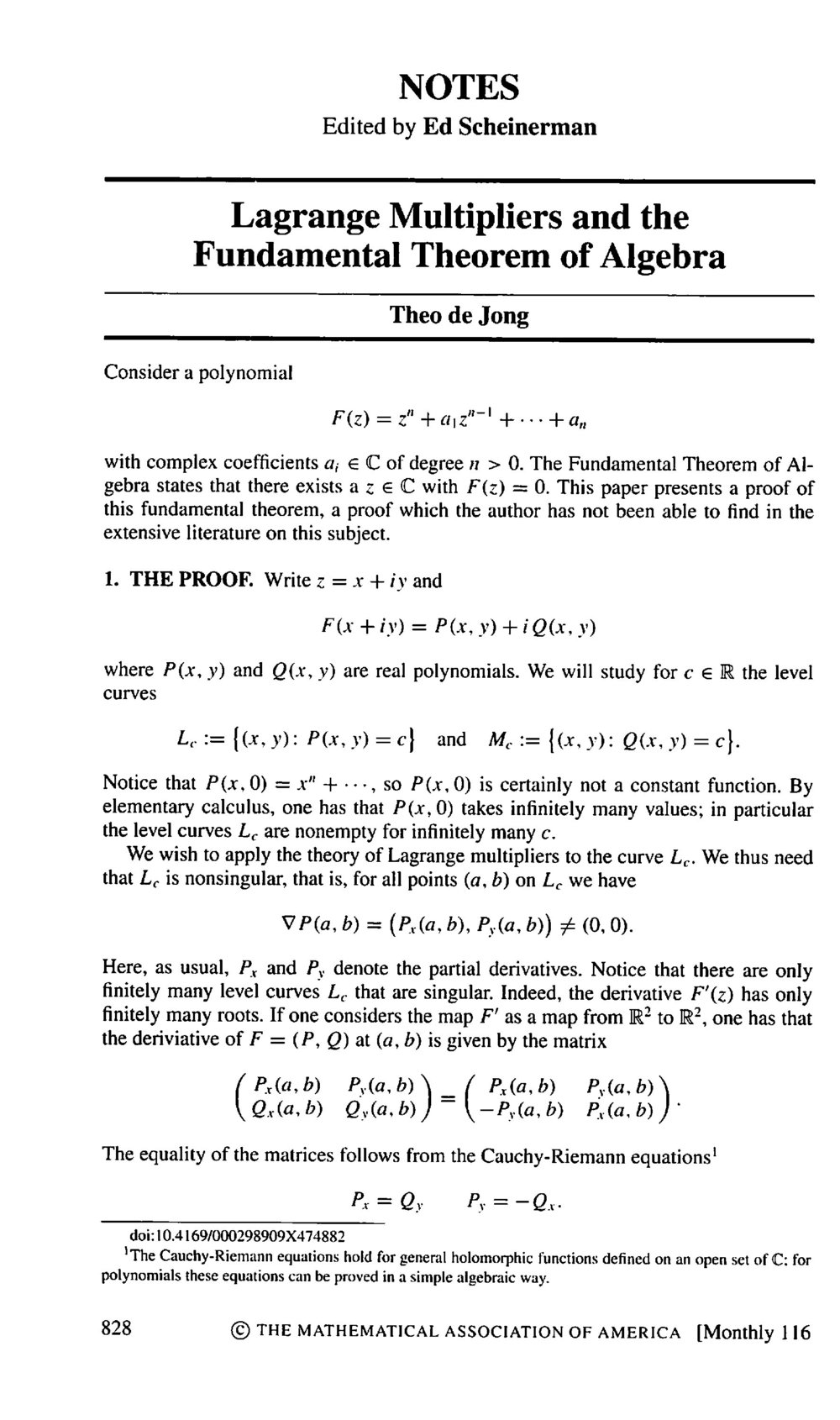
Theo de Jong gives in the Monthly of November 2009
a proof of the fundamental theorem of algebra using the Lagrange multiplier method:
In other words, when writing F(x,y) = P(x,y) + i Q(x,y), there is a point (x,y), where the real functions P and Q are both simultaneously zero. The theorem follows from the following lemma:
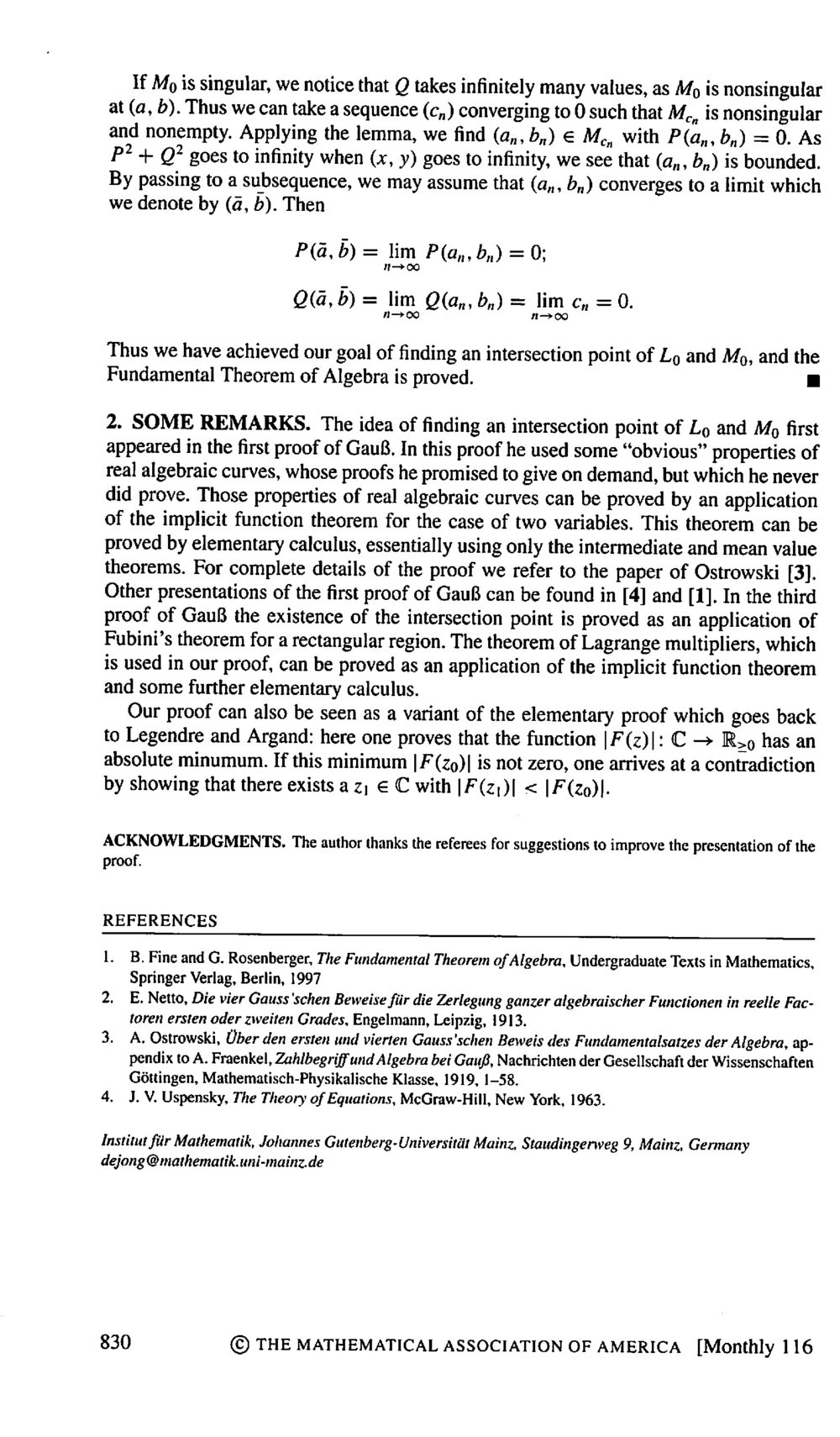
Proof of the fundamental theorem: There are infinitely many values of c, where the level curve P=c is not empty with no critical points of P. Looking at such a level curve P=c, the lemma implies that the level curve Q=0 is not empty. If Q=0 contains no critical points of Q, the lemma (applied with reversed P and Q) implies that it contains a point (a,b) with P(a,b)=0 proving the theorem. If Q=0 contains a critical point, there is a sequence of points cn converging to 0 for which Q=cn is nonsingular and contains a point (an,bn) with P(an,bn)=0. The sequence (an,bn) is bounded because P2 + Q2 goes to infinity at infinity. There is therefore an accumulation point (a,b). This is the simultaneous root of P and Q. Proof of the lemma: The function f(x,y) = Q2(x,y) has a global minimum on the contraint g(x,y) = P(x,y) = c because P2 + Q2 goes to infinity for (x,y) to infinity. Such a global minimum satisfies
     2 Q (-Py,Px) = L ( Px,Py)
     g  = c
The first relation tells that either Q=0 or ( Px,Py) is parallel
to a vector perpendicular to it, a case not possible because P=c was assumed
to have no critical point. There is therefore a point (a,b) on the level curve,
where Q(a,b)=0.
|
 Image source |
|